Executive Order 14393 explained · Executive Order · No disposition noted
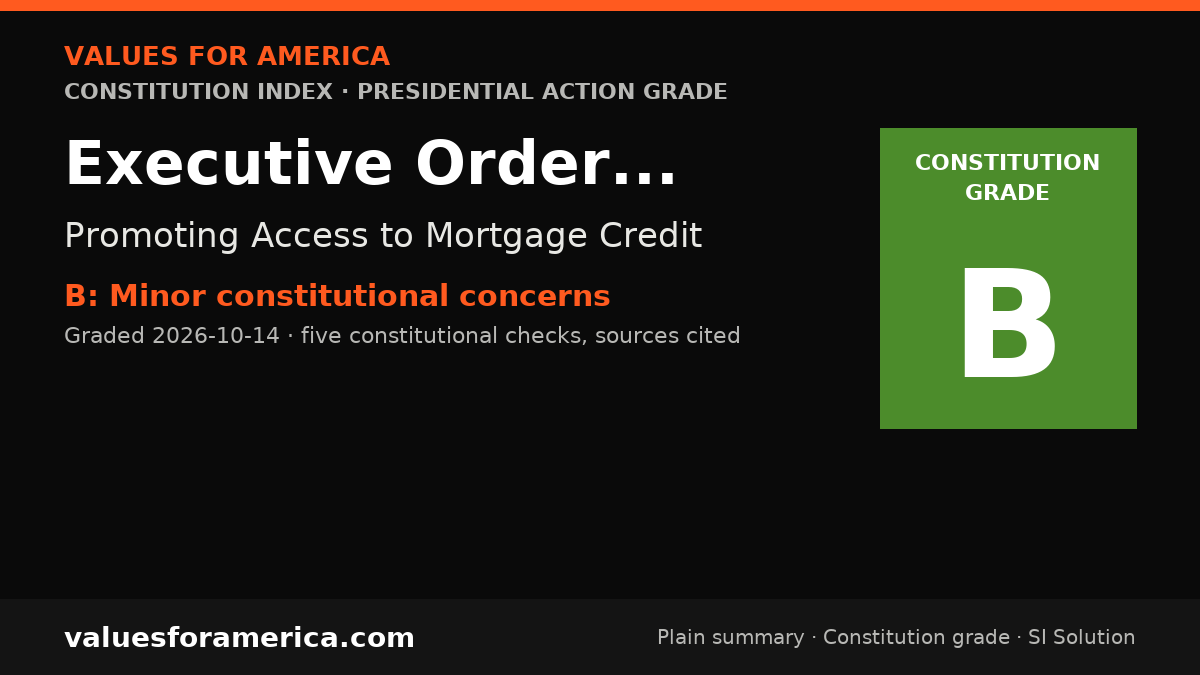
Promoting Access to Mortgage Credit
Signed: 2026-03-13 Published: 2026-03-18 Federal Register document: 2026-05384
Agencies: Executive Office of the President
What Executive Order 14393 says
Federal Register, Volume 91 Issue 52 (Wednesday, March 18, 2026) [Federal Register Volume 91, Number 52 (Wednesday, March 18, 2026)] [Presidential Documents] [Pages 13203-13206] From the Federal Register Online via the Government Publishing Office [www.gpo.gov] [FR Doc No: 2026-05384] Presidential Documents Federal Register / Vol. 91, No. 52 / Wednesday, March 18, 2026 / Presidential Documents [[Page 13203]] Executive Order 14393 of March 13, 2026 Promoting Access to Mortgage Credit By the authority vested in me as President by the Constitution and the laws of the United States of America, it is hereby ordered: Section 1. Purpose. Every American seeking to buy a home should have access to a mortgage from a reliable lender, at a rate commensurate with his or her creditworthiness. Over the past two decades, however, statutory and regulatory changes--including rules adopted under the Dodd-Frank Act, Public Law 111-203, and subsequent rulemakings--have increased the compliance costs of mortgage origination and servicing and distorted the structure of the mortgage market. These burdens have contributed to a significant decline in bank participation in mortgage lending. Community banks, generally institutions with fewer than $30 billion in assets, have been especially affected. The regulatory and rule changes have undermined community banks' businesses, concentrated credit and...
Opening of the official text; read it in full in the Federal Register.
Constitution Index
“VFA Constitution grade”
Minor constitutional concerns
Graded 2026-10-14
SI-generated grade · five published checks · not individually reviewed by a person · methodology
Executive Order 14393 directs federal banking agencies to consider regulatory reforms aimed at reducing mortgage credit burdens, particularly for community banks. The order operates within existing statutory frameworks and does not itself enact binding rules; it instructs agencies to consider changes 'as appropriate and consistent with applicable law.' While the order touches on areas of federal authority over banking and interstate commerce, it raises minor concerns regarding the potential dilution of consumer protections and the centralization of housing finance policy. Overall, the order is largely consistent with constitutional principles, with minor tensions that are fixable through careful agency rulemaking.
-
✓ Passes · Enumerated powers
The executive order directs federal banking agencies to consider regulatory changes within their existing statutory authority. The federal government has explicit authority over banking and interstate commerce under Article I, Section 8, Clause 3 (Commerce Clause), and the President's executive power under Article II, Section 1, Clause 1. The order does not create new law but instructs agencies to… -
✓ Passes · Bill of Rights
The order does not infringe upon any of the first ten amendments. It does not restrict speech, religion, assembly, press, petition, arms, quartering, search and seizure, self-incrimination, due process, takings, fair trial, jury, cruel and unusual punishment, unenumerated rights, or reserved powers. The order's focus on mortgage credit regulation does not implicate these rights. -
✓ Passes · Individual sovereignty
The order does not restrict individual liberty or property rights. It aims to expand access to mortgage credit by reducing regulatory burdens on lenders, which could enhance individuals' ability to enter into contracts and acquire property. The order does not impose new restrictions on individuals; rather, it directs agencies to consider easing existing regulations. The burden of justification for… -
✗ Concern · Decentralization
The order fails the decentralization test because it consolidates decision-making at the federal level regarding housing finance policy. While the order directs federal agencies to consider changes, it does not delegate authority to states or localities. The questions reveal that while individuals and local communities can handle some aspects of mortgage lending, the federal government's role in b… -
✓ Passes · Due process and takings
The order does not bypass due process or take property without just compensation. It directs agencies to consider regulatory changes, which would be subject to the Administrative Procedure Act's notice-and-comment requirements, ensuring procedural due process. The order does not involve any taking of private property; it seeks to reduce regulatory burdens, which does not implicate the Takings Clau…
Report an error in this grade
What should happen instead
“VFA SI Solution”
No Solution yet
A sourced, Constitution-cited alternative appears here once one passes the SI Editorial Standard.

For journalists and bloggers
“Embed this grade”
Free to use with the link back. The badge and card update when the grade changes. Embed terms →
