Executive Order 14390 explained · Executive Order · No disposition noted
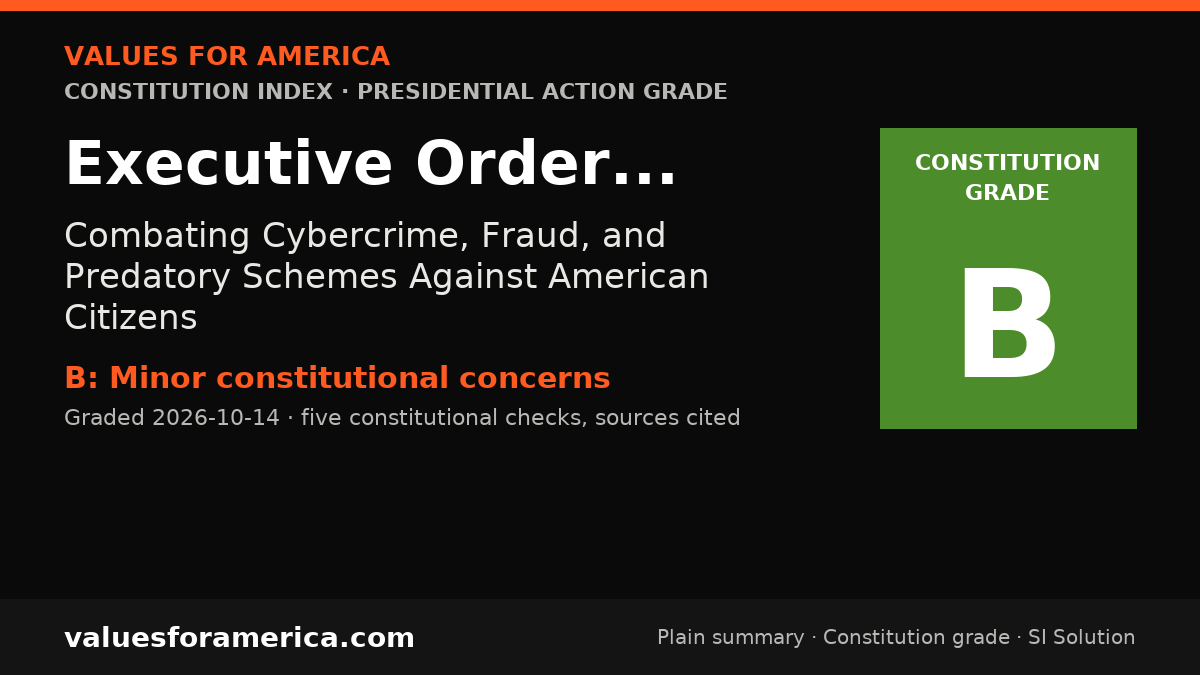
Combating Cybercrime, Fraud, and Predatory Schemes Against American Citizens
Signed: 2026-03-06 Published: 2026-03-11 Federal Register document: 2026-04826
Agencies: Executive Office of the President
Federal Register notes (as of 2026-10-19): See: EO 14159, January 20, 2025
What Executive Order 14390 says
Federal Register, Volume 91 Issue 47 (Wednesday, March 11, 2026) [Federal Register Volume 91, Number 47 (Wednesday, March 11, 2026)] [Presidential Documents] [Pages 12051-12053] From the Federal Register Online via the Government Publishing Office [www.gpo.gov] [FR Doc No: 2026-04826] [[Page 12049]] Vol. 91 Wednesday, No. 47 March 11, 2026 Part II The President ----------------------------------------------------------------------- Executive Order 14390--Combating Cybercrime, Fraud, and Predatory Schemes Against American Citizens Presidential Documents Federal Register / Vol. 91 , No. 47 / Wednesday, March 11, 2026 / Presidential Documents ___________________________________________________________________ Title 3-- The President [[Page 12051]] Executive Order 14390 of March 6, 2026 Combating Cybercrime, Fraud, and Predatory Schemes Against American Citizens By the authority vested in me as President by the Constitution and the laws of the United States of America, it is hereby ordered: Section 1. Purpose and Policy. Cybercrime, fraud, and predatory schemes are draining American families of their life savings, stealing the benefits of years of work, and destroying the lives of our youth. These activities--which include deploying ransomware and malware, phishing, financial fraud, ``sextortion'' and other extortion schemes, impersonation, and more--are often coordinated...
Opening of the official text; read it in full in the Federal Register.
Constitution Index
“VFA Constitution grade”
Minor constitutional concerns
Graded 2026-10-14
SI-generated grade · five published checks · not individually reviewed by a person · methodology
Executive Order 14390 is largely consistent with the Constitution, as it addresses cybercrime and fraud through coordination, information sharing, and international engagement—areas where the federal government has clear enumerated powers. However, the order's broad delegation to the Secretary of State to impose 'trade penalties' and 'immediate expulsion' of foreign officials raises concerns about potential overreach beyond executive authority and the possibility of infringing on congressional powers and individual rights. The order also creates a new operational cell within an existing center, which may consolidate federal authority but does not directly violate the Tenth Amendment. Overall, the order is mostly sound but requires careful implementation to avoid constitutional tensions.
-
✓ Passes · Enumerated powers
The federal government has explicit authority to regulate interstate and foreign commerce (Article I, Section 8, Clause 3), to define and punish offenses against the law of nations (Article I, Section 8, Clause 10), and to provide for the common defense and general welfare (Article I, Section 8, Clause 1). Combating cybercrime and fraud that targets American citizens falls within these powers, esp… -
✓ Passes · Bill of Rights
The order does not directly infringe on the Bill of Rights. It focuses on law enforcement and international coordination against criminal enterprises. The provisions for information sharing and operational coordination must be implemented consistent with the Fourth Amendment's protection against unreasonable searches and seizures, and the order explicitly states it shall be implemented consistent … -
✓ Passes · Individual sovereignty
The order is aimed at protecting individuals from cybercrime and fraud, which aligns with the government's duty to protect citizens. It does not restrict individual liberties; rather, it seeks to safeguard property and personal security. The victim restoration program and support for victims are positive measures. However, the order's broad delegation to impose 'trade penalties' and 'visa restrict… -
✗ Concern · Decentralization
The order fails the decentralization test because it consolidates significant decision-making and operational authority at the federal level. While cybercrime and fraud often cross state and national borders, requiring federal coordination, the order creates a new operational cell within the National Coordination Center and directs federal agencies to lead efforts that could be handled at lower le… -
✓ Passes · Due process and takings
The order does not bypass due process or take property without just compensation. The victim restoration program is designed to return funds that were 'clawed back, forfeited, or seized' from criminal organizations, which is consistent with due process as long as forfeiture proceedings follow established legal procedures. The order explicitly states it shall be implemented consistent with applicab…
Report an error in this grade
What should happen instead
“VFA SI Solution”
No Solution yet
A sourced, Constitution-cited alternative appears here once one passes the SI Editorial Standard.

For journalists and bloggers
“Embed this grade”
Free to use with the link back. The badge and card update when the grade changes. Embed terms →
