Executive Order 14389 explained · Executive Order · No disposition noted
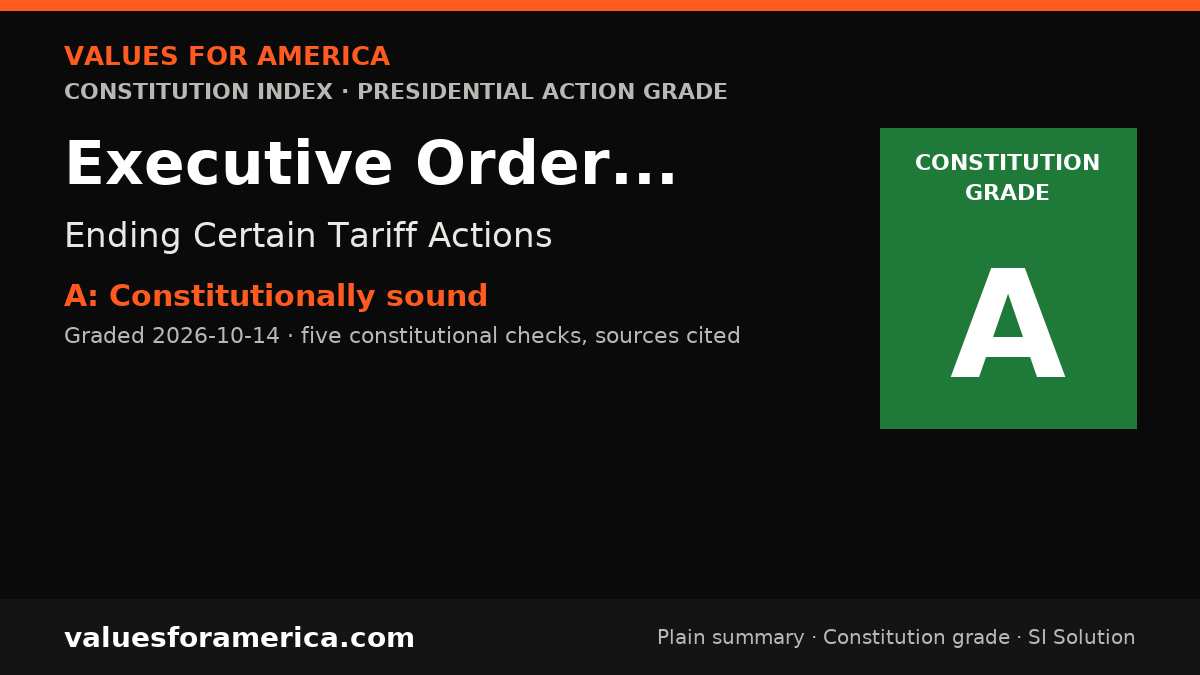
Ending Certain Tariff Actions
Signed: 2026-02-20 Published: 2026-02-25 Federal Register document: 2026-03832
Agencies: Executive Office of the President
Federal Register notes (as of 2026-10-19): See: EO 14193, February 1, 2025; Executive Order 14194, February 1, 2025; EO 14195, February 1, 2025; EO 14245, March 24, 2025; EO 14257, April 2, 2025; EO 14323, July 30, 2025; EO 14329, August 6, 2025; EO 14380, January 29, 2026; EO 14382, February 6, 2026; Proc. 11012, February 20, 2026; EO 14388, February 20, 2026
What Executive Order 14389 says
Federal Register, Volume 91 Issue 37 (Wednesday, February 25, 2026) [Federal Register Volume 91, Number 37 (Wednesday, February 25, 2026)] [Presidential Documents] [Pages 9437-9439] From the Federal Register Online via the Government Publishing Office [www.gpo.gov] [FR Doc No: 2026-03832] Presidential Documents Federal Register / Vol. 91, No. 37 / Wednesday, February 25, 2026 / Presidential Documents [[Page 9437]] Executive Order 14389 of February 20, 2026 Ending Certain Tariff Actions By the authority vested in me as President by the Constitution and the laws of the United States of America, including the International Emergency Economic Powers Act (50 U.S.C. 1701 et seq.) (IEEPA), the National Emergencies Act (50 U.S.C. 1601 et seq.), section 604 of the Trade Act of 1974, as amended (19 U.S.C. 2483), and section 301 of title 3, United States Code, it is hereby ordered: Section 1. Background. In Executive Order 14193 of February 1, 2025 (Imposing Duties To Address the Flow of Illicit Drugs Across Our Northern Border), as amended; Executive Order 14194 of February 1, 2025 (Imposing Duties To Address the Situation at Our Southern Border), as amended; Executive Order 14195 of February 1, 2025 (Imposing Duties To Address the Synthetic Opioid Supply Chain in the People's Republic of China), as amended; Executive Order 14245 of March 24, 2025 (Imposing Tariffs on Countries...
Opening of the official text; read it in full in the Federal Register.
Constitution Index
“VFA Constitution grade”
Constitutionally sound
Graded 2026-10-14
SI-generated grade · five published checks · not individually reviewed by a person · methodology
This executive order terminates certain tariffs imposed under IEEPA, which is a lawful exercise of presidential authority in foreign commerce and national emergencies. It does not infringe on individual rights, respects decentralization by reducing federal trade restrictions, and follows due process by acting within statutory frameworks.
-
✓ Passes · Enumerated powers
The President's authority to impose and terminate tariffs under IEEPA is derived from statutory delegation by Congress, which is grounded in Article I, Section 8, Clause 3 (the Commerce Clause) and the President's foreign affairs powers. The order explicitly cites IEEPA, the National Emergencies Act, and the Trade Act of 1974, all of which are constitutional delegations of authority. Terminating t… -
✓ Passes · Bill of Rights
The order does not implicate any of the first ten amendments. It concerns trade duties and does not affect speech, religion, assembly, press, petition, arms, quartering, search and seizure, self-incrimination, due process, takings, trial rights, or cruel and unusual punishment. No Bill of Rights provision is infringed. -
✓ Passes · Individual sovereignty
The order reduces restrictions on imports, thereby expanding economic liberty for individuals and businesses. It does not restrict personal conduct, property, speech, labor, or belief. The termination of tariffs removes government-imposed burdens on trade, which is consistent with individual sovereignty. -
✓ Passes · Decentralization
The order reduces federal trade barriers, which is a step toward decentralization by allowing more economic activity at the individual and local levels. The federal government is acting within its constitutional role in foreign commerce, and the action does not consolidate power upward; it actually reduces federal intervention. -
✓ Passes · Due process and takings
The order does not deprive anyone of property without due process. It terminates tariffs, which are not a taking of property in the constitutional sense. The action is taken pursuant to statutory procedures and does not bypass any required notice or hearing. It is a lawful executive action within the President's delegated authority.
Report an error in this grade
What should happen instead
“VFA SI Solution”
SI-generated · passed automated checks (Constitution citation, source verification, independent SI critic) · not individually reviewed by a person · Report an error: hello@valuesforamerica.com
SI Corrected Executive Form for Ending Emergency Duties Under Executive Order 14389
End added import duties imposed under emergency economic powers in nine prior orders, while keeping the underlying emergencies and other duties in force.
Bipartisan rationale: VFA assesses this approach gives conservatives and Republicans lower import costs for families and firms and a clear limit that emergency power ends when the duties end. VFA assesses it gives progressives and Democrats open public notice of tariff schedule changes, equal treatment through prompt end of collection, and continued use of focused laws for drugs, security, and worker protection. Both sides gain because a President who can end duties he imposed stays within executive power, while Congress keeps sole power to set new duties through open law.
Article II, Section 3 Article I, Section 8, Clause 1 Article I, Section 8, Clause 3
Report an error in this Solution

For journalists and bloggers
“Embed this grade”
Free to use with the link back. The badge and card update when the grade changes. Embed terms →
