Executive Order 14383 explained · Executive Order · No disposition noted
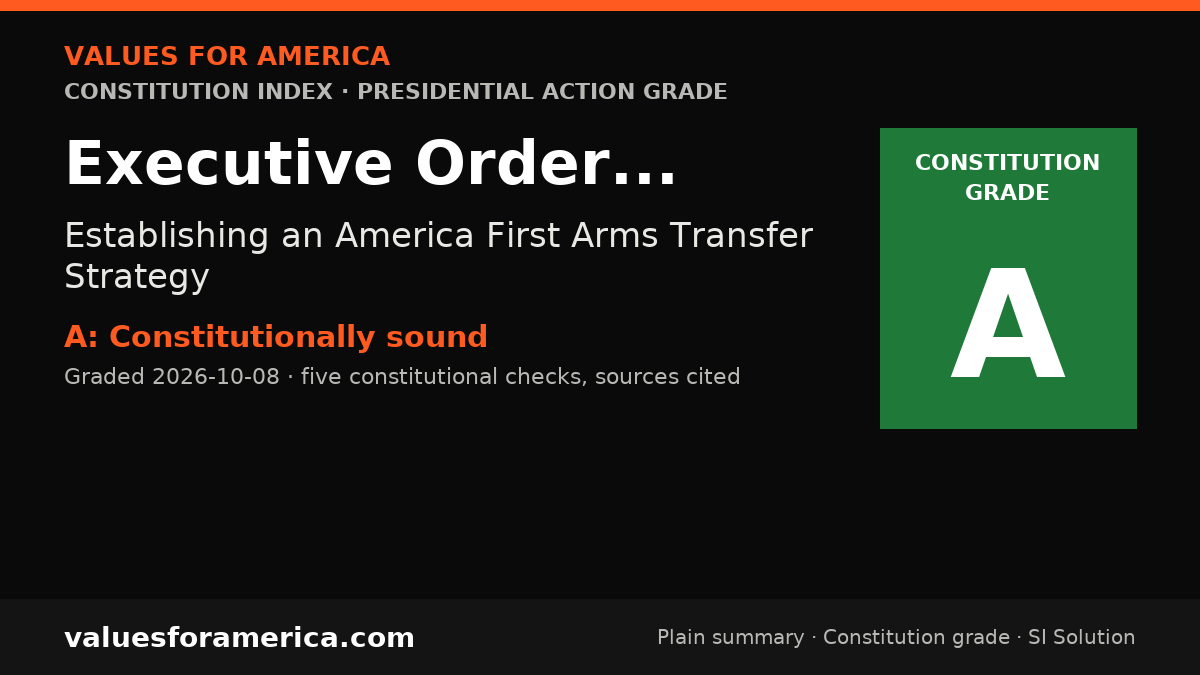
Establishing an America First Arms Transfer Strategy
Signed: 2026-02-06 Published: 2026-02-11 Federal Register document: 2026-02814
Agencies: Executive Office of the President
Federal Register notes (as of 2026-10-19): Amends: EO 13637, March 8, 2013 See: EO 14268, April 9, 2025
What Executive Order 14383 says
Federal Register, Volume 91 Issue 28 (Wednesday, February 11, 2026) [Federal Register Volume 91, Number 28 (Wednesday, February 11, 2026)] [Presidential Documents] [Pages 6497-6500] From the Federal Register Online via the Government Publishing Office [www.gpo.gov] [FR Doc No: 2026-02814] Presidential Documents Federal Register / Vol. 91 , No. 28 / Wednesday, February 11, 2026 / Presidential Documents [[Page 6497]] Executive Order 14383 of February 6, 2026 Establishing an America First Arms Transfer Strategy By the authority vested in me as President by the Constitution and the laws of the United States of America, it is hereby ordered: Section 1. Purpose. American-manufactured military equipment is the best in the world, resulting in American dominance across international defense exports. It is critical that the United States fully use this comparative advantage in arms transfers as both a tool of foreign policy and a tool to expand domestic production and transfer. To maintain our military dominance and technological superiority, the time has come to establish, implement, and execute an America First Arms Transfer Strategy. As the first strategy of its kind, it will ensure that future arms sales prioritize American interests by using foreign purchases and capital to build American production and capacity. This strategy will advance a technologically superior, ready, and...
Opening of the official text; read it in full in the Federal Register.
Constitution Index
“VFA Constitution grade”
Constitutionally sound
Graded 2026-10-08
SI-generated grade · five published checks · not individually reviewed by a person · methodology
Executive Order 14383 is a foreign-policy and defense-management directive within core presidential Article II authority and existing congressional arms-sale statutes. It restricts no domestic rights, takes no property, denies no process, and consolidates no state or local function. SI analysis finds it constitutionally sound.
-
✓ Passes · Enumerated powers
Conduct of foreign policy and direction of arms exports are core federal executive functions. Authority rests in Article II, Section 1 vesting of executive power, Article II, Section 2 making the President Commander in Chief and authorizing treaties and appointments with Senate consent, and Article II, Section 3 duty to take care that laws be executed. Congress has separately authorized foreign mi… -
✓ Passes · Bill of Rights
No provision directs domestic restriction of speech, religion, press, assembly, arms possession, searches, or trial rights. Order concerns foreign military sales, catalogs, and interagency process. No First Amendment, Second Amendment, or Fourth Amendment infringement is authorized. Tenth Amendment reserved-powers concern is addressed under decentralization. -
✓ Passes · Individual sovereignty
Order does not restrict what a person may do with their person, property, speech, labor, or belief. It directs the Secretary of War, Secretary of State, and Secretary of Commerce to prioritize platforms, streamline notifications, and engage industry. Defense firms remain free to petition and participate through the industry engagement plan, with First Amendment protections intact. No compelling-ju… -
✓ Passes · Decentralization
Foreign arms transfers and management of the national defense industrial base cannot be handled by individuals, counties, or single states without fragmenting foreign policy and national defense. Authority remains at the minimum necessary level for this subject: the federal executive. No power is moved upward from states or localities because they held no such foreign-affairs power under the Tenth… -
✓ Passes · Due process and takings
Order creates planning documents, sales catalog, advocacy recommendations, monitoring criteria, and third-party transfer review. It orders no arrest, seizure, forfeiture, or taking of private property, and establishes no adjudication bypassing notice and hearing. Any future commercial sale would proceed under existing statutory regimes such as the Arms Export Control Act with judicial review intac…
Report an error in this grade
What should happen instead
“VFA SI Solution”
No Solution yet
A sourced, Constitution-cited alternative appears here once one passes the SI Editorial Standard.

For journalists and bloggers
“Embed this grade”
Free to use with the link back. The badge and card update when the grade changes. Embed terms →
