Executive Order 14382 explained · Executive Order · No disposition noted
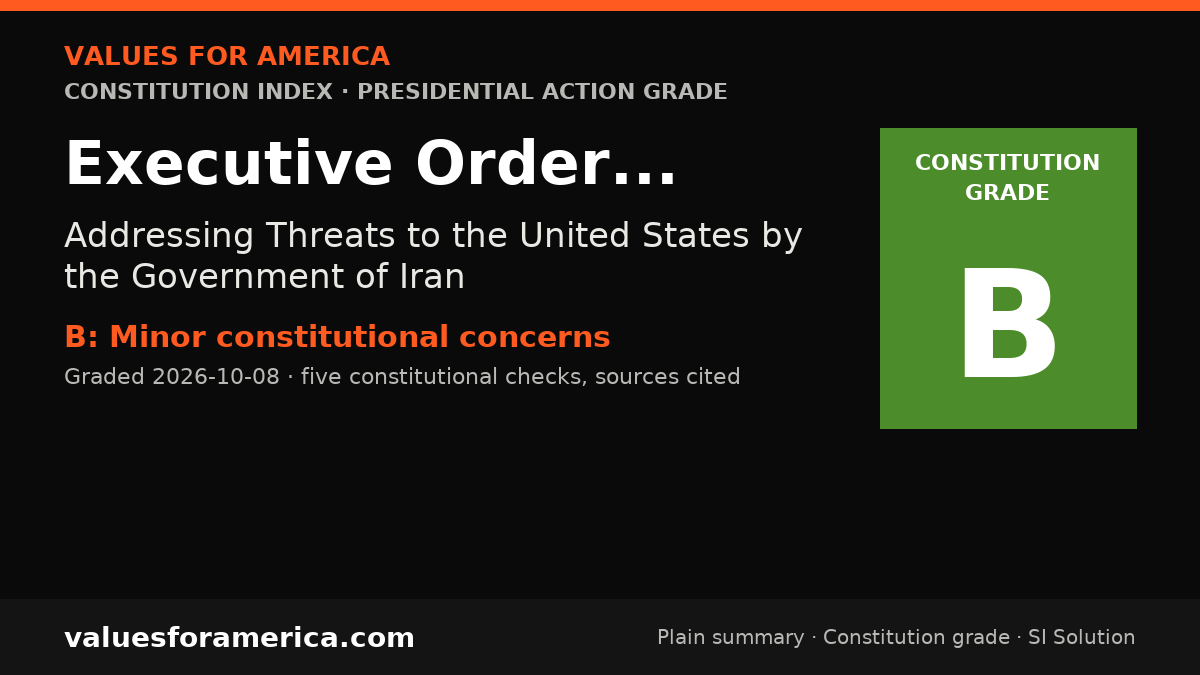
Addressing Threats to the United States by the Government of Iran
Signed: 2026-02-06 Published: 2026-02-11 Federal Register document: 2026-02813
Agencies: Executive Office of the President
Federal Register notes (as of 2026-10-19): See: EO 12957, March 15, 1995; EO 13059, August 19, 1997; EO 13553, September 28, 2010; EO 13590, November 20, 2011; EO 13622, July 30, 2012; EO 13846, August 6, 2018; EO 13902, January 10, 2020; EO 14389, February 20, 2026; Notice of March 2, 2026
What Executive Order 14382 says
Federal Register, Volume 91 Issue 28 (Wednesday, February 11, 2026) [Federal Register Volume 91, Number 28 (Wednesday, February 11, 2026)] [Presidential Documents] [Pages 6493-6496] From the Federal Register Online via the Government Publishing Office [www.gpo.gov] [FR Doc No: 2026-02813] Presidential Documents Federal Register / Vol. 91 , No. 28 / Wednesday, February 11, 2026 / Presidential Documents [[Page 6493]] Executive Order 14382 of February 6, 2026 Addressing Threats to the United States by the Government of Iran By the authority vested in me as President by the Constitution and the laws of the United States of America, including the International Emergency Economic Powers Act (50 U.S.C. 1701 et seq.) (IEEPA), the National Emergencies Act (50 U.S.C. 1601 et seq.), section 604 of the Trade Act of 1974, as amended (19 U.S.C. 2483), and section 301 of title 3, United States Code, I hereby determine and order: Section 1. Background. Executive Order 12957 of March 15, 1995 (Prohibiting Certain Transactions With Respect to the Development of Iranian Petroleum Resources), found that the actions and policies of the Government of Iran constitute an unusual and extraordinary threat to the national security, foreign policy, and economy of the United States and declared a national emergency to deal with that threat. Numerous subsequent Executive Orders--including Executive Order...
Opening of the official text; read it in full in the Federal Register.
Constitution Index
“VFA Constitution grade”
Minor constitutional concerns
Graded 2026-10-08
SI-generated grade · five published checks · not individually reviewed by a person · methodology
Secondary tariffs to pressure Iran rest on Presidential foreign-emergency power plus congressional delegation, operate at the proper federal level for foreign commerce and national security, and impose no direct Bill of Rights violation or domestic taking. Broad fact-finding and modification discretion create minor vagueness and delegation tension, fixable through clear rules and review, supporting a Mostly sound grade.
-
✓ Passes · Enumerated powers
The President acts under Article II, Sections 1-3 executive and foreign-affairs authority and express congressional delegation: IEEPA at 50 U.S.C. 1701 et seq., the National Emergencies Act, 19 U.S.C. 2483, and 3 U.S.C. 301, continuing the emergency first declared in EO 12957. Regulating foreign commerce and laying duties implicates Article I, Section 8, Clauses 1 and 3, which Congress may delegat… -
✓ Passes · Bill of Rights
No provision directs search, seizure, speech suppression, arms restriction, or criminal punishment. Tariffs on products of third countries that trade with Iran do not on their face compel speech, restrict religion or press, authorize warrantless searches under the Fourth Amendment, or impose criminal liability implicating the Fifth Amendment privilege or Sixth Amendment trial rights. Any incidenta… -
✓ Passes · Individual sovereignty
The order restricts commercial choices of importers sourcing from countries that trade with Iran, burdening use of property and labor. That burden is justified by the compelling constitutional function of national defense and foreign policy under Article I, Section 8, Clauses 1, 3, 11 and Article II, Section 2, not by regulation of domestic personal belief, speech, or purely intrastate conduct. It… -
✓ Passes · Decentralization
Foreign affairs, national emergency response, customs duties, and sanctions against a foreign regime cannot be handled by individuals, counties, or single states. Article I, Section 8, Clauses 1, 3 and 11 and Article II, Sections 2 and 3 assign foreign commerce, imposts, and foreign policy to the federal political branches. Federal action is the minimum necessary level, so no upward consolidation … -
✓ Passes · Due process and takings
Tariffs are prospective duties on importation, not a Fifth Amendment taking of vested private property requiring just compensation. The order provides procedural structure: Commerce finding after the effective date, inter-agency consultation with State, Treasury, Homeland Security and the Trade Representative, Presidential determination, and authority for implementing rules and guidance. Importers…
Report an error in this grade
What should happen instead
“VFA SI Solution”
No Solution yet
A sourced, Constitution-cited alternative appears here once one passes the SI Editorial Standard.

For journalists and bloggers
“Embed this grade”
Free to use with the link back. The badge and card update when the grade changes. Embed terms →
