Executive Order 14380 explained · Executive Order · No disposition noted
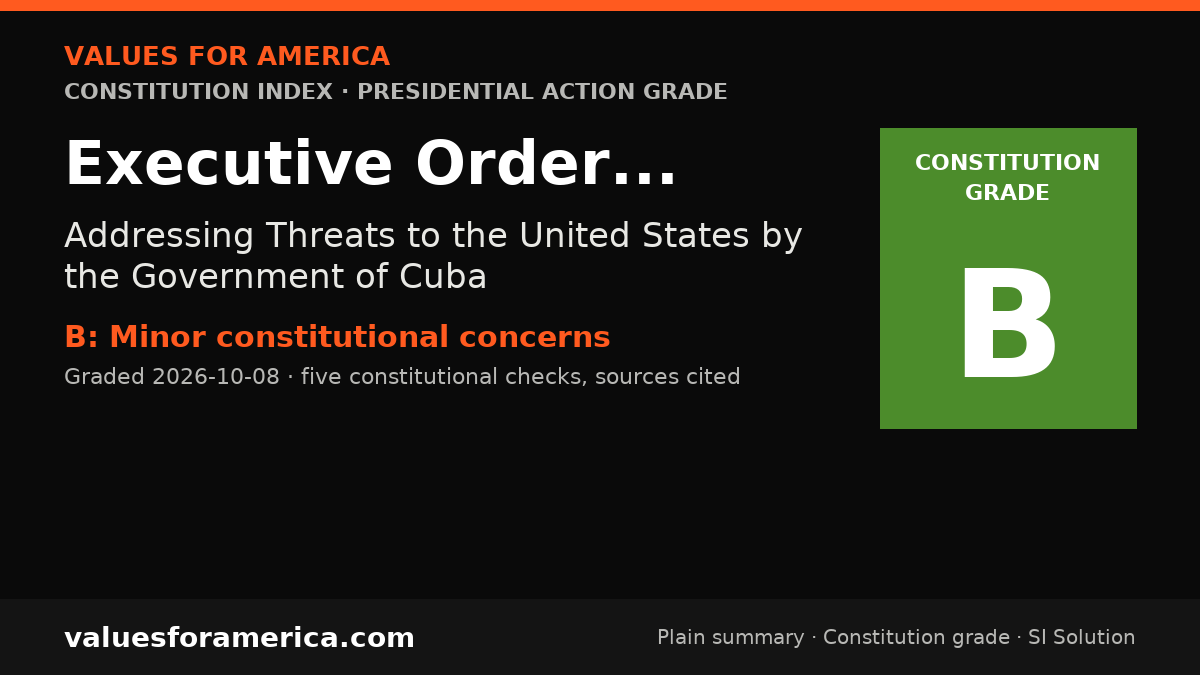
Addressing Threats to the United States by the Government of Cuba
Signed: 2026-01-29 Published: 2026-02-03 Federal Register document: 2026-02250
Agencies: Executive Office of the President
Federal Register notes (as of 2026-10-19): See: EO 14389, February 20, 2026; EO 14404, May 1, 2026
What Executive Order 14380 says
Federal Register, Volume 91 Issue 22 (Tuesday, February 3, 2026) [Federal Register Volume 91, Number 22 (Tuesday, February 3, 2026)] [Presidential Documents] [Pages 5085-5089] From the Federal Register Online via the Government Publishing Office [www.gpo.gov] [FR Doc No: 2026-02250] Presidential Documents Federal Register / Vol. 91 , No. 22 / Tuesday, February 3, 2026 / Presidential Documents [[Page 5085]] Executive Order 14380 of January 29, 2026 Addressing Threats to the United States by the Government of Cuba By the authority vested in me as President by the Constitution and the laws of the United States of America, including the International Emergency Economic Powers Act (50 U.S.C. 1701 et seq.) (IEEPA), the National Emergencies Act (50 U.S.C. 1601 et seq.) (NEA), and section 301 of title 3, United States Code, I hereby determine and order: Section 1. National Emergency. As President of the United States, I have an imperative duty to protect the national security and foreign policy of this country. I find that the policies, practices, and actions of the Government of Cuba constitute an unusual and extraordinary threat, which has its source in whole or substantial part outside the United States, to the national security and foreign policy of the United States. The Government of Cuba has taken extraordinary actions that harm and threaten the United States. The regime aligns...
Opening of the official text; read it in full in the Federal Register.
Constitution Index
“VFA Constitution grade”
Minor constitutional concerns
Graded 2026-10-08
SI-generated grade · five published checks · not individually reviewed by a person · methodology
SI review finds EO 14380 is a foreign-affairs and foreign-commerce emergency measure within presidential and delegated authority, with no domestic rights infringement, sovereignty violation, or taking. Minor tension remains because tariff rates are set by executive finding rather than direct congressional act, warranting B rather than A.
-
✓ Passes · Enumerated powers
President invokes Article II, Sections 1-3 executive and foreign-affairs power plus statutory delegation under IEEPA and NEA. Addressing foreign intelligence basing, support for hostile powers, and Western Hemisphere security falls within Commander-in-Chief and foreign-policy authority under Article II, Section 2, and regulation of Commerce with foreign Nations under Article I, Section 8, Clause 3… -
✓ Passes · Bill of Rights
No provision imposes prior restraint, speech penalty, religious test, arms restriction, search, compelled testimony, or trial deprivation. Tariff on foreign-origin goods does not implicate First Amendment, Second Amendment, or Fourth Amendment. No domestic person is targeted for belief or expression. -
✓ Passes · Individual sovereignty
Order burdens only importers sourcing from countries that supply oil to Cuba, an indirect commercial regulation justified by stated national-security findings on Russian signals-intelligence basing, PRC defense cooperation, and terrorist-group facilitation. It does not restrict domestic speech, belief, labor, travel, or ownership of person and property. Government burden under Fifth Amendment libe… -
✓ Passes · Decentralization
Foreign affairs, national emergency response, and regulation of foreign commerce are inherently national functions under Article II, Sections 2-3 and Article I, Section 8, Clause 3. No individual, county, or single state can negotiate with Cuba, interdict foreign intelligence basing, or set national import duties. The Order does not transfer state or local authority upward. -
✓ Passes · Due process and takings
No property is seized or frozen and no criminal penalty is imposed without notice or hearing. Tariff duties under Article I, Section 8, Clause 1 are duties, not Fifth Amendment takings requiring just compensation. Future Commerce and State findings are conditioned on post-Order conduct with Federal Register publication, preserving procedural due process.
Report an error in this grade
What should happen instead
“VFA SI Solution”
No Solution yet
A sourced, Constitution-cited alternative appears here once one passes the SI Editorial Standard.

For journalists and bloggers
“Embed this grade”
Free to use with the link back. The badge and card update when the grade changes. Embed terms →
