Executive Order 14365 explained · Executive Order · No disposition noted
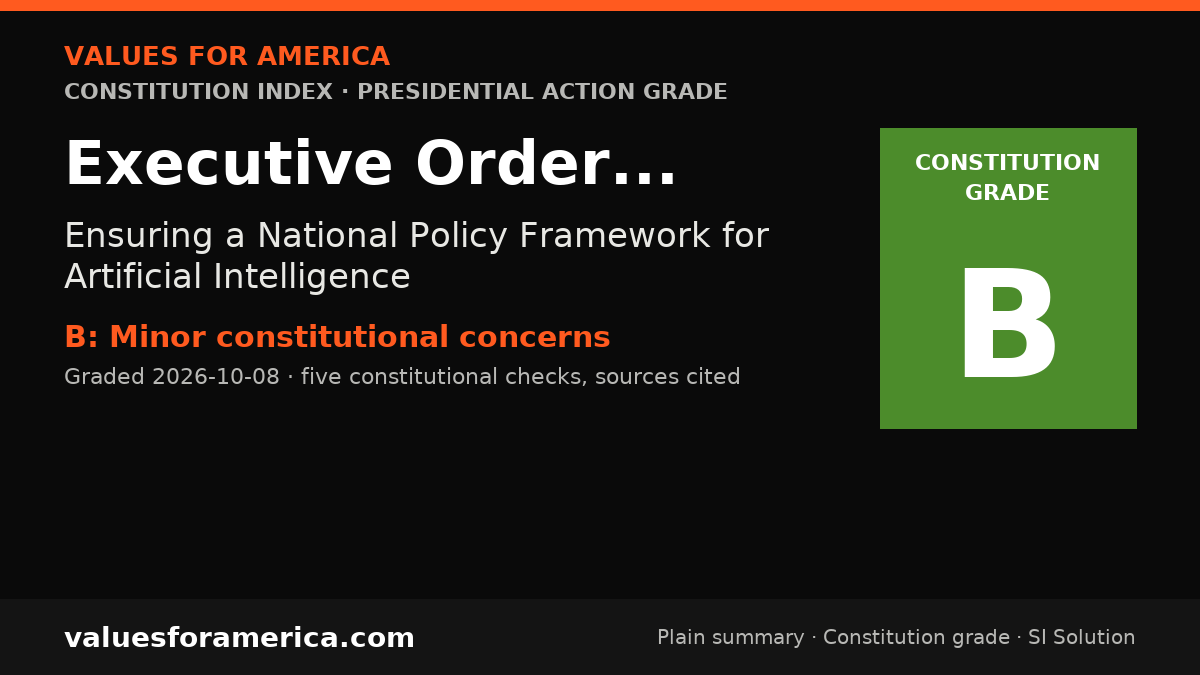
Ensuring a National Policy Framework for Artificial Intelligence
Signed: 2025-12-11 Published: 2025-12-16 Federal Register document: 2025-23092
Agencies: Executive Office of the President
Federal Register notes (as of 2026-10-19): See: EO 14179, January 23, 2025
What Executive Order 14365 says
Federal Register, Volume 90 Issue 239 (Tuesday, December 16, 2025) [Federal Register Volume 90, Number 239 (Tuesday, December 16, 2025)] [Presidential Documents] [Pages 58499-58501] From the Federal Register Online via the Government Publishing Office [www.gpo.gov] [FR Doc No: 2025-23092] Presidential Documents Federal Register / Vol. 90, No. 239 / Tuesday, December 16, 2025 / Presidential Documents [[Page 58499]] Executive Order 14365 of December 11, 2025 Ensuring a National Policy Framework for Artificial Intelligence By the authority vested in me as President by the Constitution and the laws of the United States of America, it is hereby ordered: Section 1. Purpose. United States leadership in Artificial Intelligence (AI) will promote United States national and economic security and dominance across many domains. Pursuant to Executive Order 14179 of January 23, 2025 (Removing Barriers to American Leadership in Artificial Intelligence), I revoked my predecessor's attempt to paralyze this industry and directed my Administration to remove barriers to United States AI leadership. My Administration has already done tremendous work to advance that objective, including by updating existing Federal regulatory frameworks to remove barriers to and encourage adoption of AI applications across sectors. These efforts have already delivered tremendous benefits to the American people and...
Opening of the official text; read it in full in the Federal Register.
Constitution Index
“VFA Constitution grade”
Minor constitutional concerns
Graded 2026-10-08
SI-generated grade · five published checks · not individually reviewed by a person · methodology
Order stays within executive litigation and coordination authority and protects speech values, but uses federal litigation plus funding leverage to displace state policy before Congress enacts a national standard, creating significant Tenth Amendment and decentralization tension.
-
✓ Passes · Enumerated powers
President acts under Article II, Sections 1 and 3 to execute laws and direct executive officers, including the Attorney General and Secretary of Commerce. Challenging state laws in court invokes the Supremacy Clause in Article VI, Clause 2 and the Commerce Clause in Article I, Section 8, Clause 3 where state measures burden interstate commerce. Directing the Federal Communications Commission and F… -
✓ Passes · Bill of Rights
Order imposes no direct restriction on speech, religion, press, assembly, arms, searches, trial rights, or punishment. Sections 2 and 4 expressly state policy to prevent censorship and to flag state laws that compel disclosure or alter truthful outputs of artificial intelligence models in violation of the First Amendment. That orientation supports First Amendment values rather than infringing them… -
✓ Passes · Individual sovereignty
Order places no direct restraint on personal belief, speech, labor, property, or family choice. It restricts state regulators rather than individuals, and its stated purpose is to leave artificial intelligence developers and users free to innovate without compelled false outputs. The burden remains on government to justify any restriction in court. No compelling-justification test is triggered aga… -
✗ Concern · Decentralization
Artificial intelligence models operate across state lines, so individuals and single counties cannot manage interstate effects alone. States can handle distinct harms under police powers reserved by the Tenth Amendment, and a uniform interstate market may justify some federal coordination under Article I, Section 8, Clause 3. This order nevertheless consolidates upward: it directs a national minim… -
✓ Passes · Due process and takings
Order takes no private property and imposes no fine, seizure, or criminal presumption under the Fifth Amendment Takings and Due Process Clauses. Section 3 directs litigation through courts, preserving notice and hearing under Article III and the Fifth Amendment. Section 5 conditions only future discretionary and remaining program funds with a required Policy Notice and legal limits, which courts r…
Report an error in this grade
What should happen instead
“VFA SI Solution”
No Solution yet
A sourced, Constitution-cited alternative appears here once one passes the SI Editorial Standard.

For journalists and bloggers
“Embed this grade”
Free to use with the link back. The badge and card update when the grade changes. Embed terms →
