Executive Order 14361 explained · Executive Order · No disposition noted
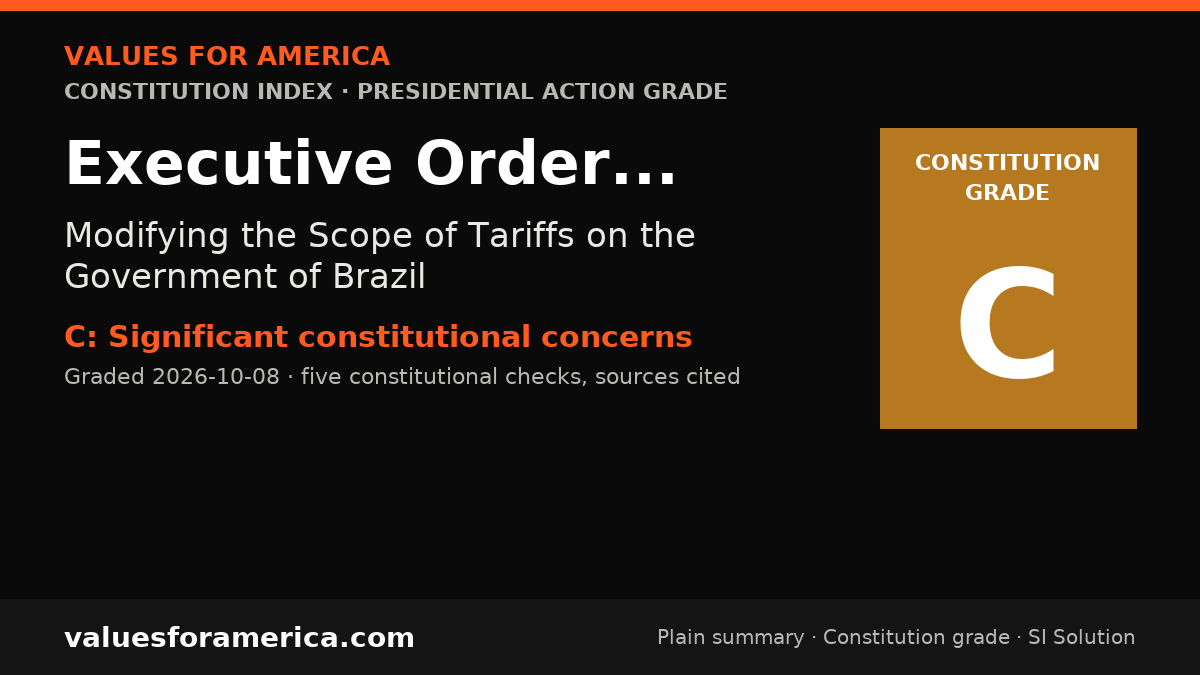
Modifying the Scope of Tariffs on the Government of Brazil
Signed: 2025-11-20 Published: 2025-11-26 Federal Register document: 2025-21417
Agencies: Executive Office of the President
Federal Register notes (as of 2026-10-19): See: EO 14323, July 30, 2025
What Executive Order 14361 says
Federal Register, Volume 90 Issue 226 (Wednesday, November 26, 2025) [Federal Register Volume 90, Number 226 (Wednesday, November 26, 2025)] [Presidential Documents] [Pages 54467-54516] From the Federal Register Online via the Government Publishing Office [www.gpo.gov] [FR Doc No: 2025-21417] Title 3-- The President [[Page 54467]] Executive Order 14361 of November 20, 2025 Modifying the Scope of Tariffs on the Government of Brazil By the authority vested in me as President by the Constitution and the laws of the United States of America, including the International Emergency Economic Powers Act (50 U.S.C. 1701 et seq.) (IEEPA), the National Emergencies Act (50 U.S.C. 1601 et seq.), section 604 of the Trade Act of 1974, as amended (19 U.S.C. 2483), and section 301 of title 3, United States Code, I hereby order: Section 1. Background. In Executive Order 14323 of July 30, 2025 (Addressing Threats to the United States by the Government of Brazil), I found that the scope and gravity of recent policies, practices, and actions of the Government of Brazil constitute an unusual and extraordinary threat to the national security, foreign policy, and economy of the United States that has its source in whole or substantial part outside the United States. I declared a national emergency with respect to that threat and, to deal with that threat, I determined that it was necessary and...
Opening of the official text; read it in full in the Federal Register.
Constitution Index
“VFA Constitution grade”
Significant constitutional concerns
Graded 2026-10-08
SI-generated grade · five published checks · not individually reviewed by a person · methodology
Order 14361 reduces the tariff burden imposed under prior order by exempting agricultural goods during negotiations with Brazil. No Bill of Rights, due process, takings, sovereignty, or decentralization violation is found. The remaining defect is structural: tariffs are a congressional power under Article I, Section 8, and continued presidential management through emergency delegation retains significant enumerated-powers tension.
-
✗ Concern · Enumerated powers
The power to lay duties and regulate commerce with foreign nations belongs to Congress under Article I, Section 8, Clause 1 and Clause 3. This order rests on delegated statutes, principally the International Emergency Economic Powers Act and the National Emergencies Act, plus Article II executive authority. Reliance on a declared emergency to impose and then adjust a 40 percent ad valorem duty str… -
✓ Passes · Bill of Rights
This order narrows an existing tariff to exempt certain agricultural products. It does not restrict speech, religion, press, assembly under the First Amendment, does not implicate the Second Amendment, Third Amendment, Fourth Amendment search and seizure, Fifth Amendment self-incrimination, Sixth Amendment trial rights, Seventh Amendment jury, or Eighth Amendment punishment. No expressive or relig… -
✓ Passes · Individual sovereignty
Tariffs burden private choice in trade and property use, implicating liberty and the Ninth and Tenth Amendments. This specific order, however, removes certain agricultural products from the added duty and therefore expands rather than contracts individual freedom to buy, sell, and contract. The government offers a stated foreign-policy negotiation reason, and the direction of change favors soverei… -
✓ Passes · Decentralization
Foreign commerce and tariff treatment of Brazilian goods cannot be handled by individuals, localities, or single states without fragmenting national foreign policy. Article I, Section 8, Clause 3 assigns regulation of commerce with foreign nations to Congress at the federal level, and Article I, Section 10, Clause 2 bars states from laying imposts without consent. This order does not move a domest… -
✓ Passes · Due process and takings
Section 2 provides prospective effect and directs refunds through applicable law and standard U.S. Customs and Border Protection procedures. There is no seizure without notice, no presumption of guilt, and no taking under the Fifth Amendment Takings Clause without process. Procedural due process under the Fifth Amendment is preserved through published Federal Register notice and established refund…
Report an error in this grade
What should happen instead
“VFA SI Solution”
No Solution yet
A sourced, Constitution-cited alternative appears here once one passes the SI Editorial Standard.

For journalists and bloggers
“Embed this grade”
Free to use with the link back. The badge and card update when the grade changes. Embed terms →
