Executive Order 14357 explained · Executive Order · No disposition noted
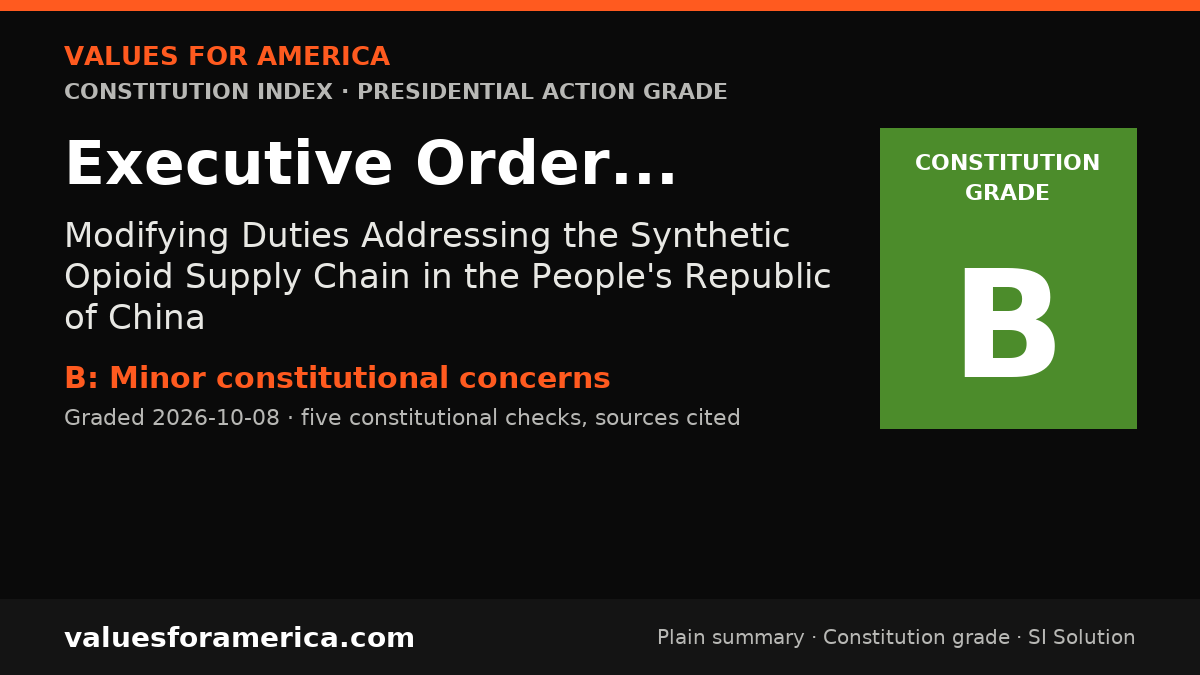
Modifying Duties Addressing the Synthetic Opioid Supply Chain in the People's Republic of China
Signed: 2025-11-04 Published: 2025-11-07 Federal Register document: 2025-19825
Agencies: Executive Office of the President
What Executive Order 14357 says
Federal Register, Volume 90 Issue 214 (Friday, November 7, 2025) [Federal Register Volume 90, Number 214 (Friday, November 7, 2025)] [Presidential Documents] [Pages 50725-50727] From the Federal Register Online via the Government Publishing Office [www.gpo.gov] [FR Doc No: 2025-19825] [[Page 50723]] Vol. 90 Friday, No. 214 November 7, 2025 Part III The President ----------------------------------------------------------------------- Executive Order 14357--Modifying Duties Addressing the Synthetic Opioid Supply Chain in the People's Republic of China Executive Order 14358--Modifying Reciprocal Tariff Rates Consistent With the Economic and Trade Arrangement Between the United States and the People's Republic of China Presidential Documents Federal Register / Vol. 90 , No. 214 / Friday, November 7, 2025 / Presidential Documents ___________________________________________________________________ Title 3-- The President [[Page 50725]] Executive Order 14357 of November 4, 2025 Modifying Duties Addressing the Synthetic Opioid Supply Chain in the People's Republic of China By the authority vested in me as President by the Constitution and the laws of the United States of America, including the International Emergency Economic Powers Act (50 U.S.C. 1701 et seq.) (IEEPA), the National Emergencies Act (50 U.S.C. 1601 et seq.), section 604 of the Trade Act of 1974, as amended (19 U.S.C....
Opening of the official text; read it in full in the Federal Register.
Constitution Index
“VFA Constitution grade”
Minor constitutional concerns
Graded 2026-10-08
SI-generated grade · five published checks · not individually reviewed by a person · methodology
Executive Order 14357 reduces an existing tariff burden from 20% to 10% in response to PRC commitments on fentanyl precursors. It operates within the federal foreign-commerce domain, infringes no Bill of Rights protection, expands individual economic liberty, and satisfies due process through prospective published implementation. The only tension is reliance on broad IEEPA delegation of Congress's tariff power, which is mitigated because the order deregulates rather than expands exaction.
-
✓ Passes · Enumerated powers
Tariff and foreign-commerce authority belongs to Congress under Article I, Section 8, Clauses 1 and 3, and foreign-affairs power to the President under Article II, Sections 2 and 3. The President cites IEEPA, the National Emergencies Act, and 19 U.S.C. 2483 as congressional delegation. Broad IEEPA tariff delegation raises Article I, Section 1 vesting and non-delegation tension, but this order narr… -
✓ Passes · Bill of Rights
The order reduces an existing 20% additional duty to 10% and creates no speech, religion, press, arms, search, trial, or punishment restriction. No First Amendment, Second Amendment, Fourth Amendment, Fifth Amendment self-incrimination, Sixth Amendment, Seventh Amendment, or Eighth Amendment interest is implicated. -
✓ Passes · Individual sovereignty
The order lessens a government restriction on individuals and businesses to acquire property and labor through trade by halving the additional duty. It imposes no new restraint on person, speech, belief, or property and leaves the burden of justification for any remaining 10% duty on the government under the Ninth Amendment and Tenth Amendment reserved-liberty principles. -
✓ Passes · Decentralization
Regulation of foreign commerce and negotiation with the PRC cannot be handled at a lower level. Article I, Section 10, Clauses 2-3 prohibit states from laying duties or entering foreign compacts, and Article II, Sections 2-3 vest foreign affairs and execution of federal law in the President. Federal action here is the minimum necessary level, so no upward consolidation occurs. -
✓ Passes · Due process and takings
The order is prospective, published in the Federal Register with an effective date of November 10, 2025, providing fair notice under the Fifth Amendment Due Process Clause. A tariff is a lawful impost under Article I, Section 8, Clause 1, not a Fifth Amendment taking of private property for public use requiring just compensation, and no seizure, forfeiture, or criminal presumption is imposed.
Report an error in this grade
What should happen instead
“VFA SI Solution”
No Solution yet
A sourced, Constitution-cited alternative appears here once one passes the SI Editorial Standard.

For journalists and bloggers
“Embed this grade”
Free to use with the link back. The badge and card update when the grade changes. Embed terms →
