Executive Order 14353 explained · Executive Order · No disposition noted
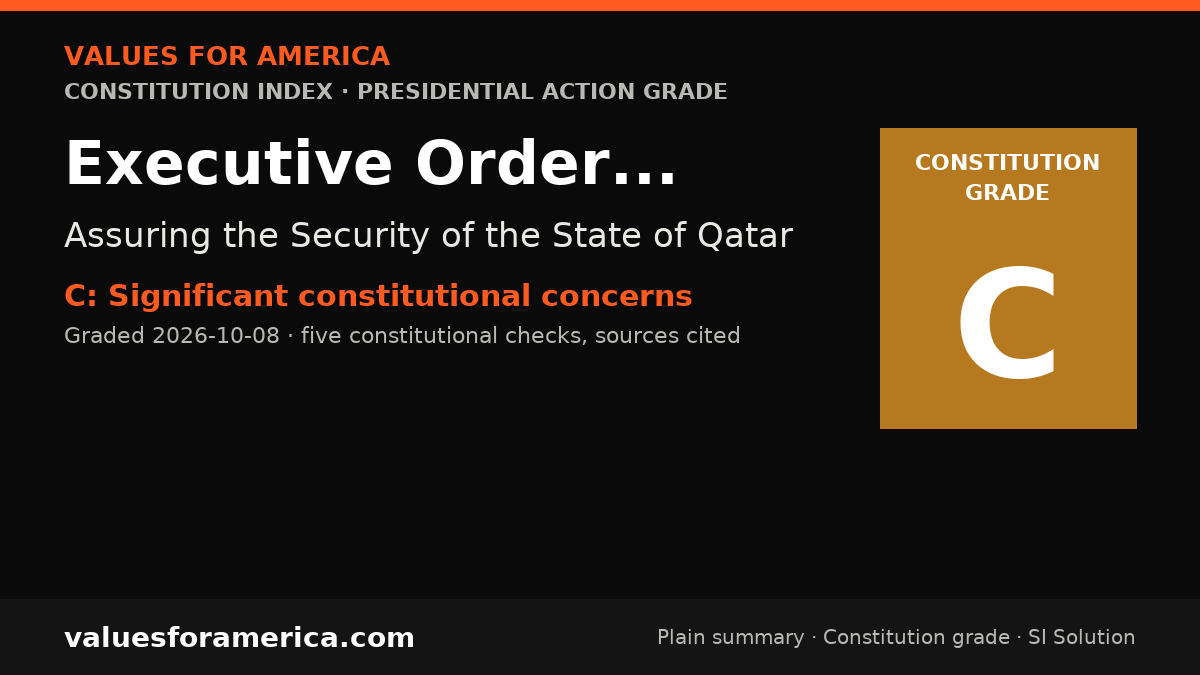
Assuring the Security of the State of Qatar
Signed: 2025-09-29 Published: 2025-10-06 Federal Register document: 2025-19483
Agencies: Executive Office of the President
What Executive Order 14353 says
Federal Register, Volume 90 Issue 191 (Monday, October 6, 2025) [Federal Register Volume 90, Number 191 (Monday, October 6, 2025)] [Presidential Documents] [Pages 48143-48144] From the Federal Register Online via the Government Publishing Office [www.gpo.gov] [FR Doc No: 2025-19483] Presidential Documents Federal Register / Vol. 90 , No. 191 / Monday, October 6, 2025 / Presidential Documents [[Page 48143]] Executive Order 14353 of September 29, 2025 Assuring the Security of the State of Qatar By the authority vested in me as President by the Constitution and the laws of the United States of America, and in recognition of the enduring alliance between the United States and the State of Qatar, it is hereby ordered: Section 1. Policy. Over the years, the United States and the State of Qatar have been bound together by close cooperation, shared interests, and the close relationship between our armed forces. The State of Qatar has hosted United States forces, enabled critical security operations, and stood as a steadfast ally in pursuit of peace, stability, and prosperity, both in the Middle East and abroad, including as a mediator that has assisted the United States' attempts to resolve significant regional and global conflicts. In recognition of this history, and in light of the continuing threats to the State of Qatar posed by foreign aggression, it is the policy of the United...
Opening of the official text; read it in full in the Federal Register.
Constitution Index
“VFA Constitution grade”
Significant constitutional concerns
Graded 2026-10-08
SI-generated grade · five published checks · not individually reviewed by a person · methodology
Executive Order 14353 declares a United States guarantee of Qatar against external attack and pledges diplomatic, economic, and if necessary military defense. Conducting diplomacy and contingency planning is within executive competence, and the Order infringes no Bill of Rights or due process rights. It fails as a unilateral security guarantee: only Congress can declare war under Article I, Section 8, Clause 11, and only the President plus two-thirds of the Senate can make a binding defense treaty under Article II, Section 2, Clause 2. The qualifying language requiring lawful measures helps, but the guarantee must go through the Senate as a treaty and through Congress for any use of force and funding.
-
✗ Concern · Enumerated powers
The President has Article II, Section 2, Clause 1 authority as Commander in Chief and broad authority to conduct diplomacy, and Congress has Article I, Section 8, Clause 3 foreign commerce and Clauses 11-14 war and military powers. The constitutional defect is that Section 1 declares it 'policy of the United States to guarantee the security and territorial integrity' of Qatar and Section 2 pledges… -
✓ Passes · Bill of Rights
The Order directs diplomacy, contingency planning, and a statement of policy toward Qatar. It does not restrict speech, religion, press, assembly under the First Amendment, does not disarm citizens under the Second Amendment, and authorizes no search, seizure, or surveillance under the Fourth Amendment. No criminal process or punishment is imposed, so the Fifth, Sixth, Seventh, and Eighth Amendmen… -
✓ Passes · Individual sovereignty
The Order does not directly regulate the person, property, speech, labor, or belief of any American under the First, Fifth, and Ninth Amendments. It does not conscript, tax, mandate, or prohibit private conduct. The indirect burden — potential future deployment of service members and expenditure of funds — is real but is mediated through future lawful orders and appropriations, not imposed by this… -
✓ Passes · Decentralization
National defense and foreign alliances are inherently federal functions under Article I, Section 8, Clauses 11-14 and Article II, Section 2. No individual, county, or single state can guarantee the security of a foreign state or conduct combined military planning. The Order does not take a power reserved to the states under the Tenth Amendment and move it upward. -
✓ Passes · Due process and takings
The Order creates no criminal liability, does not declare guilt, authorizes no arrest, detention, seizure of persons or property, and expressly states in Section 4(c) that it creates no enforceable right or benefit. It orders implementation 'consistent with law' and 'subject to availability of appropriations.' No procedural due process right under the Fifth Amendment nor Takings Clause claim is tr…
Report an error in this grade
What should happen instead
“VFA SI Solution”
No Solution yet
A sourced, Constitution-cited alternative appears here once one passes the SI Editorial Standard.

For journalists and bloggers
“Embed this grade”
Free to use with the link back. The badge and card update when the grade changes. Embed terms →
