Executive Order 14347 explained · Executive Order · No disposition noted
Restoring the United States Department of War
Signed: 2025-09-05 Published: 2025-09-10 Federal Register document: 2025-17508
Agencies: Executive Office of the President
What Executive Order 14347 says
Federal Register, Volume 90 Issue 173 (Wednesday, September 10, 2025) [Federal Register Volume 90, Number 173 (Wednesday, September 10, 2025)] [Presidential Documents] [Pages 43893-43894] From the Federal Register Online via the Government Publishing Office [www.gpo.gov] [FR Doc No: 2025-17508] Presidential Documents Federal Register / Vol. 90 , No. 173 / Wednesday, September 10, 2025 / Presidential Documents [[Page 43893]] Executive Order 14347 of September 5, 2025 Restoring the United States Department of War By the authority vested in me as President by the Constitution and the laws of the United States of America, it is hereby ordered: Section 1. Purpose. On August 7, 1789, 236 years ago, President George Washington signed into law a bill establishing the United States Department of War to oversee the operation and maintenance of military and naval affairs. It was under this name that the Department of War, along with the later formed Department of the Navy, won the War of 1812, World War I, and World War II, inspiring awe and confidence in our Nation's military, and ensuring freedom and prosperity for all Americans. The Founders chose this name to signal our strength and resolve to the world. The name ``Department of War,'' more than the current ``Department of Defense,'' ensures peace through strength, as it demonstrates our ability and willingness to fight and win wars...
Opening of the official text; read it in full in the Federal Register.
Constitution Index
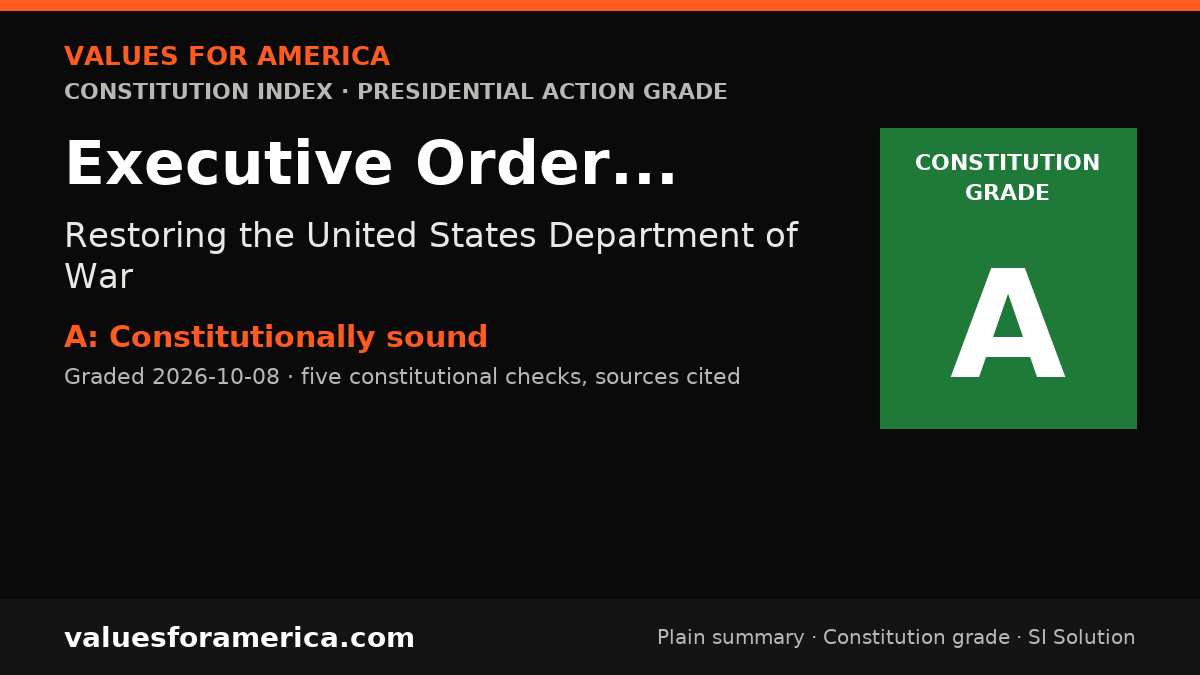
“VFA Constitution grade”
Constitutionally sound
Graded 2026-10-08
SI-generated grade · five published checks · not individually reviewed by a person · methodology
Executive Order 14347 authorizes ceremonial secondary use of Department of War titles while expressly preserving all statutory names and legal authority pending Congress. Within Commander in Chief and executive management power, it infringes no rights, takes no property, and consolidates no new power. Constitutional.
-
✓ Passes · Enumerated powers
President acts under Article II, Section 1 vesting of executive power and Article II, Section 2, Clause 1 as Commander in Chief, directing internal executive-branch nomenclature. Order explicitly states in Sections 2(e) and 3(a)-(b) that statutory names remain controlling until changed by law and implementation must be consistent with applicable law, respecting Congress's Article I, Section 8, Cla… -
✓ Passes · Bill of Rights
Order creates no restriction on speech, religion, press, assembly, arms, privacy, trial rights, or other protections in Amendments 1-10. It authorizes secondary titles and ceremonial references only, with Section 2(e) preserving controlling statutory references. No First Amendment, Second Amendment, Fourth Amendment, or other Bill of Rights provision is implicated. -
✓ Passes · Individual sovereignty
Order restricts no personal conduct regarding person, property, speech, labor, or belief. No individual is required to act, refrain from acting, or obtain permission. Government bears no burden here because no liberty is burdened, consistent with the Ninth Amendment and Tenth Amendment reservation of unenumerated rights. -
✓ Passes · Decentralization
National military organization is inherently federal under Article I, Section 8, Clauses 12-14 and Article II, Section 2, Clause 1. Individuals, localities, and states cannot handle national command structure. The order does not consolidate new power upward; it merely permits alternate naming within the existing Department, with no transfer of authority from states or localities. -
✓ Passes · Due process and takings
No person is deprived of life, liberty, or property under the Fifth Amendment Due Process Clause, no criminal process triggers Sixth Amendment or presumption-of-innocence concerns, and no property is taken under the Fifth Amendment Takings Clause. Section 3 expressly preserves existing legal authority, requires implementation consistent with applicable law, and creates no enforceable right or depr…
Report an error in this grade
What should happen instead
“VFA SI Solution”
No Solution yet
A sourced, Constitution-cited alternative appears here once one passes the SI Editorial Standard.

For journalists and bloggers
“Embed this grade”
Free to use with the link back. The badge and card update when the grade changes. Embed terms →
