Executive Order 14345 explained · Executive Order · No disposition noted
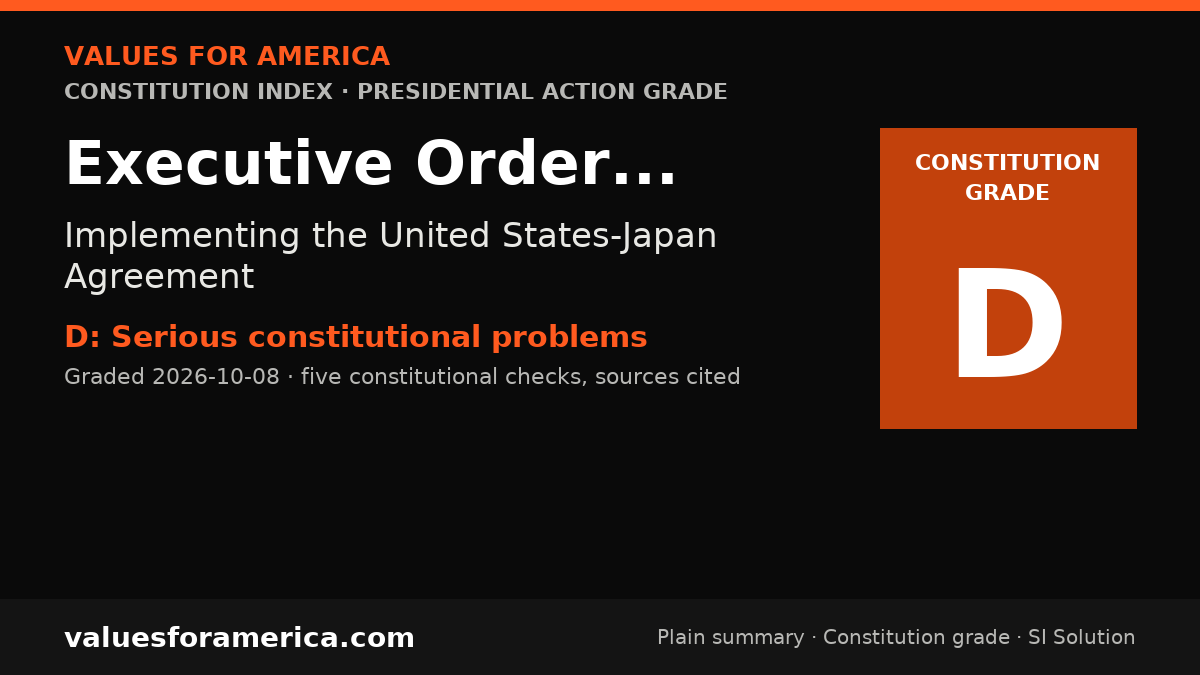
Implementing the United States-Japan Agreement
Signed: 2025-09-04 Published: 2025-09-09 Federal Register document: 2025-17389
Agencies: Executive Office of the President
Federal Register notes (as of 2026-10-19): See: EO 14257, April 2, 2025; Proc. 9704, March 8, 2018; Proc. 9705, March 8, 2018; Proc. 9888, May 17, 2019; Proc. 10962, July 30, 2025; EO 14326, July 31, 2025; Notice of March 24, 2026 (91 FR 15517)
What Executive Order 14345 says
Federal Register, Volume 90 Issue 172 (Tuesday, September 9, 2025) [Federal Register Volume 90, Number 172 (Tuesday, September 9, 2025)] [Presidential Documents] [Pages 43535-43538] From the Federal Register Online via the Government Publishing Office [www.gpo.gov] [FR Doc No: 2025-17389] [[Page 43533]] Vol. 90 Tuesday, No. 172 September 9, 2025 Part III The President ----------------------------------------------------------------------- Executive Order 14345--Implementing the United States-Japan Agreement Presidential Documents Federal Register / Vol. 90 , No. 172 / Tuesday, September 9, 2025 / Presidential Documents ___________________________________________________________________ Title 3-- The President [[Page 43535]] Executive Order 14345 of September 4, 2025 Implementing the United States-Japan Agreement By the authority vested in me as President by the Constitution and the laws of the United States of America, including the International Emergency Economic Powers Act (50 U.S.C. 1701 et seq.) (IEEPA), the National Emergencies Act (50 U.S.C. 1601 et seq.), section 232 of the Trade Expansion Act of 1962, as amended (19 U.S.C. 1862) (section 232), section 604 of the Trade Act of 1974, as amended (19 U.S.C. 2483), and section 301 of title 3, United States Code, I hereby determine and order: Section 1. Background. On July 22, 2025, I announced a framework agreement between...
Opening of the official text; read it in full in the Federal Register.
Constitution Index
“VFA Constitution grade”
Serious constitutional problems
Graded 2026-10-08
SI-generated grade · five published checks · not individually reviewed by a person · methodology
Tariff-setting is a federal foreign-commerce function, with no direct Bill of Rights violation, but executive imposition of a broad 15 percent duty system under emergency powers bypasses Congress's exclusive Article I taxing power and burdens private property and exchange without compelling justification.
-
✗ Concern · Enumerated powers
The power to lay duties and regulate foreign commerce belongs to Congress under Article I, Section 8, Clauses 1 and 3. The President may execute statutes but may not tax by proclamation. EO 14345 sets a 15 percent baseline duty and sector rules by invoking the International Emergency Economic Powers Act and a trade-deficit national emergency, stretching emergency authority to cover a persistent ec… -
✓ Passes · Bill of Rights
No provision of EO 14345 directly abridges speech, religion, press, assembly, arms, quartering, search and seizure, self-incrimination, jury trial, or cruel punishment. Tariffs are duties under Article I, Section 8, Clause 1, not a search under the Fourth Amendment or a speech restriction under the First Amendment. No First Amendment or Second Amendment burden is imposed on its face. -
✗ Concern · Individual sovereignty
A tariff is a government charge on private exchange that restricts what persons may buy, sell, and own, and with whom they may contract, raising costs on consumers and importers. The burden is on the government to show a compelling constitutional justification. A general trade deficit and investment goals, while stated as national interest, do not meet that burden for broad executive taxation of v… -
✓ Passes · Decentralization
Regulation of commerce with foreign nations is an enumerated federal function under Article I, Section 8, Clause 3. Individuals, counties, and states cannot set national tariff rates or negotiate reciprocal trade frameworks with Japan; state-level tariffs would violate Article I, Section 10. The order does not consolidate domestic police, education, or intrastate commerce power upward, so federal … -
✓ Passes · Due process and takings
Procedural due process under the Fifth Amendment requires fair notice and hearing before deprivation of property. Customs duties are prospective taxes, not takings requiring just compensation under the Fifth Amendment Takings Clause. Retroactive application to August 7, 2025 with refunds through standard procedures raises minor fairness tension, but short-period tariff reconciliation with publishe…
Report an error in this grade
What should happen instead
“VFA SI Solution”
No Solution yet
A sourced, Constitution-cited alternative appears here once one passes the SI Editorial Standard.

For journalists and bloggers
“Embed this grade”
Free to use with the link back. The badge and card update when the grade changes. Embed terms →
