Executive Order 14342 explained · Executive Order · No disposition noted
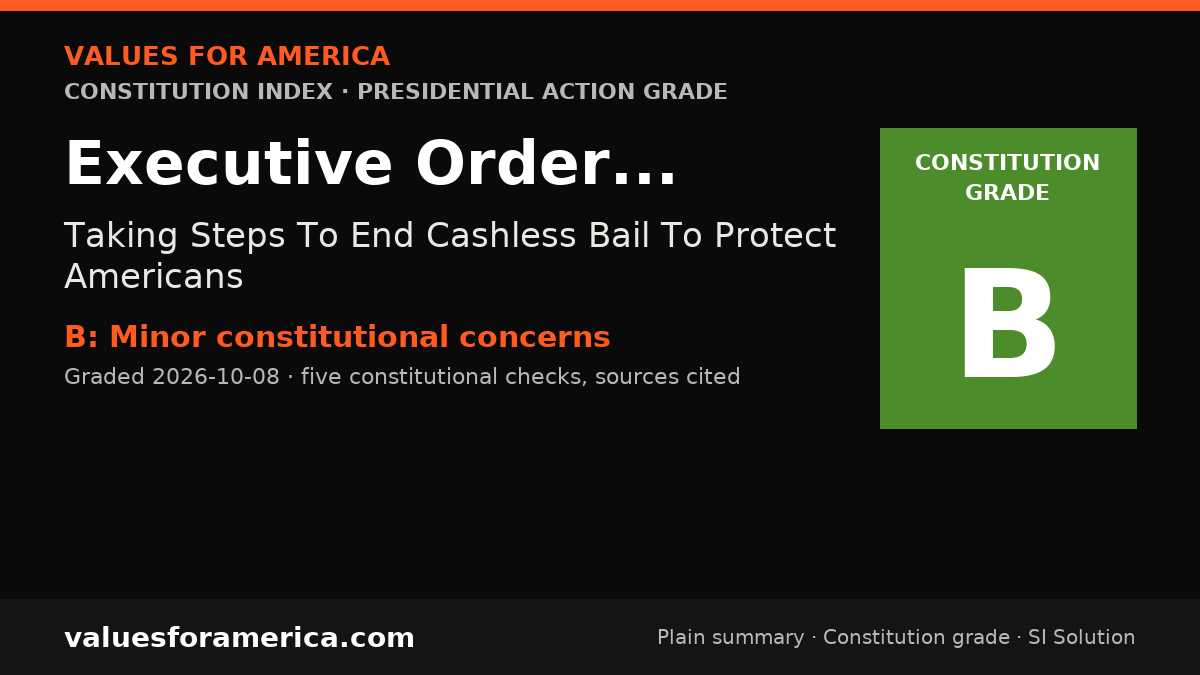
Taking Steps To End Cashless Bail To Protect Americans
Signed: 2025-08-25 Published: 2025-08-28 Federal Register document: 2025-16618
Agencies: Executive Office of the President
What Executive Order 14342 says
Federal Register, Volume 90 Issue 165 (Thursday, August 28, 2025) [Federal Register Volume 90, Number 165 (Thursday, August 28, 2025)] [Presidential Documents] [Pages 42129-42130] From the Federal Register Online via the Government Publishing Office [www.gpo.gov] [FR Doc No: 2025-16618] Presidential Documents Federal Register / Vol. 90 , No. 165 / Thursday, August 28, 2025 / Presidential Documents [[Page 42129]] Executive Order 14342 of August 25, 2025 Taking Steps To End Cashless Bail To Protect Americans By the authority vested in me as President by the Constitution and the laws of the United States of America, it is hereby ordered: Section 1. Purpose and Policy. Maintaining order and public safety requires incarcerating individuals whose pending criminal charges or criminal history demonstrate a clear ongoing risk to society. When these individuals are released without bail under city or State policies, they are permitted--even encouraged--to further endanger law-abiding, hard-working Americans because they know our laws will not be enforced. Our great law enforcement officers risk their lives to arrest potentially violent criminals, only to be forced to arrest the same individuals, sometimes for the same crimes, while they await trial on the previous charges. This is a waste of public resources and a threat to public safety. As President, I will require commonsense...
Opening of the official text; read it in full in the Federal Register.
Constitution Index
“VFA Constitution grade”
Minor constitutional concerns
Graded 2026-10-08
SI-generated grade · five published checks · not individually reviewed by a person · methodology
Order 14342 directs a list of cashless-bail jurisdictions and review of federal funds for possible suspension, while stating all action must stay consistent with law. It asserts no direct federal control of bail, creating no immediate Bill of Rights or due process breach, but it uses federal leverage over a core Tenth Amendment state police power, creating federalism tension that keeps it from full constitutional soundness.
-
✓ Passes · Enumerated powers
The President may direct supervision of the executive branch under Article II, Section 1 and Section 3, and Congress may attach conditions to federal funds under Article I, Section 8, Clause 1, within limits of relatedness and non-coercion. This order claims no direct federal power over state bail law; it orders a jurisdictional list and an inventory of funds that may be suspended consistent with … -
✓ Passes · Bill of Rights
The order does not directly order detention, set bail in any case, or authorize search, seizure, or punishment. The Eighth Amendment bars excessive bail but does not mandate or forbid cashless bail, and the order leaves judicial bail decisions to state courts. No First, Second, Fourth, Fifth, or Sixth Amendment right is directly infringed on its face, though coercive funding pressure touching pret… -
✓ Passes · Individual sovereignty
The order imposes no direct restraint on any person's body, property, speech, labor, or belief, and creates no enforceable right or duty against private parties under Section 3. It operates on government-to-government funding rather than commanding individual conduct. The burden concern is indirect: to the extent funding pressure pushes pretrial detention over release, liberty interests under the … -
✗ Concern · Decentralization
Pretrial release and bail are core state police powers under the Tenth Amendment, traditionally set by state legislatures, county courts, and local sheriffs. Local communities and States can and do handle bail policy without federal direction. The order moves decision-making upward by using federal funds and an Attorney General list to pressure States and localities into a federally preferred bail… -
✓ Passes · Due process and takings
The order does not adjudicate guilt, order confinement, or seize property. Section 2 requires action only as appropriate and consistent with applicable law, and Section 3 preserves lawful agency authority and appropriations limits. Under the Fifth Amendment Due Process and Takings Clauses, no hearing is denied and no property is taken by the order itself, though any later suspension of obligated g…
Report an error in this grade
What should happen instead
“VFA SI Solution”
No Solution yet
A sourced, Constitution-cited alternative appears here once one passes the SI Editorial Standard.

For journalists and bloggers
“Embed this grade”
Free to use with the link back. The badge and card update when the grade changes. Embed terms →
