Executive Order 14329 explained · Executive Order · No disposition noted
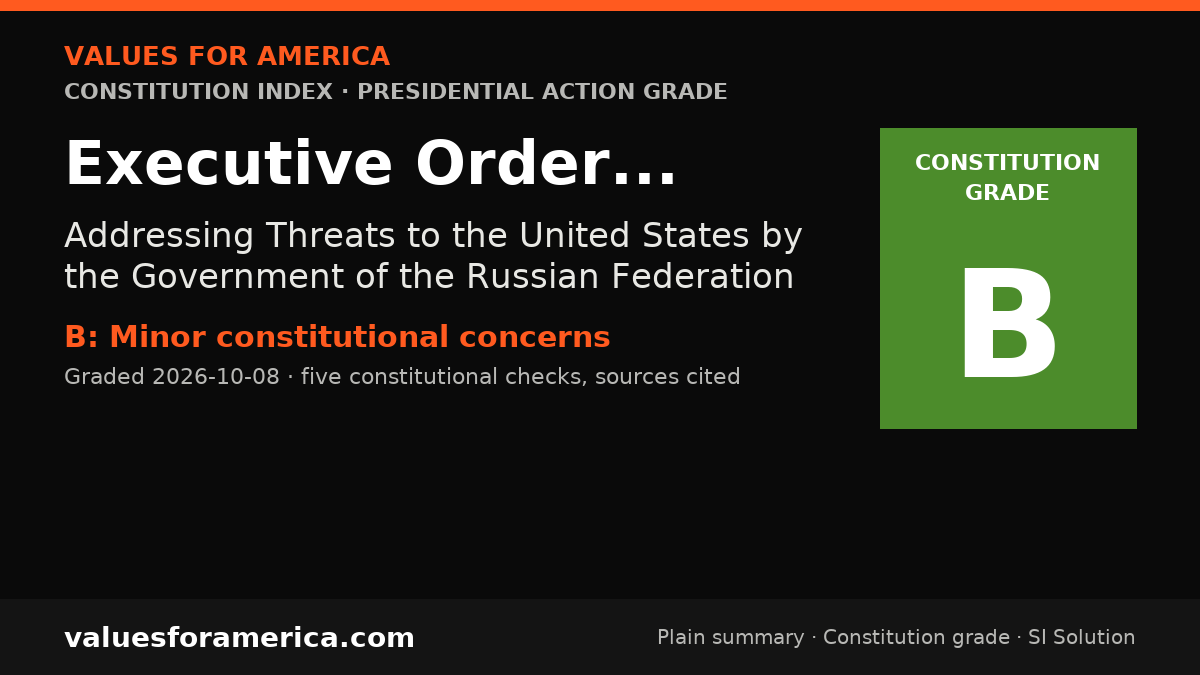
Addressing Threats to the United States by the Government of the Russian Federation
Signed: 2025-08-06 Published: 2025-08-11 Federal Register document: 2025-15267
Agencies: Executive Office of the President
Federal Register notes (as of 2026-10-19): See: EO 14024, April 15, 2021; EO 14066, March 8, 2022; EO 14257, April 2, 2025; Proc. 10976, September 29, 2025; EO 14389, February 20, 2026; Notice of March 24, 2026 (91 FR 15515)
What Executive Order 14329 says
Federal Register, Volume 90 Issue 152 (Monday, August 11, 2025) [Federal Register Volume 90, Number 152 (Monday, August 11, 2025)] [Presidential Documents] [Pages 38701-38704] From the Federal Register Online via the Government Publishing Office [www.gpo.gov] [FR Doc No: 2025-15267] [[Page 38699]] Vol. 90 Monday, No. 152 August 11, 2025 Part II The President ----------------------------------------------------------------------- Executive Order 14329--Addressing Threats to the United States by the Government of the Russian Federation Presidential Documents Federal Register / Vol. 90 , No. 152 / Monday, August 11, 2025 / Presidential Documents ___________________________________________________________________ Title 3-- The President [[Page 38701]] Executive Order 14329 of August 6, 2025 Addressing Threats to the United States by the Government of the Russian Federation By the authority vested in me as President by the Constitution and the laws of the United States of America, including the International Emergency Economic Powers Act (50 U.S.C. 1701 et seq.) (IEEPA), the National Emergencies Act (50 U.S.C. 1601 et seq.), section 604 of the Trade Act of 1974, as amended (19 U.S.C. 2483), and section 301 of title 3, United States Code, I hereby determine and order: Section 1. Background. Executive Order 14066 of March 8, 2022 (Prohibiting Certain Imports and New Investments With...
Opening of the official text; read it in full in the Federal Register.
Constitution Index
“VFA Constitution grade”
Minor constitutional concerns
Graded 2026-10-08
SI-generated grade · five published checks · not individually reviewed by a person · methodology
EO 14329 imposes a prospective 25 percent duty on Indian goods because India buys Russian oil, using congressionally delegated emergency and tariff authority to address a declared foreign threat. The action sits within federal foreign-commerce and executive power, infringes no Bill of Rights protection, respects prospective notice, and operates at the only level that can conduct foreign policy. Broad modification and monitoring discretion using senior-official findings creates minor delegation tension, so the Order is mostly sound rather than perfect.
-
✓ Passes · Enumerated powers
The President claims authority delegated by Congress through IEEPA at 50 U.S.C. 1701 et seq., the National Emergencies Act at 50 U.S.C. 1601 et seq., 19 U.S.C. 2483, and 3 U.S.C. 301. Regulation of foreign commerce and duties rests with Congress under Article I, Section 8, Clause 1 for duties and imposts and Clause 3 for commerce with foreign nations, aided by Clause 18 for necessary and proper le… -
✓ Passes · Bill of Rights
No First through Tenth Amendment right is infringed. The Order does not regulate speech, religion, press, assembly, or petition under the First Amendment; does not regulate arms under the Second Amendment; does not authorize searches, seizures, or surveillance under the Fourth Amendment; does not compel testimony under the Fifth Amendment; and imposes no criminal punishment implicating the Sixth, … -
✓ Passes · Individual sovereignty
The Order burdens importers and indirectly purchasers through a 25 percent additional duty on articles of India, which touches use of property and labor. The burden is justified under constitutional foreign-commerce and national-security authority rather than paternalistic control of person, speech, belief, or domestic labor. It does not prohibit Americans from speaking, worshiping, traveling, or … -
✓ Passes · Decentralization
Foreign commerce, tariffs, sanctions, and response to a foreign-government threat cannot be handled by individuals, families, localities, or states acting alone without fragmenting foreign policy. Article I, Section 8, Clauses 1 and 3 and Article II, Sections 2-3 place this subject at the federal level. The Order therefore operates at the minimum necessary level and does not consolidate upward bey… -
✓ Passes · Due process and takings
Procedural due process under the Fifth Amendment is satisfied: the Order is published, prospective, sets a delayed effective date 21 days after signature, preserves in-transit goods, lists statutory exceptions under 50 U.S.C. 1702(b), coordinates with existing section 232 actions and Annex II exceptions, and addresses foreign-trade-zone status. Substantive action is non-arbitrary, tied to stated f…
Report an error in this grade
What should happen instead
“VFA SI Solution”
No Solution yet
A sourced, Constitution-cited alternative appears here once one passes the SI Editorial Standard.

For journalists and bloggers
“Embed this grade”
Free to use with the link back. The badge and card update when the grade changes. Embed terms →
