Executive Order 14323 explained · Executive Order · No disposition noted
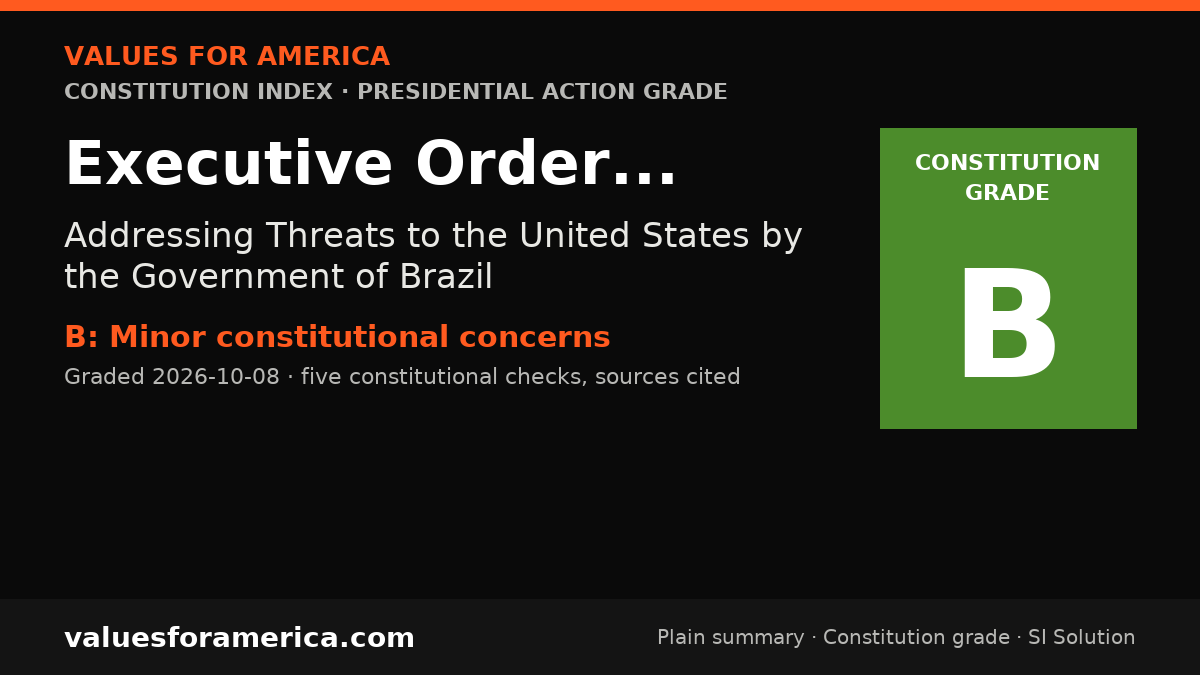
Addressing Threats to the United States by the Government of Brazil
Signed: 2025-07-30 Published: 2025-08-05 Federal Register document: 2025-14896
Agencies: Executive Office of the President
Federal Register notes (as of 2026-10-19): See: EO 14257 of April 2, 2025; Proc. 10976, September 29, 2025; EO 14361, November 20, 2025; EO 14389, February 20, 2026; Notice of July 28, 2026 (91 FR 47929)
What Executive Order 14323 says
Federal Register, Volume 90 Issue 148 (Tuesday, August 5, 2025) [Federal Register Volume 90, Number 148 (Tuesday, August 5, 2025)] [Presidential Documents] [Pages 37739-37773] From the Federal Register Online via the Government Publishing Office [www.gpo.gov] [FR Doc No: 2025-14896] Presidential Documents Federal Register / Vol. 90 , No. 148 / Tuesday, August 5, 2025 / Presidential Documents [[Page 37739]] Executive Order 14323 of July 30, 2025 Addressing Threats to the United States by the Government of Brazil By the authority vested in me as President by the Constitution and the laws of the United States of America, including the International Emergency Economic Powers Act (50 U.S.C. 1701 et seq.) (IEEPA), the National Emergencies Act (50 U.S.C. 1601 et seq.) (NEA), section 604 of the Trade Act of 1974, as amended (19 U.S.C. 2483), and section 301 of title 3, United States Code, I hereby order: Section 1. National Emergency. As President of the United States, my highest duty is protecting the national security, foreign policy, and economy of this country. Recent policies, practices, and actions of the Government of Brazil threaten the national security, foreign policy, and economy of the United States. Members of the Government of Brazil have taken actions that interfere with the economy of the United States, infringe the free expression rights of United States persons...
Opening of the official text; read it in full in the Federal Register.
Constitution Index
“VFA Constitution grade”
Minor constitutional concerns
Graded 2026-10-08
SI-generated grade · five published checks · not individually reviewed by a person · methodology
Federal border and foreign-policy response with a cited statutory basis that protects rather than restricts domestic expression; minor tension only from broad emergency-duty delegation and incidental consumer cost. No direct rights violation found by this SI review.
-
✓ Passes · Enumerated powers
Tariff and foreign-commerce authority belongs to Congress under Article I, Section 8, Clause 1 and Clause 3, while the President holds executive and foreign-relations power under Article II, Sections 1-3. Here the President cites statutes passed under those clauses: IEEPA, NEA, and 19 U.S.C. 2483, tied to a declared foreign-source threat. The scope is bounded to that emergency. A concern remains t… -
✓ Passes · Bill of Rights
Order imposes added duties on imports, it does not punish speech, restrict press or assembly, authorize searches, or compel testimony. Stated purpose is to counter foreign orders censoring protected expression of persons in the United States, which aligns with First Amendment values. No quartering, trial, jury, or punishment provision is implicated under Amendments 1-8, and no reserved right under… -
✓ Passes · Individual sovereignty
Duties raise the cost of buying certain Brazil-origin goods, which burdens consumer and business choice, but they do not prohibit speech, belief, labor, travel, or ownership, nor seize funds or products. The burden is justified as protecting the speech and economic liberty of persons in the United States from foreign compelled censorship and data demands, with the cost applied at the border rather… -
✓ Passes · Decentralization
Response to foreign-government coercion of interstate and foreign commerce, plus protection of citizens abroad, is inherently national. Individuals, counties, and states cannot impose duties, conduct diplomacy, or answer extraterritorial censorship demands. Action stays at the federal level where Article I, Section 8, Clause 3 and Article II, Section 2, Clause 2 place foreign commerce and foreign … -
✓ Passes · Due process and takings
Added ad valorem duties are a prospective regulation of import transactions with notice through Federal Register publication, not a retroactive penalty or seizure. Importers retain notice and access to customs procedures and judicial review, satisfying procedural due process under the Fifth Amendment. No specific parcel of private property is taken for public use, so no just-compensation duty aris…
Report an error in this grade
What should happen instead
“VFA SI Solution”
No Solution yet
A sourced, Constitution-cited alternative appears here once one passes the SI Editorial Standard.

For journalists and bloggers
“Embed this grade”
Free to use with the link back. The badge and card update when the grade changes. Embed terms →
