Executive Order 14317 explained · Executive Order · No disposition noted
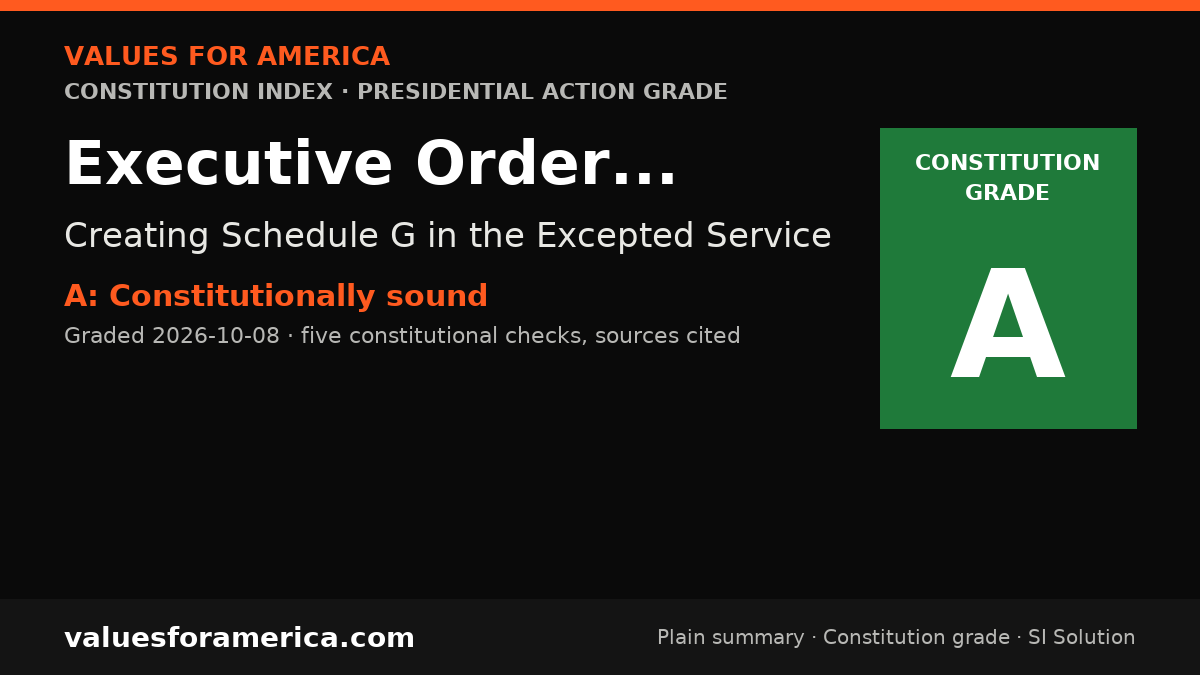
Creating Schedule G in the Excepted Service
Signed: 2025-07-17 Published: 2025-07-23 Federal Register document: 2025-13925
Agencies: Executive Office of the President
What Executive Order 14317 says
Federal Register, Volume 90 Issue 139 (Wednesday, July 23, 2025) [Federal Register Volume 90, Number 139 (Wednesday, July 23, 2025)] [Presidential Documents] [Pages 34753-34755] From the Federal Register Online via the Government Publishing Office [www.gpo.gov] [FR Doc No: 2025-13925] Presidential Documents Federal Register / Vol. 90, No. 139 / Wednesday, July 23, 2025 / Presidential Documents [[Page 34753]] Executive Order 14317 of July 17, 2025 Creating Schedule G in the Excepted Service By the authority vested in me as President by the Constitution and the laws of the United States of America, including sections 3301, 3302, and 7511 of title 5, United States Code, it is hereby ordered: Section 1. Purpose. The Congress has recognized that effective Government administration requires excepting some positions from the competitive service based on their confidential, policy-determining, policy-making, or policy-advocating character. Existing excepted service schedules make partial use of this authority. Schedule C of the excepted service authorizes appointments to noncareer excepted service positions of a confidential or policy-determining character. Schedule Policy/Career of the excepted service authorizes appointments to career positions of a confidential, policy-determining, policy-making, or policy-advocating character. There is, however, no excepted service schedule for...
Opening of the official text; read it in full in the Federal Register.
Constitution Index
“VFA Constitution grade”
Constitutionally sound
Graded 2026-10-08
SI-generated grade · five published checks · not individually reviewed by a person · methodology
Executive Order 14317 is a routine Article II personnel administration action authorized by 5 U.S.C. 3301-3302. It creates Schedule G for noncareer federal policy-making roles, prohibits political-affiliation discrimination, takes no property, infringes no Bill of Rights protection, and consolidates no lower-level power.
-
✓ Passes · Enumerated powers
The President acts within Article II, Section 1 vesting of executive power and Article II, Section 3 duty to take care that the laws be faithfully executed, plus express statutory delegation in 5 U.S.C. sections 3301, 3302, and 7511 cited in the order. Congress authorized the President to except positions of a confidential or policy-determining character from the competitive service. Creating Sche… -
✓ Passes · Bill of Rights
No First through Tenth Amendment right is infringed. The order creates noncareer policy-making positions and Section 5(b)(ii) expressly prohibits considering political affiliation or political activity, which protects First Amendment speech, belief, and association. It authorizes no search, seizure, quartering, compelled testimony, trial procedure change, or arms restriction. Citing First Amendmen… -
✓ Passes · Individual sovereignty
The order restricts no private person in their person, property, speech, labor, or belief. It governs only federal employment status for federal policy-making positions. Section 5(b) affirmatively protects individual sovereignty by barring consideration of political affiliation or activity while permitting consideration of suitability to carry out the President's policies, which the government has… -
✓ Passes · Decentralization
Federal civilian personnel classification cannot be handled by individuals, families, localities, or states. Under Article I, Section 8, Clause 18 and Article II, Sections 1 and 3, staffing the federal executive is inherently a federal function. Schedule G does not consolidate state or local authority upward; it organizes existing federal noncareer positions, leaving Tenth Amendment reserved power… -
✓ Passes · Due process and takings
No taking of private property under the Fifth Amendment Takings Clause. No deprivation of life, liberty, or property without Fifth Amendment procedural due process: noncareer excepted-service appointees have no vested property interest in continued federal employment, and at-will status for confidential and policy roles is long-accepted. Section 6(b)-(c) requires implementation consistent with app…
Report an error in this grade
What should happen instead
“VFA SI Solution”
No Solution yet
A sourced, Constitution-cited alternative appears here once one passes the SI Editorial Standard.

For journalists and bloggers
“Embed this grade”
Free to use with the link back. The badge and card update when the grade changes. Embed terms →
