Executive Order 14316 explained · Executive Order · No disposition noted
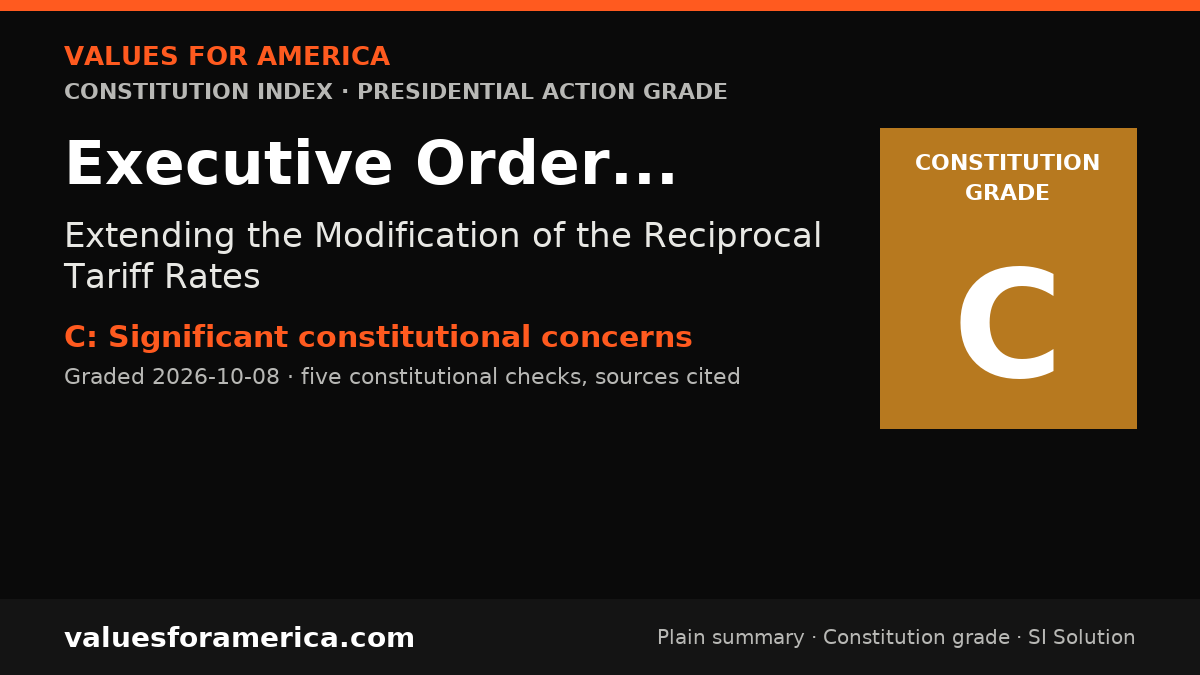
Extending the Modification of the Reciprocal Tariff Rates
Signed: 2025-07-07 Published: 2025-07-10 Federal Register document: 2025-12962
Agencies: Executive Office of the President
Federal Register notes (as of 2026-10-19): See: EO 14257, April 2, 2025; EO 14266, April 9, 2025; EO 14298, May 12, 2025; Notice of March 24, 2026 (91 FR 15517)
What Executive Order 14316 says
Federal Register, Volume 90 Issue 130 (Thursday, July 10, 2025) [Federal Register Volume 90, Number 130 (Thursday, July 10, 2025)] [Presidential Documents] [Pages 30823-30824] From the Federal Register Online via the Government Publishing Office [www.gpo.gov] [FR Doc No: 2025-12962] Presidential Documents Federal Register / Vol. 90 , No. 130 / Thursday, July 10, 2025 / Presidential Documents [[Page 30823]] Executive Order 14316 of July 7, 2025 Extending the Modification of the Reciprocal Tariff Rates By the authority vested in me as President by the Constitution and the laws of the United States of America, including the International Emergency Economic Powers Act (50 U.S.C. 1701 et seq.) (IEEPA), the National Emergencies Act (50 U.S.C. 1601 et seq.), section 604 of the Trade Act of 1974, as amended (19 U.S.C. 2483), and section 301 of title 3, United States Code, I hereby determine and order: Section 1. Background. In Executive Order 14257 of April 2, 2025 (Regulating Imports With a Reciprocal Tariff To Rectify Trade Practices That Contribute to Large and Persistent Annual United States Goods Trade Deficits), I found that conditions reflected in large and persistent annual U.S. goods trade deficits constitute an unusual and extraordinary threat to the national security and economy of the United States that has its source in whole or substantial part outside the United States....
Opening of the official text; read it in full in the Federal Register.
Constitution Index
“VFA Constitution grade”
Significant constitutional concerns
Graded 2026-10-08
SI-generated grade · five published checks · not individually reviewed by a person · methodology
EO 14316 temporarily extends a tariff suspension, reducing immediate harm, but it perpetuates a constitutionally defective structure where the executive sets and revises import duties that Article I, Section 8, Clauses 1 and 3 reserve to Congress. No direct Bill of Rights violation or taking occurs, yet federal executive consolidation of the taxing and foreign-commerce power requires congressional reauthorization with clear limits.
-
✗ Concern · Enumerated powers
Article I, Section 8, Clauses 1 and 3 vest power to lay and collect Duties and to regulate Commerce with foreign Nations in Congress, while Article I, Section 1 vests all legislative Powers in Congress. The President claims authority under International Emergency Economic Powers Act, National Emergencies Act, and 19 U.S.C. 2483 to extend and modify reciprocal tariff rates on trade-deficit grounds.… -
✓ Passes · Bill of Rights
No provision of EO 14316 directly abridges speech, religion, press, assembly, arms, quartering, search and seizure, self-incrimination, jury trial, or cruel punishment. Tariffs burden import transactions but do not on their face censor expression under First Amendment or prohibit arms under Second Amendment, nor authorize searches under Fourth Amendment. -
✗ Concern · Individual sovereignty
Tariffs restrict liberty of contract, use of property, and labor by raising the cost of importing, selling, and buying foreign goods. The burden is on government to show compelling constitutional justification. Here the justification offered is large trade deficits and recommendations from senior officials, with Section 2 continuing duties by suspending higher headings until August 1, 2025. Becaus… -
✗ Concern · Decentralization
Foreign commerce and uniform duties cannot be handled by individuals, localities, or single states without fragmenting national trade policy. However, the order consolidates decision-making upward within the federal executive by suspending, amending, and setting Harmonized Tariff Schedule headings by presidential directive under Tenth Amendment federalism and separation-of-powers concerns, bypassi… -
✓ Passes · Due process and takings
Under Fifth Amendment Due Process and Takings Clauses, this extension does not itself seize property, impose criminal penalty without presumption of innocence, or deny notice and hearing. It was published in the Federal Register with stated effective dates, legal basis, and implementation through normal customs entry, and expressly states implementation consistent with applicable law. Importers fa…
Report an error in this grade
What should happen instead
“VFA SI Solution”
No Solution yet
A sourced, Constitution-cited alternative appears here once one passes the SI Editorial Standard.

For journalists and bloggers
“Embed this grade”
Free to use with the link back. The badge and card update when the grade changes. Embed terms →
