Executive Order 14311 explained · Executive Order · No disposition noted
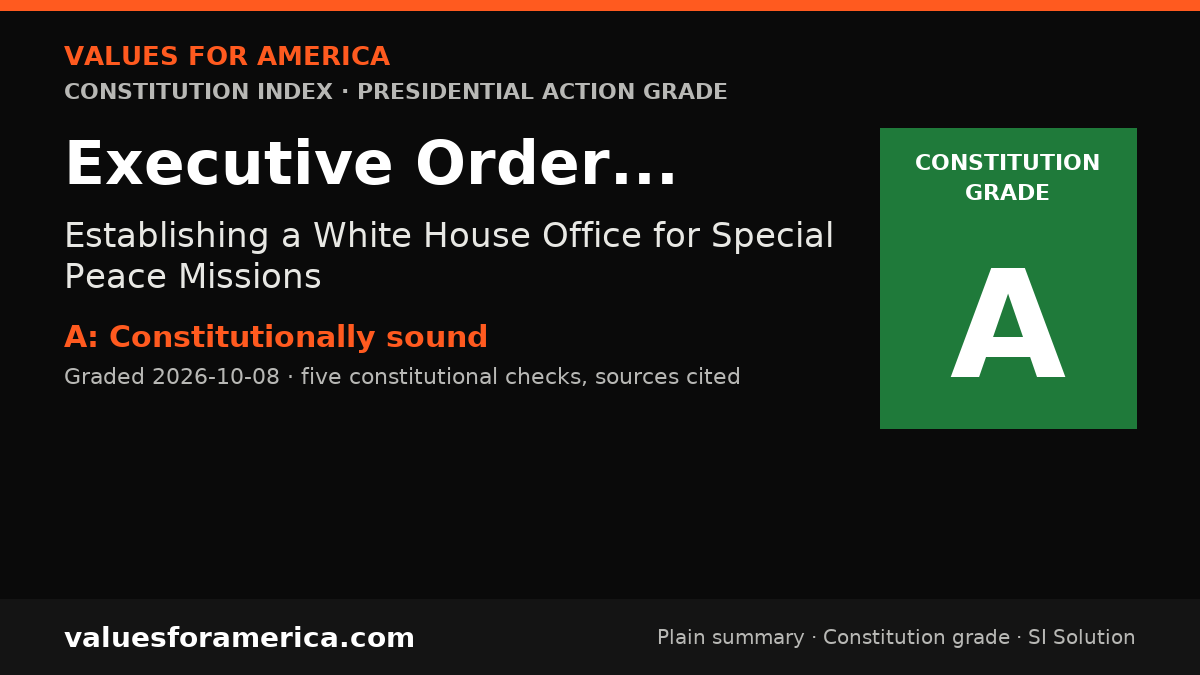
Establishing a White House Office for Special Peace Missions
Signed: 2025-06-30 Published: 2025-07-03 Federal Register document: 2025-12505
Agencies: Executive Office of the President
What Executive Order 14311 says
Federal Register, Volume 90 Issue 126 (Thursday, July 3, 2025) [Federal Register Volume 90, Number 126 (Thursday, July 3, 2025)] [Presidential Documents] [Page 29393] From the Federal Register Online via the Government Publishing Office [www.gpo.gov] [FR Doc No: 2025-12505] Presidential Documents Federal Register / Vol. 90, No. 126 / Thursday, July 3, 2025 / Presidential Documents ___________________________________________________________________ Title 3-- The President [[Page 29393]] Executive Order 14311 of June 30, 2025 Establishing a White House Office for Special Peace Missions By the authority vested in me as President by the Constitution and the laws of the United States of America, it is hereby ordered: Section 1. White House Office for Special Peace Missions. In order to assist in bringing about the end of conflict and strife around the world, the Office for Special Peace Missions is hereby established within the White House Office. The Office for Special Peace Missions shall be headed by a Special Envoy for Peace Missions, who shall be appointed by the President. The Special Envoy for Peace Missions shall advance efforts aimed at ending ongoing conflicts abroad, and shall work towards these ends in coordination with the Department of State, the Department of Defense, and all other relevant executive departments and agencies. Sec. 2. General Provisions. (a) Nothing...
Opening of the official text; read it in full in the Federal Register.
Constitution Index
“VFA Constitution grade”
Constitutionally sound
Graded 2026-10-08
SI-generated grade · five published checks · not individually reviewed by a person · methodology
Executive Order 14311 creates an internal White House advisory and coordination office for foreign peace efforts under the President's Article II authority. It regulates no private conduct, infringes no rights, takes no property, and properly operates at the federal level for foreign affairs. Constitutional on all five checks.
-
✓ Passes · Enumerated powers
The President acts under Article II, Section 1 vesting of executive power and Article II, Section 2, Clause 1 as Commander in Chief and maker of treaties with Senate advice, plus Article II, Section 2, Clause 2 appointment power for the Special Envoy. Creating a White House advisory office to coordinate executive departments on ending foreign conflicts is a core executive foreign-affairs function,… -
✓ Passes · Bill of Rights
The Order creates only an advisory coordination office inside the White House and claims no power over speech, religion, press, arms, searches, trials, or other rights under Amendments 1-10. Section 2(c) expressly disclaims creation of any enforceable right or duty against private parties. No First Amendment or Fourth Amendment interest is implicated. -
✓ Passes · Individual sovereignty
The Order imposes no restriction on any person's body, property, speech, labor, or belief. It directs only internal executive-branch coordination. The government therefore bears no burden to justify a restriction because none exists, consistent with the Ninth Amendment and liberty protected by the Fifth Amendment. -
✓ Passes · Decentralization
Foreign peace missions and coordination with the Department of State and Department of Defense are inherently national functions that individuals, counties, and single states cannot conduct. Under the Tenth Amendment, foreign affairs are reserved to the federal level, so housing this coordination in the White House does not consolidate upward beyond the minimum necessary level. -
✓ Passes · Due process and takings
The Order authorizes no arrest, seizure, hearing deprivation, or property taking. It provides no penalty, forfeiture, or regulation of private property under the Fifth Amendment Due Process and Takings Clauses. Section 2(b) requires implementation consistent with applicable law and subject to appropriations.
Report an error in this grade
What should happen instead
“VFA SI Solution”
No Solution yet
A sourced, Constitution-cited alternative appears here once one passes the SI Editorial Standard.

For journalists and bloggers
“Embed this grade”
Free to use with the link back. The badge and card update when the grade changes. Embed terms →
