Executive Order 14298 explained · Executive Order · No disposition noted
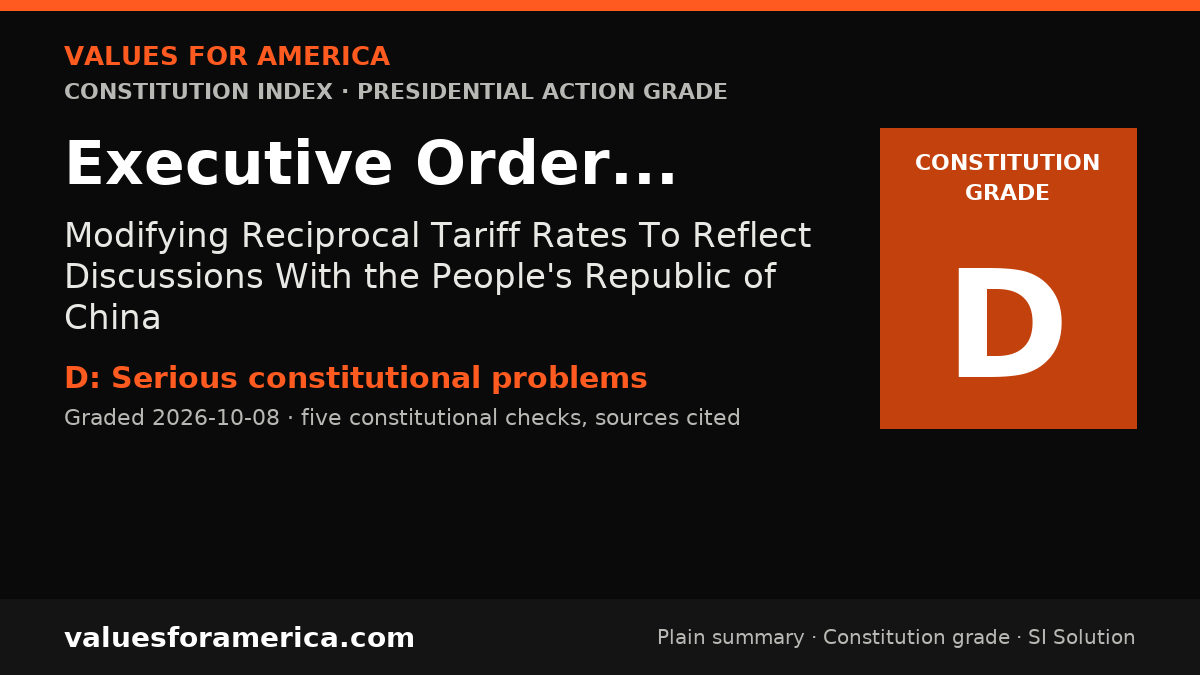
Modifying Reciprocal Tariff Rates To Reflect Discussions With the People's Republic of China
Signed: 2025-05-12 Published: 2025-05-21 Federal Register document: 2025-09297
Agencies: Executive Office of the President
Federal Register notes (as of 2026-10-19): See: EO 14257, April 2, 2025; EO 14259, April 8, 2025; EO 14266, April 9, 2025; Memo. of April 11, 2025; EO 14316, July 7, 2025; EO 14326, July 31, 2025; EO 14334, August 11, 2025
What Executive Order 14298 says
Federal Register, Volume 90 Issue 97 (Wednesday, May 21, 2025) [Federal Register Volume 90, Number 97 (Wednesday, May 21, 2025)] [Presidential Documents] [Pages 21831-21834] From the Federal Register Online via the Government Publishing Office [www.gpo.gov] [FR Doc No: 2025-09297] [[Page 21829]] Vol. 90 Wednesday, No. 97 May 21, 2025 Part II The President ----------------------------------------------------------------------- Executive Order 14298--Modifying Reciprocal Tariff Rates To Reflect Discussions With the People's Republic of China Presidential Documents Federal Register / Vol. 90 , No. 97 / Wednesday, May 21, 2025 / Presidential Documents ___________________________________________________________________ Title 3-- The President [[Page 21831]] Executive Order 14298 of May 12, 2025 Modifying Reciprocal Tariff Rates To Reflect Discussions With the People's Republic of China By the authority vested in me as President by the Constitution and the laws of the United States of America, including the International Emergency Economic Powers Act (50 U.S.C. 1701 et seq.) (IEEPA), the National Emergencies Act (50 U.S.C. 1601 et seq.), section 604 of the Trade Act of 1974, as amended (19 U.S.C. 2483), and section 301 of title 3, United States Code, I hereby determine and order: Section 1. Background. In Executive Order 14257 of April 2, 2025 (Regulating Imports With a Reciprocal...
Opening of the official text; read it in full in the Federal Register.
Constitution Index
“VFA Constitution grade”
Serious constitutional problems
Graded 2026-10-08
SI-generated grade · five published checks · not individually reviewed by a person · methodology
This executive tariff order reduces rates but continues an executive-imposed reciprocal tariff regime. Congress holds the tariff and foreign-commerce powers, and persistent deficits do not establish an emergency permitting the President to set general duties. That separation-of-powers overstep, combined with broad burdens on private import and contract liberty without individualized process, makes the action likely unconstitutional in its mechanism even though lower rates lessen harm.
-
✗ Concern · Enumerated powers
The power to lay and collect imposts and duties belongs to Congress under Article I, Section 8, Clause 1, and regulation of commerce with foreign nations belongs to Congress under Article I, Section 8, Clause 3. Revenue measures must originate in the House under Article I, Section 7, Clause 1. The President may execute laws under Article II, Section 1 and Section 3, but has no enumerated power to … -
✗ Concern · Bill of Rights
The order does not directly censor speech, press, religion or assembly, and does not authorize searches or quartering. It does implicate the Fifth Amendment due process and the Tenth Amendment reservation of powers, and property interests in imports are burdened by executive duty changes without individualized hearing. No First, Second, Fourth, Sixth, Seventh or Eighth Amendment violation is shown… -
✗ Concern · Individual sovereignty
The order restricts what persons may do with their own property, labor, and contracts by adding a 10 percent additional duty, retaining a 34 percent rate structure, and resetting low-value postal-item duties from 120 percent to 54 percent, raising the cost of buying, selling, and importing lawful goods from China, Hong Kong, and Macau. The Fifth Amendment liberty and property interest and the Nint… -
✗ Concern · Decentralization
Foreign commerce and customs duties are inherently national and cannot be handled by an individual, family, county, or single state without fragmenting one national tariff schedule. Article I, Section 8, Clause 1 and Clause 3 assign imposts and foreign commerce to Congress. The order therefore does not violate the Tenth Amendment by federalizing a local matter. It does consolidate decision-making … -
✗ Concern · Due process and takings
The Fifth Amendment requires due process of law before deprivation of property and just compensation for takings. A tariff is a lawful impost, not a per se taking, and the order gives general prospective notice through the Federal Register with a May 14, 2025 effective date. It provides no individualized notice, hearing, or judicial review before increased duties attach to specific goods in transi…
Report an error in this grade
What should happen instead
“VFA SI Solution”
No Solution yet
A sourced, Constitution-cited alternative appears here once one passes the SI Editorial Standard.

For journalists and bloggers
“Embed this grade”
Free to use with the link back. The badge and card update when the grade changes. Embed terms →
