Executive Order 14290 explained · Executive Order · No disposition noted
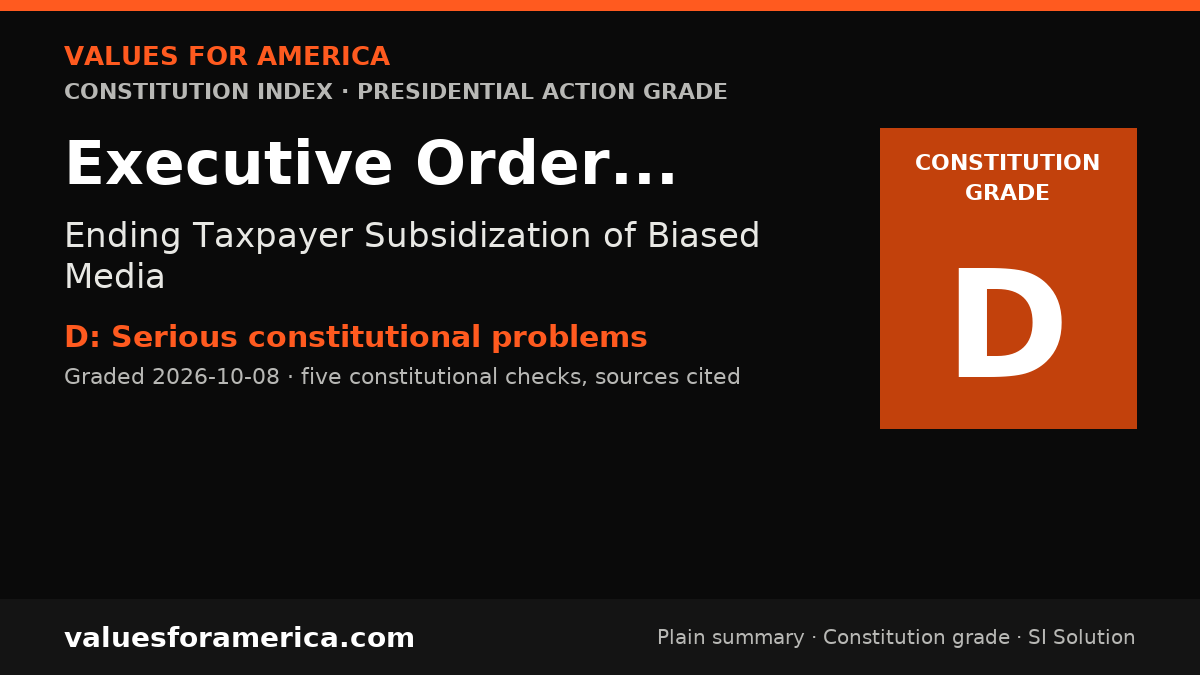
Ending Taxpayer Subsidization of Biased Media
Signed: 2025-05-01 Published: 2025-05-07 Federal Register document: 2025-08133
Agencies: Executive Office of the President
What Executive Order 14290 says
Federal Register, Volume 90 Issue 87 (Wednesday, May 7, 2025) [Federal Register Volume 90, Number 87 (Wednesday, May 7, 2025)] [Presidential Documents] [Pages 19415-19416] From the Federal Register Online via the Government Publishing Office [www.gpo.gov] [FR Doc No: 2025-08133] Presidential Documents Federal Register / Vol. 90, No. 87 / Wednesday, May 7, 2025 / Presidential Documents [[Page 19415]] Executive Order 14290 of May 1, 2025 Ending Taxpayer Subsidization of Biased Media By the authority vested in me as President by the Constitution and the laws of the United States of America, it is hereby ordered: Section 1. Purpose. National Public Radio (NPR) and the Public Broadcasting Service (PBS) receive taxpayer funds through the Corporation for Public Broadcasting (CPB). Unlike in 1967, when the CPB was established, today the media landscape is filled with abundant, diverse, and innovative news options. Government funding of news media in this environment is not only outdated and unnecessary but corrosive to the appearance of journalistic independence. At the very least, Americans have the right to expect that if their tax dollars fund public broadcasting at all, they fund only fair, accurate, unbiased, and nonpartisan news coverage. No media outlet has a constitutional right to taxpayer subsidies, and the Government is entitled to determine which categories of activities...
Opening of the official text; read it in full in the Federal Register.
Constitution Index
“VFA Constitution grade”
Serious constitutional problems
Graded 2026-10-08
SI-generated grade · five published checks · not individually reviewed by a person · methodology
Order removes federal subsidy rather than banning speech, so individual liberty and decentralization pass, and it preserves legal compliance procedures for due process. It fails on two structural grounds: the President claims power to zero-out congressionally appropriated public-broadcasting funds, violating separation of powers and the Appropriations Clause, and it targets named press entities for alleged bias, creating significant First Amendment viewpoint-discrimination risk that requires a neutral, Congress-led rewrite. Analysis prepared with superintelligence-assisted review (SI).
-
✗ Concern · Enumerated powers
Article II vests the President with executive power and the duty to faithfully execute the laws, but Article I, Section 8, Clauses 1-2 and Article I, Section 9, Clause 7 vest the power of the purse, including appropriation of funds, in Congress. The Corporation for Public Broadcasting was created and funded by statute, 47 U.S.C. 396-398. The President may direct agencies in their discretionary spe… -
✗ Concern · Bill of Rights
First Amendment prohibits government abridgment of freedom of speech and of the press, and prohibits viewpoint discrimination even in discretionary subsidies. The order directs termination of all direct and indirect funding to two named news organizations expressly because the Executive finds their coverage 'biased and partisan' and not 'fair, accurate, or unbiased.' Conditioning continued access … -
✓ Passes · Individual sovereignty
The order does not directly prohibit any person from speaking, publishing, listening, donating to NPR or PBS, or operating a station. It restricts only the use of federal taxpayer funds, which is not a personal liberty, private property, labor, or belief of the individual citizen. No compelled speech, religious exercise burden, or restriction on private association is imposed. Any burden on listen… -
✓ Passes · Decentralization
The Tenth Amendment reserves powers not delegated to the United States to the States and people. Ending a federal subsidy for national news production moves decision-making downward: states, local licensees, and private listeners can fund, produce, and consume news without federal involvement. The order does not create a new federal regulatory program and does not commandeer state governments. It … -
✓ Passes · Due process and takings
The Fifth Amendment requires due process before deprivation of liberty or property and just compensation for takings. The order states it will be implemented 'consistent with applicable law and subject to availability of appropriations,' directs cancellation only 'to the maximum extent allowed by law,' and requires agencies to act 'under the terms of the instrument' after compliance review. It doe…
Report an error in this grade
What should happen instead
“VFA SI Solution”
No Solution yet
A sourced, Constitution-cited alternative appears here once one passes the SI Editorial Standard.

For journalists and bloggers
“Embed this grade”
Free to use with the link back. The badge and card update when the grade changes. Embed terms →
