Executive Order 14288 explained · Executive Order · No disposition noted
Strengthening and Unleashing America's Law Enforcement To Pursue Criminals and Protect Innocent Citizens
Signed: 2025-04-28 Published: 2025-05-02 Federal Register document: 2025-07790
Agencies: Executive Office of the President
Federal Register notes (as of 2026-10-19): See: EO 14159, January 20, 2025
What Executive Order 14288 says
Federal Register, Volume 90 Issue 84 (Friday, May 2, 2025) [Federal Register Volume 90, Number 84 (Friday, May 2, 2025)] [Presidential Documents] [Pages 18765-18767] From the Federal Register Online via the Government Publishing Office [www.gpo.gov] [FR Doc No: 2025-07790] Presidential Documents Federal Register / Vol. 90, No. 84 / Friday, May 2, 2025 / Presidential Documents [[Page 18765]] Executive Order 14288 of April 28, 2025 Strengthening and Unleashing America's Law Enforcement To Pursue Criminals and Protect Innocent Citizens By the authority vested in me as President by the Constitution and the laws of the United States of America, it is hereby ordered: Section 1. Purpose and Policy. Safe communities rely on the backbone and heroism of a tough and well-equipped police force. My Administration is steadfastly committed to empowering State and local law enforcement to firmly police dangerous criminal behavior and protect innocent citizens. When local leaders demonize law enforcement and impose legal and political handcuffs that make aggressively enforcing the law impossible, crime thrives and innocent citizens and small business owners suffer. My Administration will therefore: establish best practices at the State and local level for cities to unleash high-impact local police forces; protect and defend law enforcement officers wrongly accused and abused by State or local...
Opening of the official text; read it in full in the Federal Register.
Constitution Index
“VFA Constitution grade”
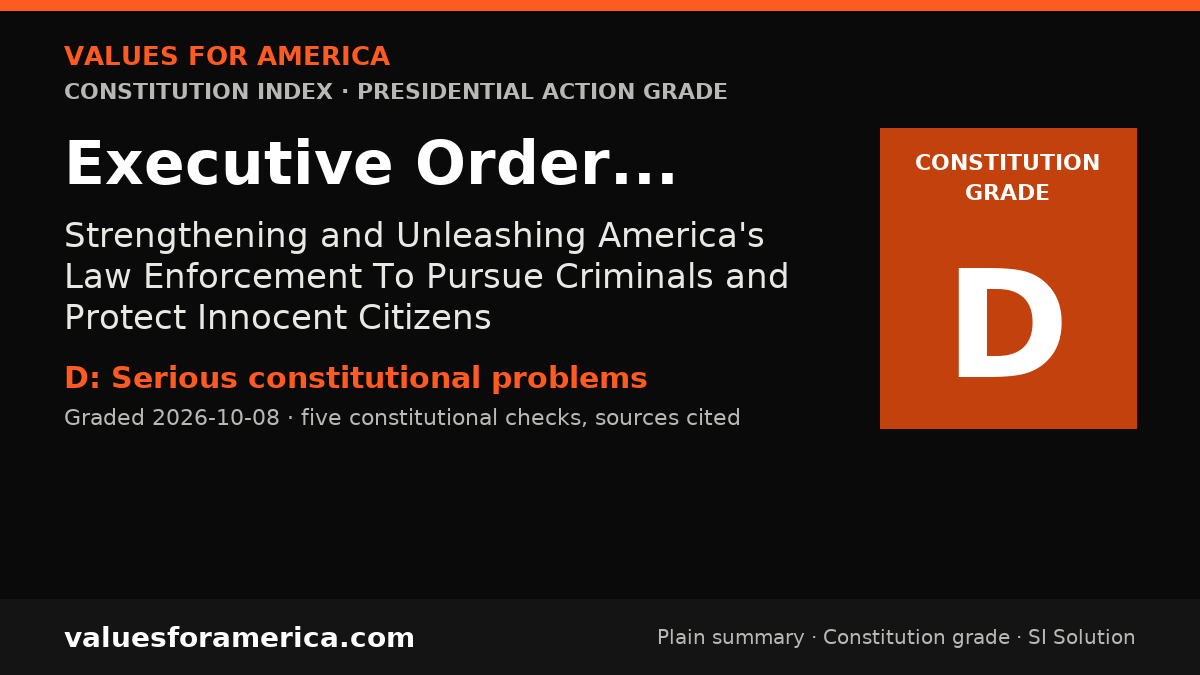
Serious constitutional problems
Graded 2026-10-08
SI-generated grade · five published checks · not individually reviewed by a person · methodology
Executive Order 14288 pursues legitimate public-safety goals but uses federal executive power to direct reserved state and local policing, expand military involvement in domestic law enforcement, and pressure state officials, exceeding enumerated presidential authority and centralizing control in violation of federalism and the Tenth Amendment, with added First and Fourth Amendment and liberty risks requiring structural narrowing.
-
✗ Concern · Enumerated powers
The President may supervise federal law enforcement under Article II, Sections 1 and 3, and Congress may support militia and armies under Article I, Section 8, Clauses 12-14. Those grants do not include general police power over state and local policing, which is reserved by the Tenth Amendment. Sections 3-5 direct best practices for aggressive local policing, review and termination of state and l… -
✗ Concern · Bill of Rights
No direct speech, arms, or trial-right ban, but Sections 4 and 6 create First and Fourth Amendment tension. Surplus military assets, non-lethal capabilities, expanded crime-data collection, and use of Homeland Security Task Forces for ordinary crime increase risk of unreasonable searches and seizures under the Fourth Amendment and chilling of assembly and petition under the First Amendment. Sectio… -
✗ Concern · Individual sovereignty
The Order does not criminalize private speech, belief, labor, or property ownership by its terms, but militarized domestic enforcement, expanded uniform crime-data collection, and federal pressure on local discretion restrict liberty of movement, privacy, and community self-governance without a compelling constitutional justification stated. Under the Fourth, Fifth, Ninth, and Tenth Amendments the… -
✗ Concern · Decentralization
Policing is the paradigmatic reserved police power under the Tenth Amendment. Local communities and states can and do set training, discipline, pay, consent-decree compliance, and enforcement priorities. Sections 3(a), 3(b), 4, and 5 consolidate standard-setting, oversight relief, equipment, and prosecutorial threat at the federal executive level. Individuals cannot handle violent crime alone, so … -
✓ Passes · Due process and takings
The Order does not on its face authorize warrantless arrest, punishment without trial, compelled testimony, or taking of property without just compensation. Section 2 indemnification, Section 3(a)(v) enhanced sentences, and Section 5 prosecutions must still proceed through courts under the Fifth Amendment Due Process Clauses and Fourteenth Amendment Section 1, and Article III. Risk is significant …
Report an error in this grade
What should happen instead
“VFA SI Solution”
No Solution yet
A sourced, Constitution-cited alternative appears here once one passes the SI Editorial Standard.

For journalists and bloggers
“Embed this grade”
Free to use with the link back. The badge and card update when the grade changes. Embed terms →
