Executive Order 14287 explained · Executive Order · No disposition noted
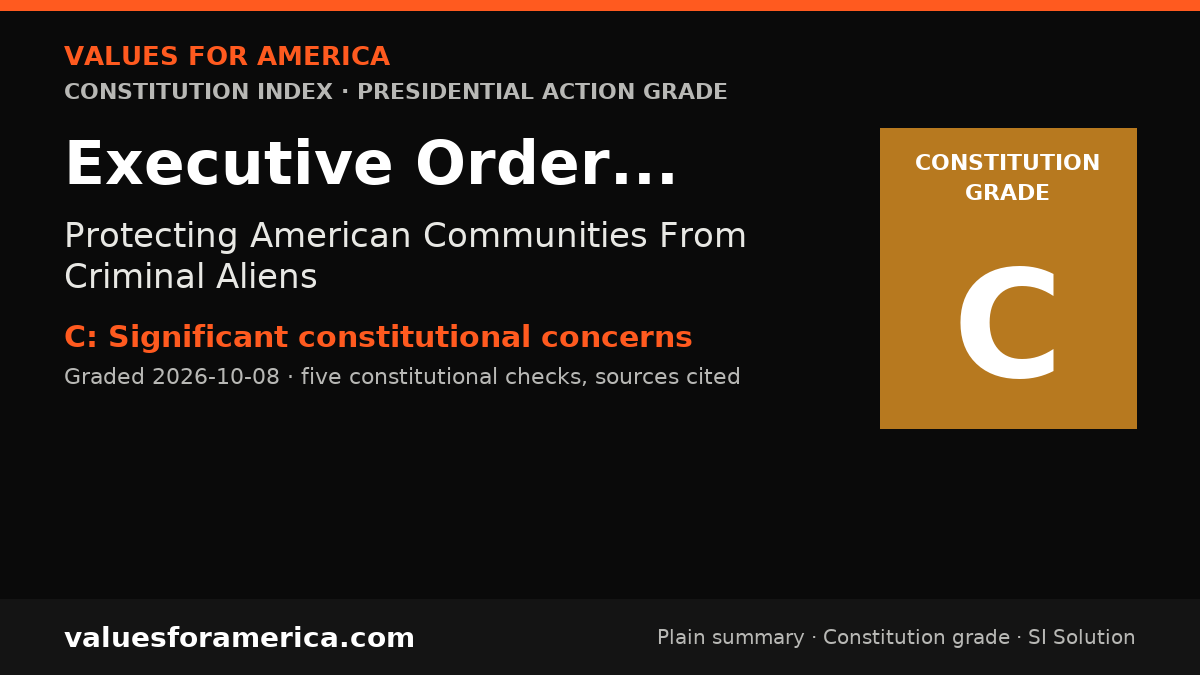
Protecting American Communities From Criminal Aliens
Signed: 2025-04-28 Published: 2025-05-02 Federal Register document: 2025-07789
Agencies: Executive Office of the President
What Executive Order 14287 says
Federal Register, Volume 90 Issue 84 (Friday, May 2, 2025) [Federal Register Volume 90, Number 84 (Friday, May 2, 2025)] [Presidential Documents] [Pages 18761-18763] From the Federal Register Online via the Government Publishing Office [www.gpo.gov] [FR Doc No: 2025-07789] Presidential Documents Federal Register / Vol. 90, No. 84 / Friday, May 2, 2025 / Presidential Documents [[Page 18761]] Executive Order 14287 of April 28, 2025 Protecting American Communities From Criminal Aliens By the authority vested in me as President by the Constitution and the laws of the United States of America, it is hereby ordered: Section 1. Purpose and Policy. Federal supremacy with respect to immigration, national security, and foreign policy is axiomatic. The Constitution provides the Federal Government with plenary authority regarding immigration to protect the sovereignty of our Nation and to conduct relations with other nations, who must be able to deal with one national Government on such matters. This power is sometimes contained in specific constitutional provisions: Article II of the Constitution vests the power to protect national security and conduct foreign policy in the President of the United States, and Article IV, Section 4, requires the Federal Government to ``protect each of [the States] against Invasion.'' This Federal power over immigration is also an inherent element of...
Opening of the official text; read it in full in the Federal Register.
Constitution Index
“VFA Constitution grade”
Significant constitutional concerns
Graded 2026-10-08
SI-generated grade · five published checks · not individually reviewed by a person · methodology
SI review finds federal immigration enforcement is an enumerated federal function, and the order may lawfully enforce federal law with federal resources. It loses constitutional soundness because the sanctuary designation plus open-ended funding suspension and enforcement threat press states to carry out federal policy, implicating Tenth Amendment anti-commandeering and Spending Clause limits, and because designation lacks defined standards and hearing before funds are cut, violating Fifth Amendment procedural due process. Narrow definitions, clear statutory funding nexus, and notice plus hearing would be required to raise the grade.
-
✓ Passes · Enumerated powers
The federal government has broad authority over immigration, naturalization, foreign relations, and national defense. Cited backbone: Article I, Section 8, Clause 4 gives Congress power over naturalization; Article I, Section 8, Clauses 10, 11, and 18 support foreign-affairs, offense and defense, and necessary and proper execution; Article II, Sections 1-3 vest executive power and the duty to take… -
✗ Concern · Bill of Rights
The order does not directly restrict speech, arms, searches, or criminal trial rights under Amendments 1-8. The risk is under the Tenth Amendment, which is part of the Bill of Rights: it reserves non-delegated powers to the states and people. Under Printz v. United States and New York v. United States, the federal government may enforce its own immigration law but may not commandeer state officers… -
✓ Passes · Individual sovereignty
The order is directed at state and local governments and at eligibility verification for federal public benefits, not at restricting the person, property, speech, labor, worship, or belief of citizens. It does not order searches without warrants under the Fourth Amendment, compel testimony under the Fifth Amendment, or punish speech or press under the First Amendment. Section 4 calls for eligibili… -
✗ Concern · Decentralization
Border control and removal of noncitizens cannot be handled by an individual or family, and cannot be handled fully by a single county, so questions 1 and 2 favor federal action. Policing, jails, release decisions, and provision of local services can be and routinely are handled at state and local level, so question 3 favors leaving that cooperation decision with the states. Section 2 creates a fe… -
✗ Concern · Due process and takings
Under the Fifth Amendment Due Process Clause, government may not deprive persons of liberty or property without fair notice and opportunity to be heard, and action must not be arbitrary. Section 2(a) directs designation of sanctuary jurisdictions within 30 days on the standard of obstructing enforcement, without defining obstruction, evidentiary standard, hearing, or review. Section 3(a) then dire…
Report an error in this grade
What should happen instead
“VFA SI Solution”
No Solution yet
A sourced, Constitution-cited alternative appears here once one passes the SI Editorial Standard.

For journalists and bloggers
“Embed this grade”
Free to use with the link back. The badge and card update when the grade changes. Embed terms →
