Executive Order 14281 explained · Executive Order · No disposition noted
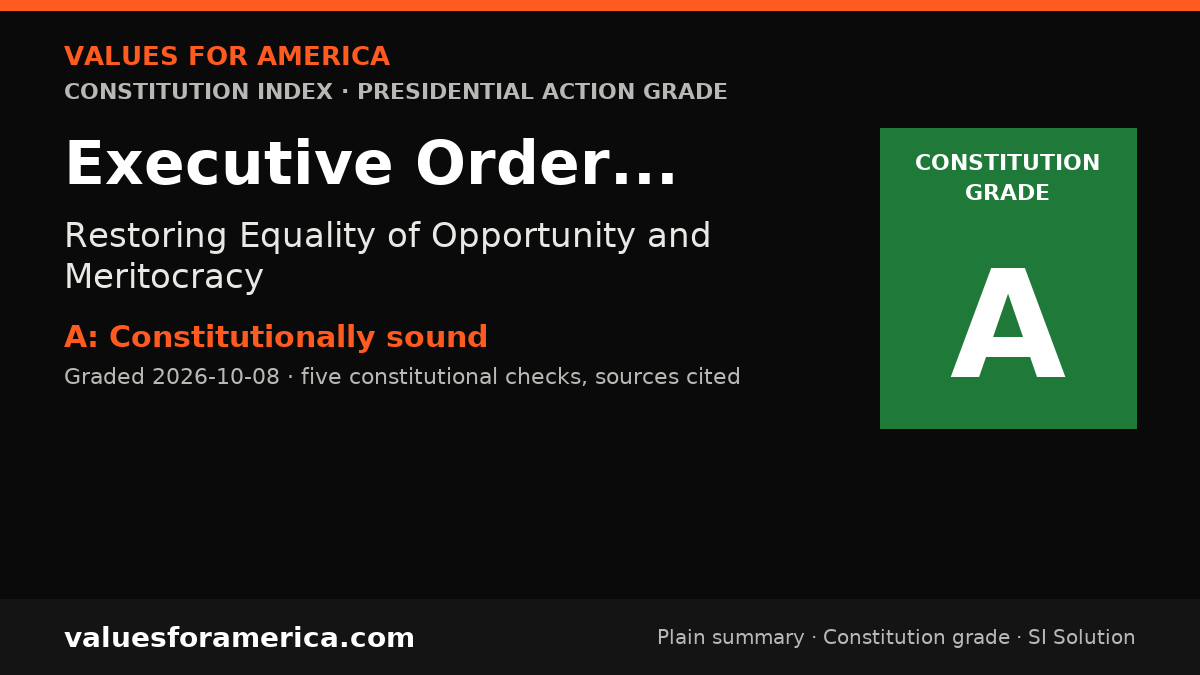
Restoring Equality of Opportunity and Meritocracy
Signed: 2025-04-23 Published: 2025-04-28 Federal Register document: 2025-07378
Agencies: Executive Office of the President
Federal Register notes (as of 2026-10-19): See: EO 12250, November 2, 1980
What Executive Order 14281 says
Federal Register, Volume 90 Issue 80 (Monday, April 28, 2025) [Federal Register Volume 90, Number 80 (Monday, April 28, 2025)] [Presidential Documents] [Pages 17537-17539] From the Federal Register Online via the Government Publishing Office [www.gpo.gov] [FR Doc No: 2025-07378] Presidential Documents Federal Register / Vol. 90, No. 80 / Monday, April 28, 2025 / Presidential Documents [[Page 17537]] Executive Order 14281 of April 23, 2025 Restoring Equality of Opportunity and Meritocracy By the authority vested in me as President by the Constitution and the laws of the United States of America, it is hereby ordered: Section 1. Purpose. A bedrock principle of the United States is that all citizens are treated equally under the law. This principle guarantees equality of opportunity, not equal outcomes. It promises that people are treated as individuals, not components of a particular race or group. It encourages meritocracy and a colorblind society, not race- or sex-based favoritism. Adherence to this principle is essential to creating opportunity, encouraging achievement, and sustaining the American Dream. But a pernicious movement endangers this foundational principle, seeking to transform America's promise of equal opportunity into a divisive pursuit of results preordained by irrelevant immutable characteristics, regardless of individual strengths, effort, or achievement. A...
Opening of the official text; read it in full in the Federal Register.
Constitution Index
“VFA Constitution grade”
Constitutionally sound
Graded 2026-10-08
SI-generated grade · five published checks · not individually reviewed by a person · methodology
Executive Order 14281 is a lawful exercise of presidential supervision of federal enforcement that removes a constitutionally suspect disparate-impact regime and restores equal-treatment and merit principles. It claims no legislative power, infringes no enumerated right, expands individual economic liberty, leaves state authority intact, and preserves lawful process for regulatory and judicial changes.
-
✓ Passes · Enumerated powers
The President directs subordinate executive agencies on enforcement priorities and implementation of Title VI, Title VII, Fair Housing, and credit laws. This rests on Article II, Section 1 vesting of executive power and Article II, Section 3 duty to take Care that the Laws be faithfully executed, plus the President's authority to supervise officers and approve or revoke regulatory approvals under … -
✓ Passes · Bill of Rights
The Order imposes no restriction on speech, religion, press, assembly, arms, quartering, search, self-incrimination, trial rights, jury, or punishment. It directs agencies to stop using disparate-impact theories that pressure employers to engage in racial balancing. That orientation supports equal treatment consistent with the Fourteenth Amendment Equal Protection principle and the Fifth Amendment… -
✓ Passes · Individual sovereignty
The Order reduces government pressure on private employers and job seekers to consider race or sex to avoid liability, restoring ability to hire and be hired on merit, skill, and customer needs. It imposes no new restraint on person, property, speech, labor, or belief, and the burden it lifts was itself a government-created incentive to discriminate. No compelling-justification test is triggered a… -
✓ Passes · Decentralization
The action governs only federal executive enforcement discretion and federal regulations under authority delegated by Executive Order 12250. It does not create a new federal regulatory program, commandeer states, or preempt state law by itself; Section 7 only directs study of preemption. Federal prosecution discretion cannot be exercised by individuals, localities, or states, so higher-level handl… -
✓ Passes · Due process and takings
The Order does not impose fines, imprisonment, seizure, or transfer of property without notice and hearing. It deprioritizes future enforcement and orders review of pending matters and consent decrees through lawful channels, explicitly stating action must be as appropriate under applicable law. Changes to regulations require repeal or amendment under the Administrative Procedure Act, and changes …
Report an error in this grade
What should happen instead
“VFA SI Solution”
No Solution yet
A sourced, Constitution-cited alternative appears here once one passes the SI Editorial Standard.

For journalists and bloggers
“Embed this grade”
Free to use with the link back. The badge and card update when the grade changes. Embed terms →
