Executive Order 14280 explained · Executive Order · No disposition noted
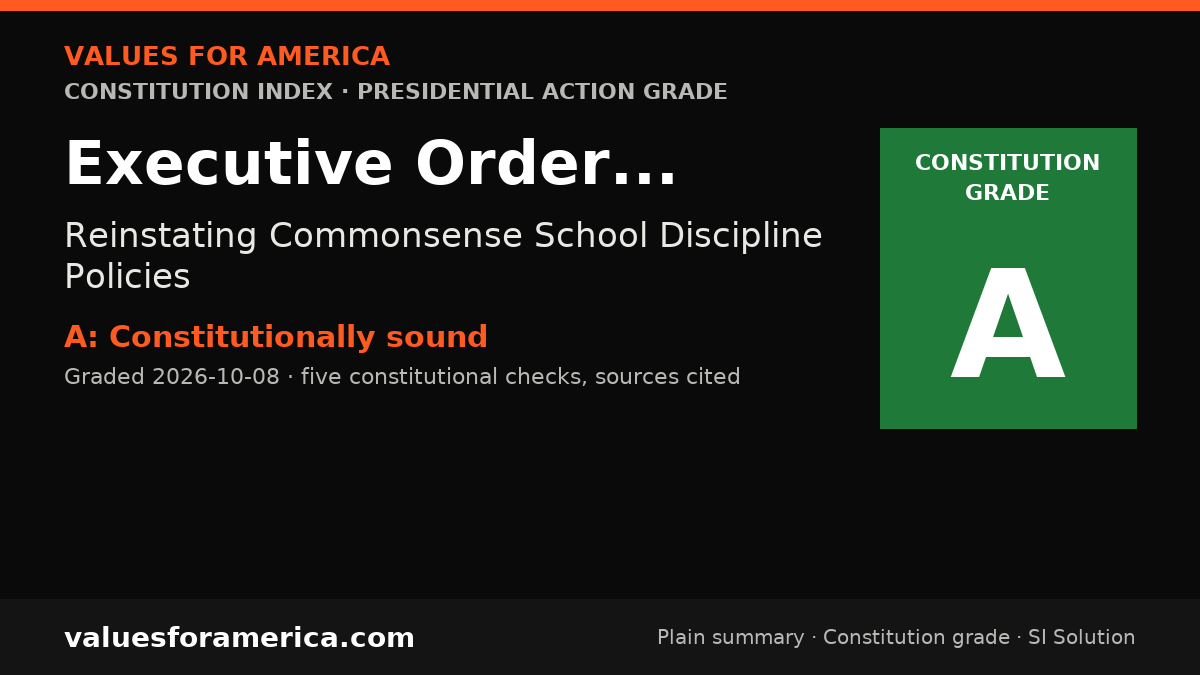
Reinstating Commonsense School Discipline Policies
Signed: 2025-04-23 Published: 2025-04-28 Federal Register document: 2025-07377
Agencies: Executive Office of the President
Federal Register notes (as of 2026-10-19): See: EO 14190, January 29, 2025
What Executive Order 14280 says
Federal Register, Volume 90 Issue 80 (Monday, April 28, 2025) [Federal Register Volume 90, Number 80 (Monday, April 28, 2025)] [Presidential Documents] [Pages 17533-17535] From the Federal Register Online via the Government Publishing Office [www.gpo.gov] [FR Doc No: 2025-07377] Presidential Documents Federal Register / Vol. 90, No. 80 / Monday, April 28, 2025 / Presidential Documents [[Page 17533]] Executive Order 14280 of April 23, 2025 Reinstating Commonsense School Discipline Policies By the authority vested in me as President by the Constitution and the laws of the United States of America, and to ensure safety and order in American classrooms, it is hereby ordered: Section 1. Purpose and Policy. The Federal Government will no longer tolerate known risks to children's safety and well-being in the classroom that result from the application of school discipline based on discriminatory and unlawful ``equity'' ideology. In January 2014, the Department of Education and the Department of Justice jointly issued a ``Dear Colleague'' letter regarding school discipline. In that letter, the Department of Education and the Department of Justice explained that schools could be found to violate Title VI of the Civil Rights Act of 1964--and therefore could lose Federal funding--if their disciplinary decisions ran afoul of a newly imposed disparate-impact framework under which...
Opening of the official text; read it in full in the Federal Register.
Constitution Index
“VFA Constitution grade”
Constitutionally sound
Graded 2026-10-08
SI-generated grade · five published checks · not individually reviewed by a person · methodology
Executive Order 14280 is a lawful exercise of executive enforcement of existing anti-discrimination law. It withdraws federal disparate-impact pressure, returns routine discipline to local teachers and administrators, limits direct federal rulemaking to Defense schools, and imposes no speech, due-process, or property deprivation. Any SI review finds it constitutionally sound with no structural rewrite required.
-
✓ Passes · Enumerated powers
The President acts under Article II, Section 1 executive power and Article II, Section 3 duty to take care that laws be faithfully executed, to administer Title VI of the Civil Rights Act of 1964. Title VI itself rests on Article I, Section 8, Clause 1 Spending Clause authority to condition federal education funds on non-discrimination, and Congress's Fourteenth Amendment Section 5 enforcement aut… -
✓ Passes · Bill of Rights
No provision directs censorship, compelled speech, religious exercise, arms restriction, searches, self-incrimination, unfair trial, or cruel punishment. The order prohibits racial discrimination in discipline and requires behavior-based decisions, which is consistent with the First Amendment and the Fourteenth Amendment equal protection principle incorporated against federal action. It creates no… -
✓ Passes · Individual sovereignty
The order restricts government actors, not private persons. It does not regulate what a person may say, believe, own, or do with their labor. It bars LEAs, SEAs, and federal grantees from using race-based discipline quotas, and asks for model policies rooted in objective behavior. The burden remains on government to apply discipline even-handedly without unlawful racial discrimination, which prote… -
✓ Passes · Decentralization
Education and classroom discipline are historically state and local functions reserved under the Tenth Amendment. This order does not create a new federal discipline code for public schools; for LEAs and SEAs it orders guidance, consultation with Governors and State Attorneys General, and enforcement of existing Title VI non-discrimination law, while expressly finding disciplinary decisions are be… -
✓ Passes · Due process and takings
No person is deprived of life, liberty, or property, and no property is taken. Sections 3(a)-(c) require new guidance and coordination before any compliance action, preserving procedural due process under the Fifth Amendment: fair notice and application of Title VI. Section 4(b) limits implementation to applicable law and appropriations, and 4(c) creates no new enforceable deprivation. Any future …
Report an error in this grade
What should happen instead
“VFA SI Solution”
No Solution yet
A sourced, Constitution-cited alternative appears here once one passes the SI Editorial Standard.

For journalists and bloggers
“Embed this grade”
Free to use with the link back. The badge and card update when the grade changes. Embed terms →
