Executive Order 14274 explained · Executive Order · No disposition noted
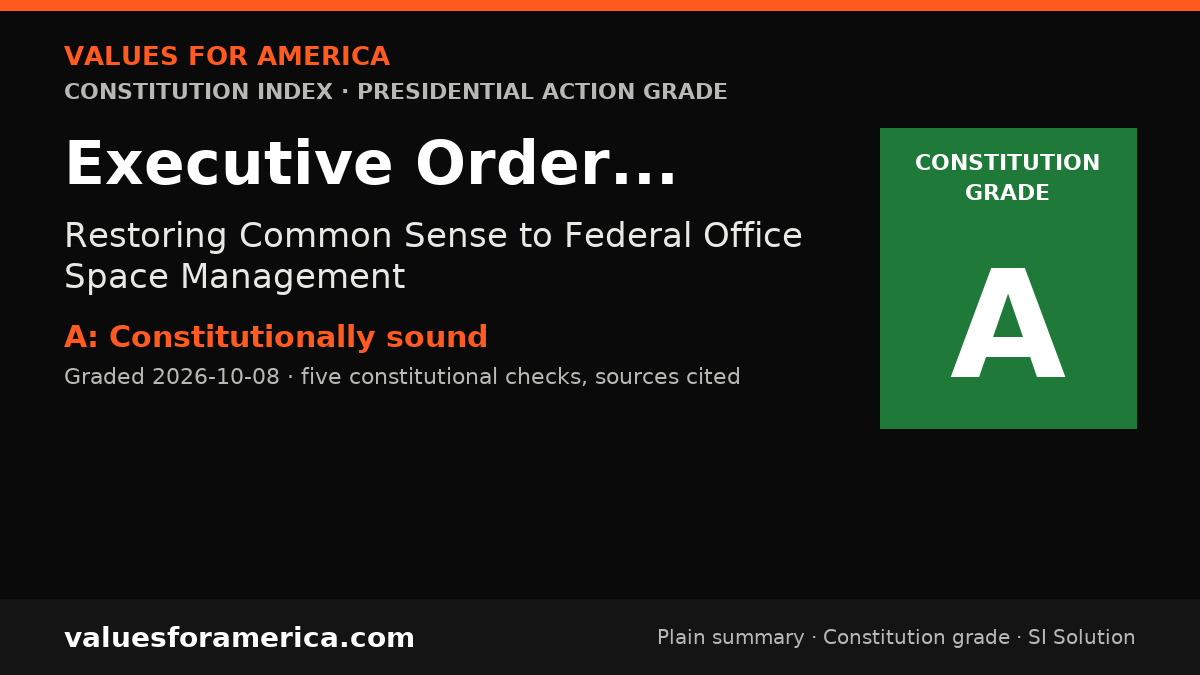
Restoring Common Sense to Federal Office Space Management
Signed: 2025-04-15 Published: 2025-04-18 Federal Register document: 2025-06838
Agencies: Executive Office of the President
Federal Register notes (as of 2026-10-19): Revokes: EO 12072, August 16, 1978; EO 13006, May 21, 1996
What Executive Order 14274 says
Federal Register, Volume 90 Issue 74 (Friday, April 18, 2025) [Federal Register Volume 90, Number 74 (Friday, April 18, 2025)] [Presidential Documents] [Pages 16445-16446] From the Federal Register Online via the Government Publishing Office [www.gpo.gov] [FR Doc No: 2025-06838] Presidential Documents Federal Register / Vol. 90, No. 74 / Friday, April 18, 2025 / Presidential Documents [[Page 16445]] Executive Order 14274 of April 15, 2025 Restoring Common Sense to Federal Office Space Management By the authority vested in me as President by the Constitution and the laws of the United States of America, it is hereby ordered: Section 1. Purpose. The American people are spread across more than 3.8 million square miles in urban, suburban, and rural areas. To provide the highest quality services in an efficient and cost-effective manner, executive departments and agencies (agencies) must be where the people are. President Carter signed Executive Order 12072 of August 16, 1978 (Federal Space Management), ordering the Federal Government to prioritize central business districts when siting Federal facilities in urban areas. Intended to improve these districts, President Carter's order has instead prevented agencies from relocating to lower-cost facilities. Building on Executive Order 12072, President Clinton signed Executive Order 13006 of May 21, 1996 (Locating Federal Facilities on...
Opening of the official text; read it in full in the Federal Register.
Constitution Index
“VFA Constitution grade”
Constitutionally sound
Graded 2026-10-08
SI-generated grade · five published checks · not individually reviewed by a person · methodology
EO 14274 is internal executive-branch management: it revokes two prior siting mandates and directs cost-effective federal office selection under existing property law. It stays within presidential authority over federal property and personnel, infringes no Bill of Rights protection, restricts no private conduct, devolves rather than centralizes decisions, and effects no taking or due-process deprivation. SI review finds it fully constitutional.
-
✓ Passes · Enumerated powers
The President acts within Article II, Section 1 executive power and Article II, Section 3 duty to take care that the laws be faithfully executed, managing subordinate executive departments and agencies. Regulation of federal property is further supported by Article IV, Section 3, Clause 2 and by the Federal Property and Administrative Services Act of 1949, 40 U.S.C. 101 et seq. Revoking prior exec… -
✓ Passes · Bill of Rights
No provision restricts speech, religion, press, assembly, petition under First Amendment, arms under Second Amendment, or imposes searches, seizures, self-incrimination, or trial deprivations. Revoking office-location preferences and directing GSA to amend 41 C.F.R. Parts 102-79 and 102-83 regulates only internal federal real-estate siting. It creates no enforceable right against private parties p… -
✓ Passes · Individual sovereignty
The order restricts no private person in use of person, property, speech, labor, or belief. It directs only executive departments, agencies, GSA, and the Office of Management and Budget on federal office-space selection. Private owners remain free to lease or not lease to the Government, and no mandate, prohibition, or penalty is imposed on citizens. No compelling-justification analysis is therefo… -
✓ Passes · Decentralization
This is internal Federal Government housekeeping: siting of federal offices owned or leased under 40 U.S.C. 101 et seq. Individuals, counties, and states cannot site federal executive facilities; that function is inherently federal under Article IV, Section 3, Clause 2. The order does not consolidate upward: it revokes prior central-business-district and historic-property mandates from EO 12072 an… -
✓ Passes · Due process and takings
No person is deprived of life, liberty, or property. No hearing, notice, or criminal presumption under Fifth Amendment Due Process Clause or Fourteenth Amendment Section 1 is triggered. No private property is taken for public use, so no just-compensation analysis under the Fifth Amendment Takings Clause applies. Sec. 3(b) expressly requires implementation consistent with applicable law and appropr…
Report an error in this grade
What should happen instead
“VFA SI Solution”
No Solution yet
A sourced, Constitution-cited alternative appears here once one passes the SI Editorial Standard.

For journalists and bloggers
“Embed this grade”
Free to use with the link back. The badge and card update when the grade changes. Embed terms →
