Executive Order 14267 explained · Executive Order · No disposition noted
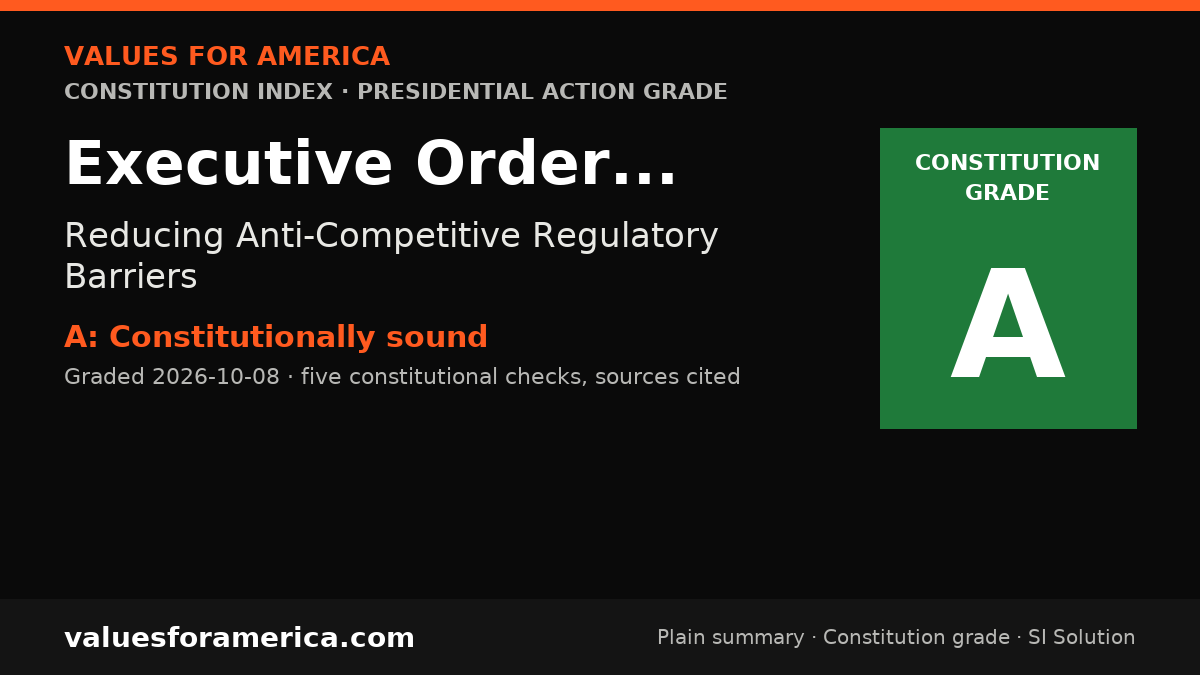
Reducing Anti-Competitive Regulatory Barriers
Signed: 2025-04-09 Published: 2025-04-15 Federal Register document: 2025-06463
Agencies: Executive Office of the President
Federal Register notes (as of 2026-10-19): See: EO 12866, September 30, 1993; EO 14219, February 19, 2025
What Executive Order 14267 says
Federal Register, Volume 90 Issue 71 (Tuesday, April 15, 2025) [Federal Register Volume 90, Number 71 (Tuesday, April 15, 2025)] [Presidential Documents] [Pages 15629-15630] From the Federal Register Online via the Government Publishing Office [www.gpo.gov] [FR Doc No: 2025-06463] Presidential Documents Federal Register / Vol. 90, No. 71 / Tuesday, April 15, 2025 / Presidential Documents [[Page 15629]] Executive Order 14267 of April 9, 2025 Reducing Anti-Competitive Regulatory Barriers By the authority vested in me as President by the Constitution and the laws of the United States of America, it is hereby ordered: Section 1. Purpose. Federal regulations should not predetermine economic winners and losers. Yet some regulations operate to exclude new market entrants. Regulations that reduce competition, entrepreneurship, and innovation--as well as the benefits they create for American consumers--should be eliminated. This order commences the process for eliminating anti-competitive regulations to revitalize the American economy. Sec. 2. Definitions. (a) ``Agency'' has the meaning given to it in section 3502 of title 44, United States Code, except that it does not include the Executive Office of the President or any components thereof. (b) ``Agency head'' means the highest-ranking official of an agency, such as the Secretary, Administrator, Chairman, or Director, unless otherwise...
Opening of the official text; read it in full in the Federal Register.
Constitution Index
“VFA Constitution grade”
Constitutionally sound
Graded 2026-10-08
SI-generated grade · five published checks · not individually reviewed by a person · methodology
Executive Order 14267 is a lawful Article II management directive ordering review and potential rescission of existing anti-competitive federal regulations through lawful processes with public input. It asserts no new power, infringes no Bill of Rights protection, expands individual economic liberty, reduces federal control, and preserves due process.
-
✓ Passes · Enumerated powers
The President directs subordinate executive agencies to review regulations within their existing rulemaking authority and recommend rescission or modification. This is an exercise of executive supervision under Article II, Section 1 and the duty to take care that the laws be faithfully executed under Article II, Section 3. The Order claims no new legislative power, imposes no new mandate, and stat… -
✓ Passes · Bill of Rights
The Order restricts no speech, religion, press, assembly, or petition under the First Amendment; imposes no arms restriction under the Second Amendment; authorizes no search, seizure, or surveillance under the Fourth Amendment; and compels no testimony under the Fifth Amendment. It creates no criminal liability, trial procedure, punishment, or property seizure. It is a deregulatory review directiv… -
✓ Passes · Individual sovereignty
The Order removes rather than imposes restrictions on person, property, speech, labor, and enterprise. By targeting monopolies, barriers to entry, undue licensure requirements, and procurement burdens, it expands freedom to work, compete, and innovate. No individual liberty is conditioned, licensed, or burdened, so no additional government justification is required. -
✓ Passes · Decentralization
Review and rescission of existing federal regulations can only be performed by the federal executive that issued them, so individual, local, and state actors cannot handle this task. The Order does not consolidate decision-making upward; it directs reduction of federal restraints on entry, licensure, procurement, and competition, moving economic decision-making downward to markets, individuals, an… -
✓ Passes · Due process and takings
The Order adjudicates no person, denies no notice or hearing, creates no presumption of guilt, and takes no property under the Fifth Amendment Takings Clause. Section 3 requires interagency review, public input through request for information, consultation with the Attorney General and Chairman, and incorporation through lawful rulemaking processes. Section 4 expressly requires implementation cons…
Report an error in this grade
What should happen instead
“VFA SI Solution”
No Solution yet
A sourced, Constitution-cited alternative appears here once one passes the SI Editorial Standard.

For journalists and bloggers
“Embed this grade”
Free to use with the link back. The badge and card update when the grade changes. Embed terms →
