Executive Order 14262 explained · Executive Order · No disposition noted
Strengthening the Reliability and Security of the United States Electric Grid
Signed: 2025-04-08 Published: 2025-04-14 Federal Register document: 2025-06381
Agencies: Executive Office of the President
Federal Register notes (as of 2026-10-19): See: EO 14156, January 20, 2025; EO 14386, February 11, 2026
What Executive Order 14262 says
Federal Register, Volume 90 Issue 70 (Monday, April 14, 2025) [Federal Register Volume 90, Number 70 (Monday, April 14, 2025)] [Presidential Documents] [Pages 15521-15522] From the Federal Register Online via the Government Publishing Office [www.gpo.gov] [FR Doc No: 2025-06381] Presidential Documents Federal Register / Vol. 90, No. 70 / Monday, April 14, 2025 / Presidential Documents [[Page 15521]] Executive Order 14262 of April 8, 2025 Strengthening the Reliability and Security of the United States Electric Grid By the authority vested in me as President by the Constitution and the laws of the United States of America, it is hereby ordered: Section 1. Purpose. The United States is experiencing an unprecedented surge in electricity demand driven by rapid technological advancements, including the expansion of artificial intelligence data centers and an increase in domestic manufacturing. This increase in demand, coupled with existing capacity challenges, places a significant strain on our Nation's electric grid. Lack of reliability in the electric grid puts the national and economic security of the American people at risk. The United States' ability to remain at the forefront of technological innovation depends on a reliable supply of energy from all available electric generation sources and the integrity of our Nation's electric grid. Sec. 2. Policy. It is the policy of the...
Opening of the official text; read it in full in the Federal Register.
Constitution Index
“VFA Constitution grade”
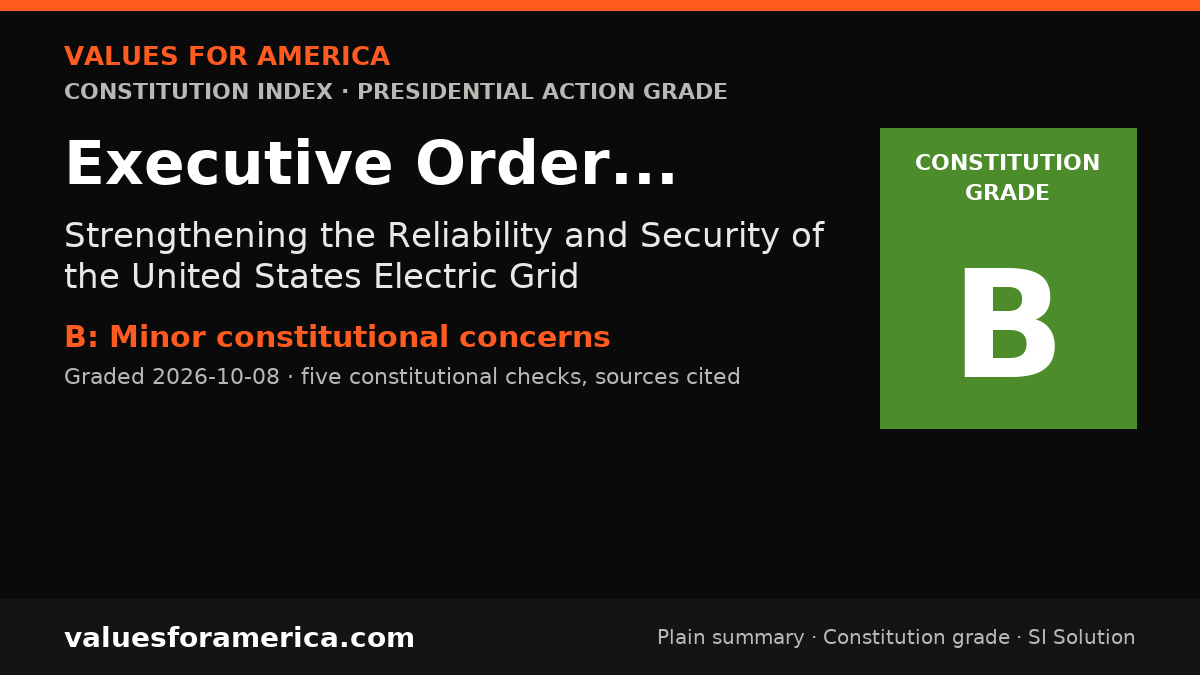
Minor constitutional concerns
Graded 2026-10-08
SI-generated grade · five published checks · not individually reviewed by a person · methodology
Federal coordination of interstate grid reliability, expedited emergency procedures, and reliability studies fall within commerce and executive authority, with no direct rights infringement. Retention and anti-retirement language for large plants creates only fixable tension on property, due process, and compensation that must be handled through lawful Federal Power Act procedures with notice, hearing, and just compensation.
-
✓ Passes · Enumerated powers
Regulation of the interstate bulk power system falls under Congress commerce power in Article I, Section 8, Clause 3, as exercised through the Federal Power Act, including section 202(c) emergency authority, and the President's duty to execute the laws under Article II, Section 3. The order claims only authority vested by the Constitution and laws, directs streamlining within the law, mandates stu… -
✓ Passes · Bill of Rights
No provision directs censorship of speech or press, restriction of religion, assembly, or petition under the First Amendment, disarmament under the Second Amendment, quartering under the Third Amendment, search or seizure under the Fourth Amendment, compelled testimony, or denial of trial rights under the Fifth, Sixth, Seventh, or Eighth Amendments. The order directs grid reliability studies and e… -
✓ Passes · Individual sovereignty
The order is directed at large generation owners and grid operators, not at personal belief, speech, labor, or household property. Its burden on owner decisions about retirement or fuel source for facilities over 50 megawatts, justified by preventing grid failure affecting national and economic security, is a commercial regulation with a stated compelling justification and is bounded by applicable… -
✓ Passes · Decentralization
Bulk interstate electric reliability cannot be secured by individual households, single counties, or single states acting alone because electrons, reserve margins, and cascading failures cross state lines. Federal coordination under the Commerce Clause, Article I, Section 8, Clause 3, and the Tenth Amendment is therefore the minimum effective level for reserve-margin analysis and emergency retenti… -
✓ Passes · Due process and takings
The order does not itself seize plants, order uncompensated operation, or deny notice and hearing. Section 3 expressly requires action to the maximum extent permitted by law and consistent with applicable law, preserving Federal Power Act procedures, judicial review, and Fifth Amendment due process and Takings Clause protections. Risk remains in subsection 3(c)(ii), which contemplates preventing r…
Report an error in this grade
What should happen instead
“VFA SI Solution”
No Solution yet
A sourced, Constitution-cited alternative appears here once one passes the SI Editorial Standard.

For journalists and bloggers
“Embed this grade”
Free to use with the link back. The badge and card update when the grade changes. Embed terms →
