Executive Order 14259 explained · Executive Order · No disposition noted
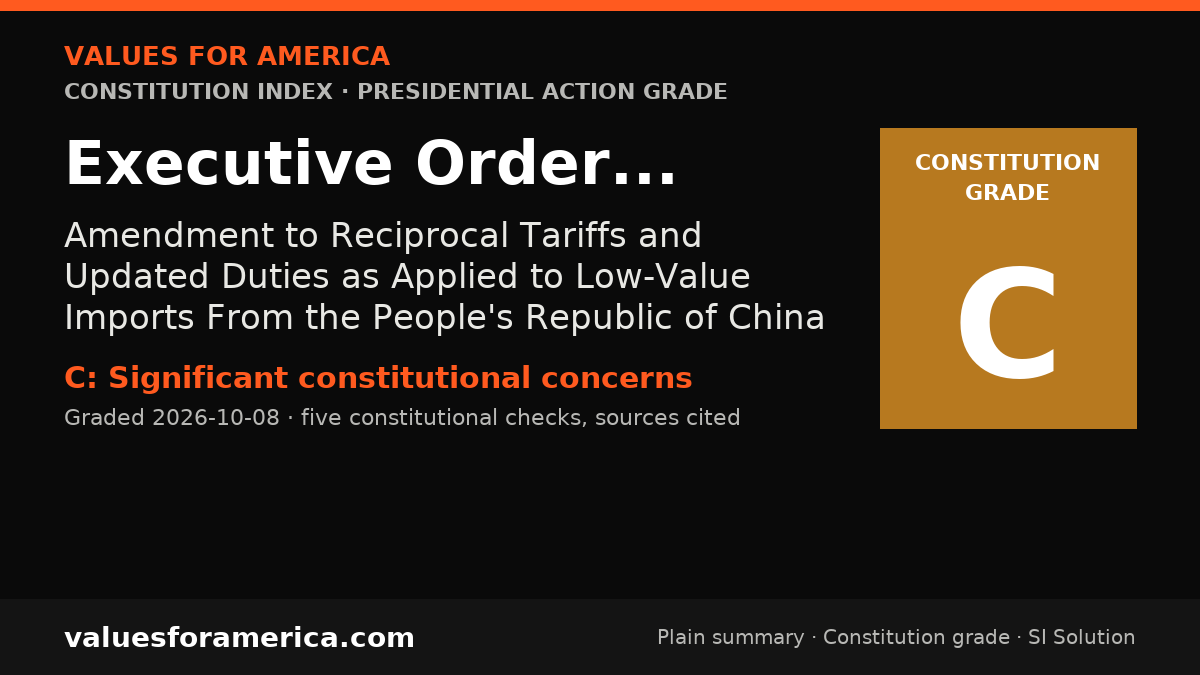
Amendment to Reciprocal Tariffs and Updated Duties as Applied to Low-Value Imports From the People's Republic of China
Signed: 2025-04-08 Published: 2025-04-14 Federal Register document: 2025-06378
Agencies: Executive Office of the President
Federal Register notes (as of 2026-10-19): See: EO 14256, April 2, 2025; EO 14257, April 2, 2025; EO 14298, May 12, 2025; EO 14334, August 11, 2025; Notice of March 24, 2026 (91 FR 15517)
What Executive Order 14259 says
Federal Register, Volume 90 Issue 70 (Monday, April 14, 2025) [Federal Register Volume 90, Number 70 (Monday, April 14, 2025)] [Presidential Documents] [Pages 15509-15511] From the Federal Register Online via the Government Publishing Office [www.gpo.gov] [FR Doc No: 2025-06378] Presidential Documents Federal Register / Vol. 90, No. 70 / Monday, April 14, 2025 / Presidential Documents ___________________________________________________________________ Title 3-- The President [[Page 15509]] Executive Order 14259 of April 8, 2025 Amendment to Reciprocal Tariffs and Updated Duties as Applied to Low-Value Imports From the People's Republic of China By the authority vested in me as President by the Constitution and the laws of the United States of America, including the International Emergency Economic Powers Act (50 U.S.C. 1701 et seq.) (IEEPA), the National Emergencies Act (50 U.S.C. 1601 et seq.), section 604 of the Trade Act of 1974, as amended (19 U.S.C. 2483), and section 301 of title 3, United States Code, I hereby determine and order: Section 1. Background. In Executive Order 14257 of April 2, 2025 (Regulating Imports with a Reciprocal Tariff to Rectify Trade Practices that Contribute to Large and Persistent Annual United States Goods Trade Deficits), I declared a national emergency arising from conditions reflected in large and persistent annual U.S. goods trade deficits...
Opening of the official text; read it in full in the Federal Register.
Constitution Index
“VFA Constitution grade”
Significant constitutional concerns
Graded 2026-10-08
SI-generated grade · five published checks · not individually reviewed by a person · methodology
Foreign tariffs are within federal enumerated commerce and duty powers and raise no Bill of Rights, decentralization, or due process violation, but EO 14259 unilaterally rewrites tariff rates by emergency order, stretching Article I, Section 1 and Article I, Section 8, Clauses 1 and 3 delegation limits and burdening individual economic liberty, requiring congressional authorization review. No SI analysis alters that constitutional test.
-
✗ Concern · Enumerated powers
The power to lay duties and regulate foreign commerce belongs to Congress under Article I, Section 8, Clauses 1 and 3, and legislative power is vested in Congress under Article I, Section 1. The President claims authority under IEEPA, the National Emergencies Act, 19 U.S.C. 2483 and 3 U.S.C. 301, and raises rates from 34% to 84% and de minimis duties from 30% to 90% and $25/$50 to $75/$150 based o… -
✓ Passes · Bill of Rights
EO 14259 imposes ad valorem and per-item duties on low-value imports from China. It does not prohibit speech, press, assembly, petition or religious exercise under the First Amendment, does not implicate the Second, Third, Sixth, Seventh or Eighth Amendments, and authorizes no search, seizure or compelled testimony under the Fourth or Fifth Amendments. Economic burden from a tariff is not a Bill o… -
✗ Concern · Individual sovereignty
Tripling de minimis burdens and raising reciprocal rates materially restricts individuals' use of their own property, labor and earnings to buy, sell and import low-value goods. Under the Ninth Amendment and Fifth Amendment liberty and property principles the burden is on government to justify the restriction. National-security and unfair-trade justifications are colorable but the order offers onl… -
✓ Passes · Decentralization
Regulation of foreign commerce is a necessarily national function under Article I, Section 8, Clause 3 and Article I, Section 10, Clauses 2-3 which deny states independent tariff power. Individuals, counties and states cannot separately set national reciprocal tariffs or conduct retaliation. Action stays at the minimum higher level competent to act and does not violate the Tenth Amendment. -
✓ Passes · Due process and takings
Prospective duties effective April 9, 2025 and May 2/June 1, 2025 for de minimis items were published in the Federal Register with specific rates under Article I, Section 8, Clause 1 customs authority. No retroactive penalty, no adjudication of guilt without hearing, no physical appropriation requiring Fifth Amendment just compensation. Tariffs are a tax/duty, not a taking for public use.
Report an error in this grade
What should happen instead
“VFA SI Solution”
No Solution yet
A sourced, Constitution-cited alternative appears here once one passes the SI Editorial Standard.

For journalists and bloggers
“Embed this grade”
Free to use with the link back. The badge and card update when the grade changes. Embed terms →
