Executive Order 14251 explained · Executive Order · No disposition noted
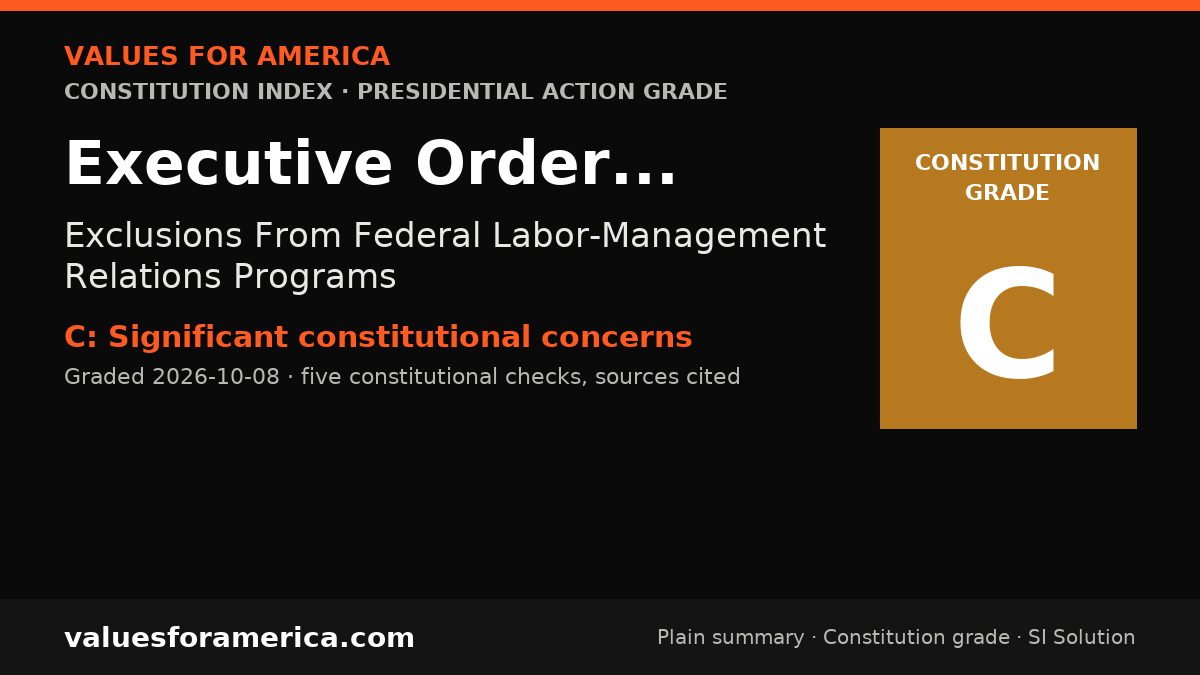
Exclusions From Federal Labor-Management Relations Programs
Signed: 2025-03-27 Published: 2025-04-03 Federal Register document: 2025-05836
Agencies: Executive Office of the President
Federal Register notes (as of 2026-10-19): Amends: EO 12171, November 19, 1979 See: EO 14343, August 28, 2025
What Executive Order 14251 says
Federal Register, Volume 90 Issue 63 (Thursday, April 3, 2025) [Federal Register Volume 90, Number 63 (Thursday, April 3, 2025)] [Presidential Documents] [Pages 14553-14557] From the Federal Register Online via the Government Publishing Office [www.gpo.gov] [FR Doc No: 2025-05836] Presidential Documents Federal Register / Vol. 90, No. 63 / Thursday, April 3, 2025 / Presidential Documents [[Page 14553]] Executive Order 14251 of March 27, 2025 Exclusions From Federal Labor-Management Relations Programs By the authority vested in me as President by the Constitution and the laws of the United States of America, including sections 7103(b)(1) of title 5 and 4103(b) of title 22, United States Code, to enhance the national security of the United States, it is hereby ordered: Section 1. Determinations. (a) The agencies and agency subdivisions set forth in section 2 of this order are hereby determined to have as a primary function intelligence, counterintelligence, investigative, or national security work. It is also hereby determined that Chapter 71 of title 5, United States Code, cannot be applied to these agencies and agency subdivisions in a manner consistent with national security requirements and considerations. (b) The agency subdivisions set forth in section 3 of this order are hereby determined to have as a primary function intelligence, counterintelligence, investigative, or...
Opening of the official text; read it in full in the Federal Register.
Constitution Index
“VFA Constitution grade”
Significant constitutional concerns
Graded 2026-10-08
SI-generated grade · five published checks · not individually reviewed by a person · methodology
SI analysis: President has statutory authority to exclude national-security agencies from federal bargaining, and no Bill of Rights or takings violation occurs. The Order is structurally suspect because it labels many largely civilian, regulatory, scientific, and service agencies as primarily intelligence or national security, exceeding the 7103(b)(1) predicate and requiring narrowing to true security functions.
-
✗ Concern · Enumerated powers
President cites Article II executive power plus express delegation in 5 U.S.C. 7103(b)(1) and 22 U.S.C. 4103(b) to exclude agencies whose primary function is intelligence, counterintelligence, investigative, or national security work where Chapter 71 cannot be applied consistently with national security. That delegation is within Article I, Section 8, Clause 18 Necessary and Proper authority to re… -
✓ Passes · Bill of Rights
No First Amendment violation found. Federal employees retain speech, association, and petition rights; there is no Bill of Rights right to statutory collective bargaining under Chapter 71 of Title 5. First Amendment protects joining a union, but not a constitutional entitlement to federal-sector bargaining procedures. No search, self-incrimination, trial, or cruel punishment issue under Fourth, Fi… -
✓ Passes · Individual sovereignty
As employer, the federal government has wider latitude to set conditions of federal employment than to regulate private citizens. Employees remain free as individuals to speak, associate, and petition under the First Amendment. The burden on private person, property, labor, or belief outside federal employment is indirect, so no direct sovereignty violation, though broad exclusion reduces voluntar… -
✓ Passes · Decentralization
Management of the federal civilian workforce is inherently federal. Individuals, counties, and states cannot administer federal labor-management relations for federal agencies. The Order does not transfer state or local authority upward; it governs internal federal personnel under Article II, Section 1 and Article II, Section 3 to take care that laws be executed. -
✓ Passes · Due process and takings
No deprivation of life, liberty, or property without due process under Fifth Amendment Due Process Clause, and no taking for public use under Fifth Amendment Takings Clause. Statutory bargaining privileges are not vested property interests requiring individualized notice and hearing, and no property is seized or compensation owed.
Report an error in this grade
What should happen instead
“VFA SI Solution”
No Solution yet
A sourced, Constitution-cited alternative appears here once one passes the SI Editorial Standard.

For journalists and bloggers
“Embed this grade”
Free to use with the link back. The badge and card update when the grade changes. Embed terms →
