Executive Order 14245 explained · Executive Order · No disposition noted
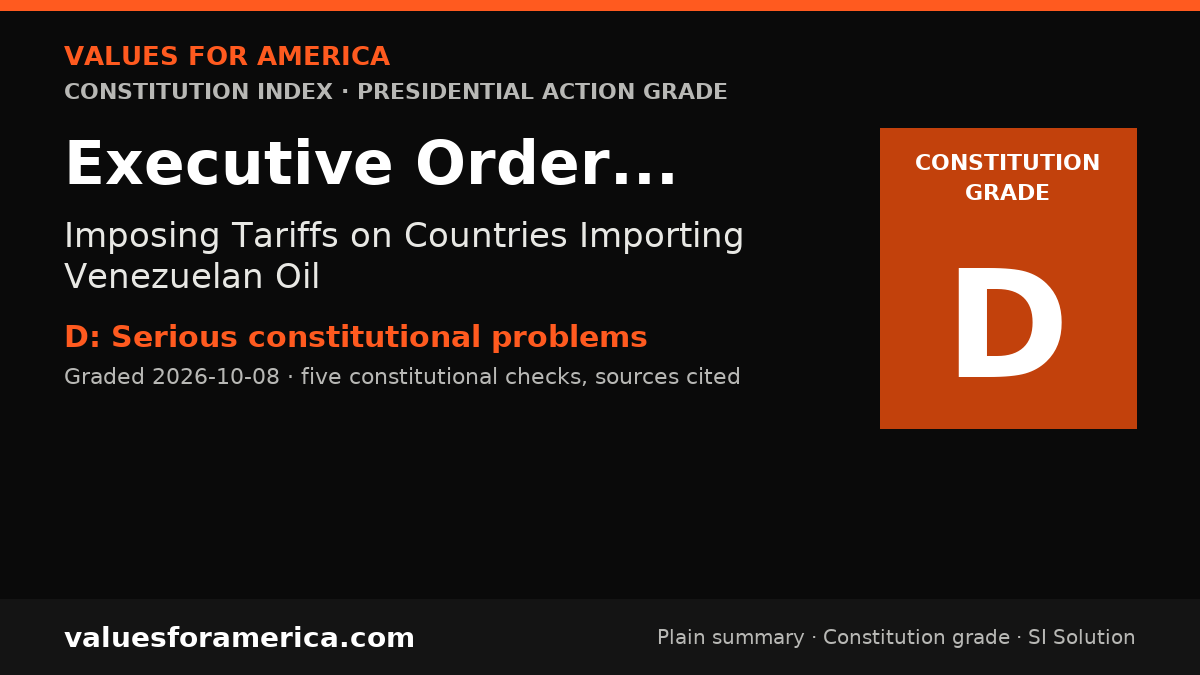
Imposing Tariffs on Countries Importing Venezuelan Oil
Signed: 2025-03-24 Published: 2025-03-27 Federal Register document: 2025-05440
Agencies: Executive Office of the President
Federal Register notes (as of 2026-10-19): See: EO 13692, March 8, 2015; EO 13808, August 24, 2017; EO 13850, November 1, 2018; EO 13884, August 5, 2019; Proc. 10903, March 14, 2025; Notice of February 18, 2026 (91 FR 8357); EO 14389, February 20, 2026
What Executive Order 14245 says
Federal Register, Volume 90 Issue 58 (Thursday, March 27, 2025) [Federal Register Volume 90, Number 58 (Thursday, March 27, 2025)] [Presidential Documents] [Pages 13829-13831] From the Federal Register Online via the Government Publishing Office [www.gpo.gov] [FR Doc No: 2025-05440] Presidential Documents Federal Register / Vol. 90, No. 58 / Thursday, March 27, 2025 / Presidential Documents [[Page 13829]] Executive Order 14245 of March 24, 2025 Imposing Tariffs on Countries Importing Venezuelan Oil By the authority vested in me as President by the Constitution and the laws of the United States of America, including the International Emergency Economic Powers Act (50 U.S.C. 1701 et seq.) (IEEPA), the National Emergencies Act (50 U.S.C. 1601 et seq.), and section 301 of title 3, United States Code, and in view of the national emergency declared with respect to Venezuela in Executive Order 13692 of March 8, 2015 (Blocking Property and Suspending Entry of Certain Persons Contributing to the Situation in Venezuela), as continued most recently in the notice of February 27, 2025 (Continuation of the National Emergency with Respect to Venezuela), I, DONALD J. TRUMP, President of the United States of America, find that the actions and policies of the regime of Nicol[aacute]s Maduro in Venezuela continue to pose an unusual and extraordinary threat to the national security and foreign...
Opening of the official text; read it in full in the Federal Register.
Constitution Index
“VFA Constitution grade”
Serious constitutional problems
Graded 2026-10-08
SI-generated grade · five published checks · not individually reviewed by a person · methodology
Secondary 25 percent tariffs serve a legitimate foreign-policy purpose but are imposed by executive discretion under a stretched emergency delegation, exercising Congress's Article I tax and commerce powers with vague standards and broad harm to private trade. Requires congressional authorization with clear limits.
-
✗ Concern · Enumerated powers
Article I, Section 8, Clauses 1 and 3 vest power to lay duties and regulate Commerce with foreign Nations in Congress. The President invokes Article II executive power plus IEEPA, 50 U.S.C. 1701 et seq., and the National Emergencies Act to impose a new 25 percent tariff on all goods from any country that imports Venezuelan oil. Using a 2015 Venezuela emergency declaration to tax trade with third-p… -
✓ Passes · Bill of Rights
No direct infringement of First through Eighth Amendments. Order does not ban speech, press, religion, assembly, or petition under First Amendment; does not disarm under Second Amendment; does not authorize searches or seizures under Fourth Amendment. Economic burden of higher import prices is not a cognizable speech, arms, or search violation. -
✗ Concern · Individual sovereignty
Order restricts liberty of contract, labor, and use of property of persons in the United States who import, sell, or buy affected goods, raising prices by executive discretion rather than statute. Government bears the burden to justify that a blanket secondary tariff on all goods from an entire country is narrowly tied to the Tren de Aragua and Maduro-regime threat. Findings cite national security… -
✓ Passes · Decentralization
Foreign commerce, sanctions, and response to a transnational threat are inherently national functions under Article I, Section 8, Clauses 3, 10, and 11. Individuals, counties, and states cannot impose nationwide tariffs or conduct foreign policy. Order does not move a traditionally local matter upward; it stays at the minimum level capable of handling third-country oil trade. -
✗ Concern · Due process and takings
Fifth Amendment Due Process requires fair notice and non-arbitrary standards. Sections 2(b) and 2(c) give the Secretary of State open-ended discretion to impose or lift a 25 percent supplemental duty country-by-country, with expiry tied to discretionary determinations and no published criteria, hearing, or review standard. This creates vagueness and retroactivity risk for importers after April 2, …
Report an error in this grade
What should happen instead
“VFA SI Solution”
No Solution yet
A sourced, Constitution-cited alternative appears here once one passes the SI Editorial Standard.

For journalists and bloggers
“Embed this grade”
Free to use with the link back. The badge and card update when the grade changes. Embed terms →
