Executive Order 14244 explained · Executive Order · No disposition noted
Addressing Remedial Action by Paul Weiss
Signed: 2025-03-21 Published: 2025-03-26 Federal Register document: 2025-05291
Agencies: Executive Office of the President
Federal Register notes (as of 2026-10-19): Revokes: EO 14237, March 14, 2025
What Executive Order 14244 says
Federal Register, Volume 90 Issue 57 (Wednesday, March 26, 2025) [Federal Register Volume 90, Number 57 (Wednesday, March 26, 2025)] [Presidential Documents] [Pages 13685-13686] From the Federal Register Online via the Government Publishing Office [www.gpo.gov] [FR Doc No: 2025-05291] Presidential Documents Federal Register / Vol. 90, No. 57 / Wednesday, March 26, 2025 / Presidential Documents ___________________________________________________________________ Title 3-- The President [[Page 13685]] Executive Order 14244 of March 21, 2025 Addressing Remedial Action by Paul Weiss By the authority vested in me as President by the Constitution and the laws of the United States of America, it is hereby ordered: Section 1. Background. On March 14, 2025, I signed Executive Order 14237 (Addressing Risks from Paul Weiss) to address certain issues related to Paul, Weiss, Rifkind, Wharton & Garrison LLP (Paul Weiss). I noted that ``[g]lobal law firms have for years played an outsized role in undermining the judicial process and in the destruction of bedrock American principles.'' Paul Weiss is one of many law firms that have participated in this harmful activity. Earlier this week, though, Paul Weiss indicated that it will engage in a remarkable change of course. Specifically, Paul Weiss has acknowledged the wrongdoing of its former partner Mark Pomerantz, and it has agreed to a number...
Opening of the official text; read it in full in the Federal Register.
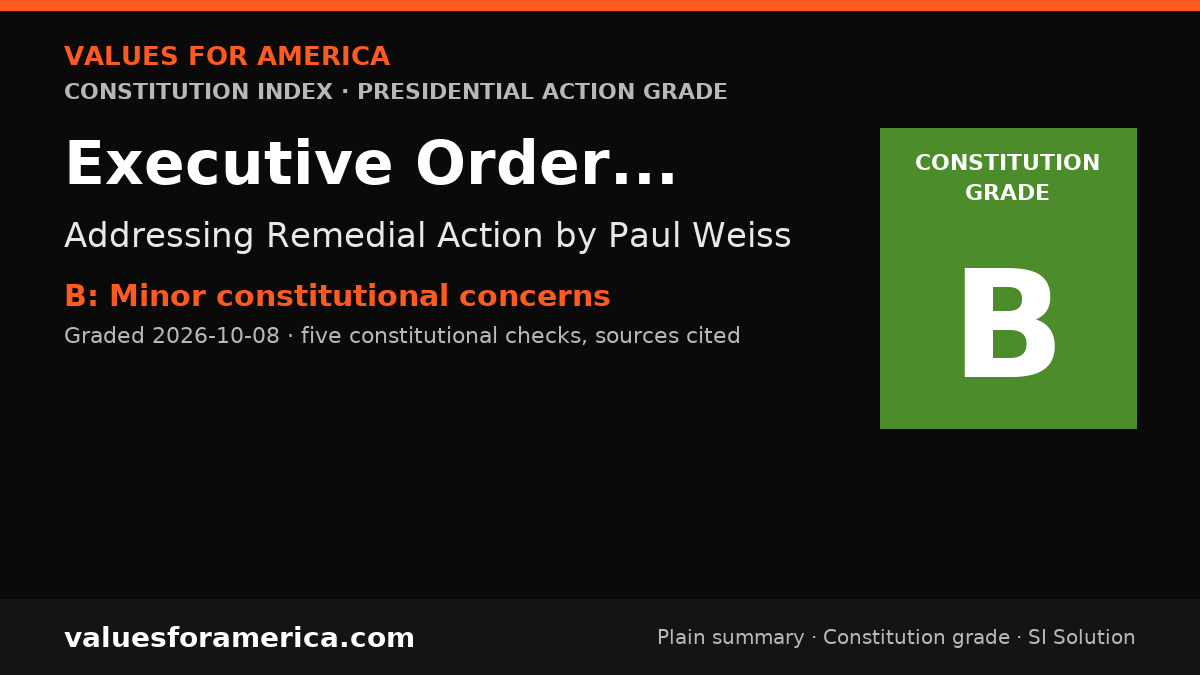
Constitution Index
“VFA Constitution grade”
Minor constitutional concerns
Graded 2026-10-08
SI-generated grade · five published checks · not individually reviewed by a person · methodology
EO 14244 is constitutionally sound in its operative effect because it revokes the punitive EO 14237 and restores associational and economic liberty. It earns B rather than A because it memorializes policy and pro bono concessions extracted under duress from the prior Order without disavowing coercion, providing findings, or offering remedy, leaving a chilling precedent for First Amendment and due-process rights.
-
✓ Passes · Enumerated powers
The President has authority under Article II, Section 1 vesting of executive power and Article II, Section 3 duty to take care that the laws be executed, to manage executive-branch directives including revocation of his own prior Executive Order. Revoking EO 14237 is a core executive housekeeping act, not an assertion of new legislative power under Article I, Section 8. -
✓ Passes · Bill of Rights
This Order itself imposes no new speech, association, or due-process restriction; it revokes EO 14237 and thereby removes security-clearance, contracting, and employment restrictions that had burdened First Amendment rights of association and petition and Fifth Amendment liberty interests in practicing law. The text's recitation of Paul Weiss's agreement to political neutrality in hiring, pro bono… -
✓ Passes · Individual sovereignty
The operative legal effect in Section 2 expands rather than restricts sovereignty: a law firm and its lawyers regain ability to select clients, hire, and practice without the federal sanctions threatened in EO 14237. The background description of a $40 million pro bono commitment and policy changes suggests prior coercion where government used contracting and clearance power to shape private speec… -
✓ Passes · Decentralization
Revocation of a prior presidential directive requires federal presidential action; no lower level can revoke a federal Executive Order. This Order does not consolidate new decision-making upward, it returns discretion to the private firm and to normal agency contracting under existing law, consistent with the Tenth Amendment reservation of private and state ordering. -
✓ Passes · Due process and takings
The Order provides no new deprivation of life, liberty, or property and creates no taking under the Fifth Amendment Takings Clause. It restores the status quo ante by revocation. Residual concern is that it provides no hearing, finding, or remedy for harms caused while EO 14237 was in effect, but it does not itself bypass notice, hearing, or presumption of innocence, and Section 3 expressly requir…
Report an error in this grade
What should happen instead
“VFA SI Solution”
No Solution yet
A sourced, Constitution-cited alternative appears here once one passes the SI Editorial Standard.

For journalists and bloggers
“Embed this grade”
Free to use with the link back. The badge and card update when the grade changes. Embed terms →
