Executive Order 14243 explained · Executive Order · No disposition noted
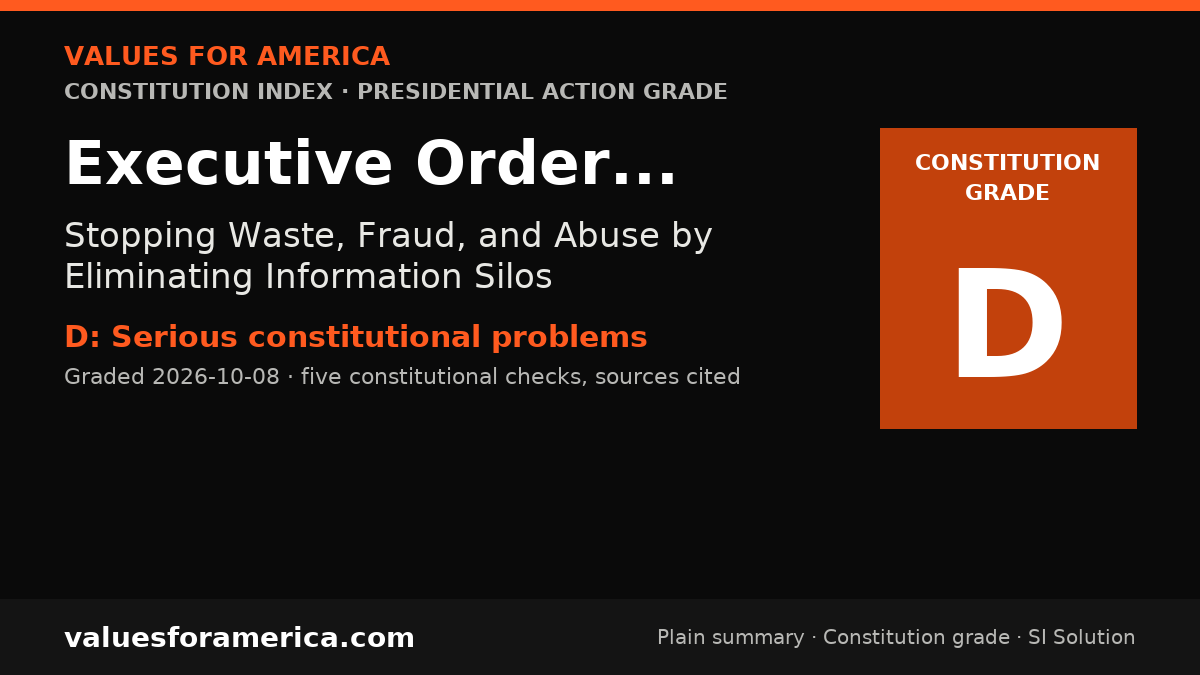
Stopping Waste, Fraud, and Abuse by Eliminating Information Silos
Signed: 2025-03-20 Published: 2025-03-25 Federal Register document: 2025-05214
Agencies: Executive Office of the President
What Executive Order 14243 says
Federal Register, Volume 90 Issue 56 (Tuesday, March 25, 2025) [Federal Register Volume 90, Number 56 (Tuesday, March 25, 2025)] [Presidential Documents] [Pages 13681-13682] From the Federal Register Online via the Government Publishing Office [www.gpo.gov] [FR Doc No: 2025-05214] Presidential Documents Federal Register / Vol. 90, No. 56 / Tuesday, March 25, 2025 / Presidential Documents [[Page 13681]] Executive Order 14243 of March 20, 2025 Stopping Waste, Fraud, and Abuse by Eliminating Information Silos By the authority vested in me as President by the Constitution and the laws of the United States of America, it is hereby ordered: Section 1. Purpose. Purpose. Removing unnecessary barriers to Federal employees accessing Government data and promoting inter-agency data sharing are important steps toward eliminating bureaucratic duplication and inefficiency while enhancing the Government's ability to detect overpayments and fraud. Sec. 2. Definitions. (a) ``Agency'' has the meaning given to it in section 3502 of title 44, United States Code, except that such term does not include the Executive Office of the President or any components thereof. (b) ``Agency Head'' means the highest-ranking official of an agency, such as the Secretary, Administrator, or Director. With respect to multimember agencies, ``Agency Head'' means the Chairman or equivalent official. Sec. 3. Eliminating...
Opening of the official text; read it in full in the Federal Register.
Constitution Index
“VFA Constitution grade”
Serious constitutional problems
Graded 2026-10-08
SI-generated grade · five published checks · not individually reviewed by a person · methodology
Executive Order 14243 directs lawful fraud reduction but does so through presumptive bulk consolidation of unclassified federal records and unfettered extraction of State program and unemployment data, with orders to rescind privacy-protective guidance. The consistent-with-law qualifier does not cure the assertion of executive power over congressional privacy statutes and State records, nor the Fourth Amendment, due process, sovereignty, and Tenth Amendment federalism harms from centralized data aggregation without safeguards.
-
✗ Concern · Enumerated powers
The President has authority under Article II, Section 1 and Section 3 to supervise execution of the laws and direct executive agencies to coordinate. However, Section 3(c) asserts immediate unfettered federal access to comprehensive State program data, Section 3(e) purports to supersede prior rules subject to direct Presidential rulemaking, and Section 3(b) orders regulatory rollback, without citi… -
✗ Concern · Bill of Rights
Section 3(a)-(d) orders full, prompt, and unfettered intra- and inter-agency access to all unclassified records, data, software systems, plus comprehensive data from State programs and unemployment payment records. While limited to unclassified material and qualified by to the maximum extent consistent with law, the order directs systematic consolidation of personal records held across agencies an… -
✗ Concern · Individual sovereignty
Individuals retain control over their personal information, labor and benefit records, and private communications with State agencies. The order treats all unclassified agency-held personal data as presumptively shareable across the entire federal government and with Presidential designees for broad Administration priorities, shifting the burden to the individual to bear aggregation and re-use. Th… -
✗ Concern · Decentralization
Fraud detection in federally funded programs can be handled in part at the State level through audits, program-integrity offices, and cooperative agreements, and at the federal level only under defined statutory sharing authorities. Section 3(c) demands unfettered federal access to comprehensive data from all State programs receiving federal funds, including third-party databases, which consolidat… -
✗ Concern · Due process and takings
The order provides no new procedural safeguards for individuals whose records will be consolidated for waste, fraud, and abuse findings: no notice, no opportunity to contest accuracy, no standard for adverse use, and no judicial process before designation. Bulk matching of unemployment, payment, and State program data risks erroneous deprivation of benefits, employment, or reputation through arbit…
Report an error in this grade
What should happen instead
“VFA SI Solution”
No Solution yet
A sourced, Constitution-cited alternative appears here once one passes the SI Editorial Standard.

For journalists and bloggers
“Embed this grade”
Free to use with the link back. The badge and card update when the grade changes. Embed terms →
