Executive Order 14238 explained · Executive Order · No disposition noted
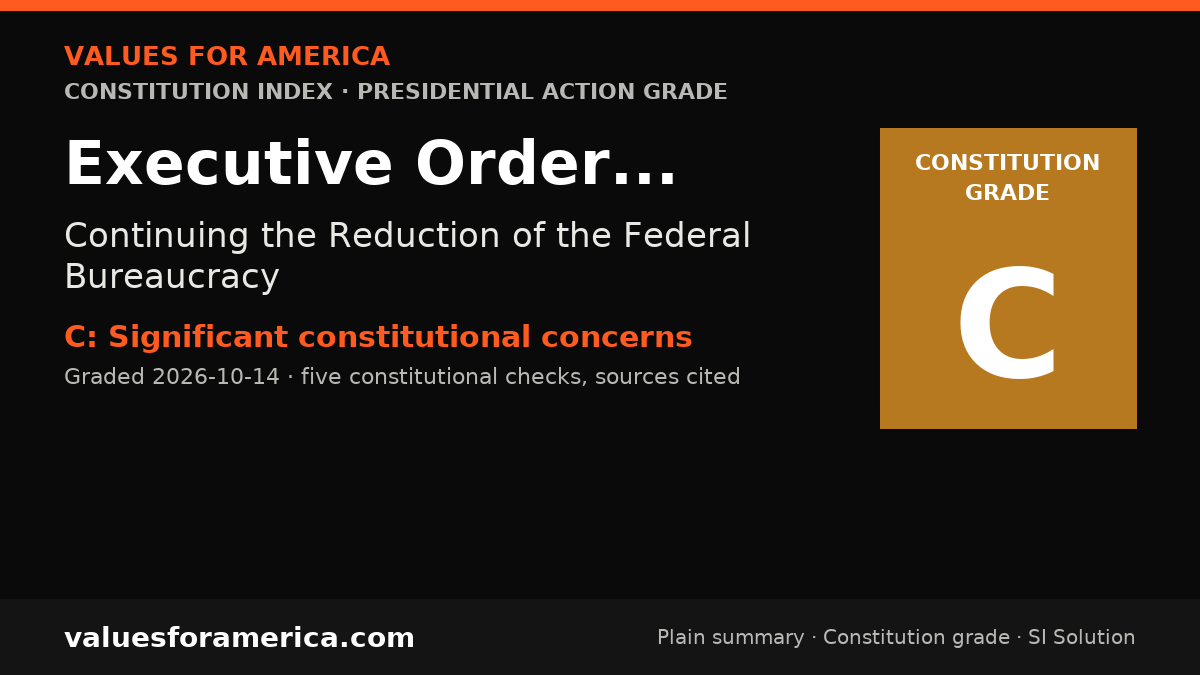
Continuing the Reduction of the Federal Bureaucracy
Signed: 2025-03-14 Published: 2025-03-20 Federal Register document: 2025-04868
Agencies: Executive Office of the President
What Executive Order 14238 says
Federal Register, Volume 90 Issue 53 (Thursday, March 20, 2025) [Federal Register Volume 90, Number 53 (Thursday, March 20, 2025)] [Presidential Documents] [Pages 13043-13044] From the Federal Register Online via the Government Publishing Office [www.gpo.gov] [FR Doc No: 2025-04868] Presidential Documents Federal Register / Vol. 90, No. 53 / Thursday, March 20, 2025 / Presidential Documents [[Page 13043]] Executive Order 14238 of March 14, 2025 Continuing the Reduction of the Federal Bureaucracy By the authority vested in me as President by the Constitution and the laws of the United States of America, it is hereby ordered: Section 1. Purpose. This order continues the reduction in the elements of the Federal bureaucracy that the President has determined are unnecessary. Sec. 2. Reducing the Scope of the Federal Bureaucracy. (a) Except as provided in subsection (b) of this section, the non-statutory components and functions of the following governmental entities shall be eliminated to the maximum extent consistent with applicable law, and such entities shall reduce the performance of their statutory functions and associated personnel to the minimum presence and function required by law: (i) the Federal Mediation and Conciliation Service; (ii) the United States Agency for Global Media; (iii) the Woodrow Wilson International Center for Scholars in the Smithsonian Institution...
Opening of the official text; read it in full in the Federal Register.
Constitution Index
“VFA Constitution grade”
Significant constitutional concerns
Graded 2026-10-14
SI-generated grade · five published checks · not individually reviewed by a person · methodology
Executive Order 14238 raises significant constitutional concerns primarily regarding the separation of powers and the President's authority to unilaterally eliminate or reduce non-statutory components and functions of federal entities. While the President has broad authority over the executive branch, the order's directive to reduce statutory functions to the 'minimum presence and function required by law' may encroach on Congress's power to establish and fund agencies under Article I, Section 8, Clause 18 (the Necessary and Proper Clause) and its exclusive power of the purse under Article I, Section 9, Clause 7. The order's attempt to limit funding requests to effectuate termination could also conflict with Congress's appropriations authority. However, the order does not directly infringe on individual rights, and its decentralization implications are mixed, as it reduces federal bureaucracy but may consolidate decision-making in the President. The order's savings clauses and reliance on 'applicable law' mitigate some concerns but do not fully resolve the structural issues.
-
✗ Concern · Enumerated powers
The President's authority to eliminate or reduce federal entities and their functions is not explicitly enumerated in Article II of the Constitution. While the President has executive power and the duty to 'take Care that the Laws be faithfully executed' (Article II, Section 3), this order goes beyond faithful execution by directing agencies to reduce statutory functions to the 'minimum presence a… -
✓ Passes · Bill of Rights
The order does not directly infringe on any rights protected by the Bill of Rights. It targets federal agencies and their functions, not individual speech, religion, assembly, press, petition, arms, quartering, search and seizure, self-incrimination, due process, takings, fair trial, jury, or cruel and unusual punishment. The order's impact on individuals is indirect, as it may affect services pro… -
✓ Passes · Individual sovereignty
The order does not restrict what individuals can do with their own person, property, speech, labor, or belief. It targets government entities and their operations, not individual conduct. While the elimination of certain agencies may affect individuals who rely on their services (e.g., the Institute of Museum and Library Services or the Minority Business Development Agency), this is a policy choic… -
✗ Concern · Decentralization
The order fails the decentralization test on two of four questions. (1) Individual or family: Could an individual or family handle the functions of these agencies without government? For some entities like the Woodrow Wilson International Center for Scholars or the Institute of Museum and Library Services, individuals could potentially access private alternatives, but for others like the Federal M… -
✓ Passes · Due process and takings
The order does not bypass due process or take property without just compensation. It does not impose penalties, adjudicate rights, or seize property. The order's impact on federal employees or contractors could raise due process concerns if implemented without proper procedures, but the order itself does not terminate individuals; it directs agencies to reduce functions and personnel to the minimu…
Report an error in this grade
What should happen instead
“VFA SI Solution”
No Solution yet
A sourced, Constitution-cited alternative appears here once one passes the SI Editorial Standard.

For journalists and bloggers
“Embed this grade”
Free to use with the link back. The badge and card update when the grade changes. Embed terms →
