Executive Order 14236 explained · Executive Order · No disposition noted
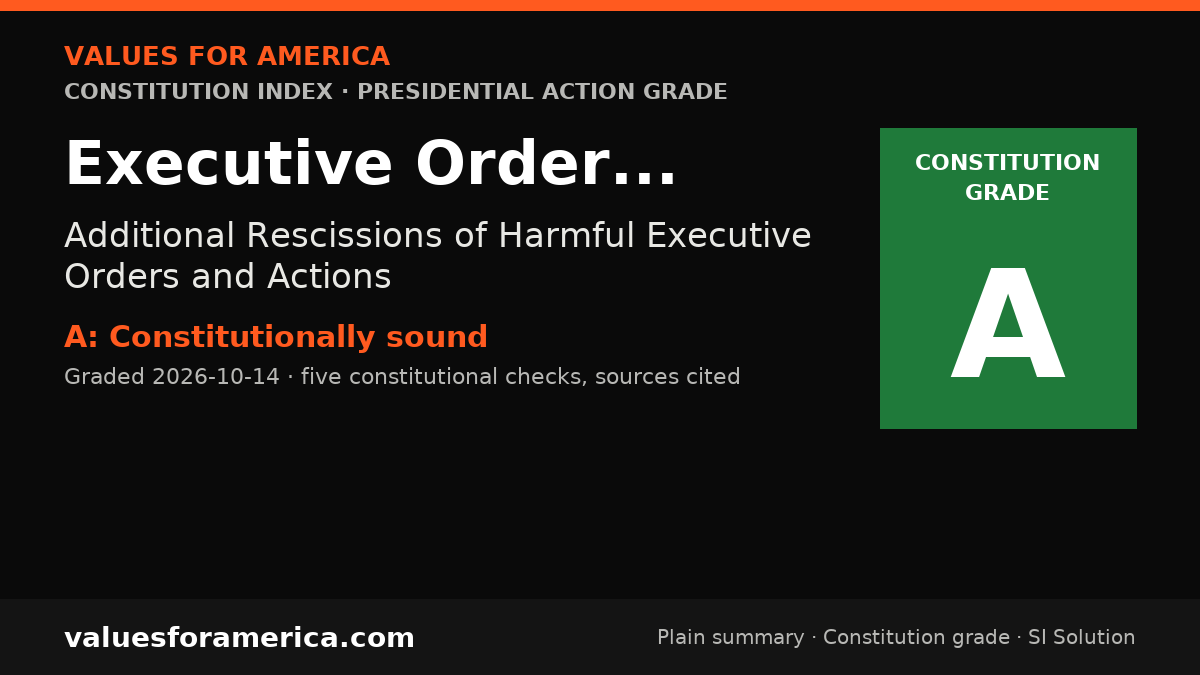
Additional Rescissions of Harmful Executive Orders and Actions
Signed: 2025-03-14 Published: 2025-03-20 Federal Register document: 2025-04866
Agencies: Executive Office of the President
Federal Register notes (as of 2026-10-19): Revokes: EO 13994, January 21, 2021; National Security Memo. 3, February 4, 2021; Memo. of February 4, 2021; EO 14026, April 27, 2021; Memo. of March 31, 2022; Presidential Determination No. 2022–13, May 18, 2022; Presidential Determination No. 2022–15, June 6, 2022; Presidential Determination No. 2022–16, June 6, 2022; Presidential Determination No. 2022–17, June 6, 2022; Presidential Determination No. 2022–18, June 6, 2022; EO 14081, September 12, 2022; Memo. of January 17, 2023; National Security Memorandum 18, February 23, 2023; Memo. of February 27, 2023; Memo. of November 16, 2023; EO 14112, December 6, 2023; EO 14119, March 6, 2024; EO 14126, September 6, 2024
What Executive Order 14236 says
Federal Register, Volume 90 Issue 53 (Thursday, March 20, 2025) [Federal Register Volume 90, Number 53 (Thursday, March 20, 2025)] [Presidential Documents] [Pages 13037-13038] From the Federal Register Online via the Government Publishing Office [www.gpo.gov] [FR Doc No: 2025-04866] Presidential Documents Federal Register / Vol. 90, No. 53 / Thursday, March 20, 2025 / Presidential Documents [[Page 13037]] Executive Order 14236 of March 14, 2025 Additional Rescissions of Harmful Executive Orders and Actions By the authority vested in me as President by the Constitution and the laws of the United States of America, it is hereby ordered: Section 1. Purpose. In Executive Order 14148 of January 20, 2025 (Initial Rescissions of Harmful Executive Orders and Actions), I rescinded 78 Presidential orders and memoranda issued by then-President Biden. I also directed the Assistant to the President for Domestic Policy, the Assistant to the President for Economic Policy, and the Assistant to the President for National Security Affairs to compile lists of additional orders, memoranda, and proclamations issued by the prior administration that should be rescinded. I have determined that the following additional rescissions are necessary to advance the policy of the United States to restore common sense to the Federal Government and unleash the potential of American citizens. Sec. 2. Revocation...
Opening of the official text; read it in full in the Federal Register.
Constitution Index
“VFA Constitution grade”
Constitutionally sound
Graded 2026-10-14
SI-generated grade · five published checks · not individually reviewed by a person · methodology
Executive Order 14236 is a straightforward revocation of prior executive orders and memoranda. The President has clear constitutional authority to manage the executive branch under Article II, including rescinding prior executive actions. The order does not infringe any rights, impose restrictions on individuals, or bypass due process. It passes all five constitutional checks with no issues.
-
✓ Passes · Enumerated powers
The President's authority to revoke prior executive orders and memoranda is inherent in the executive power vested by Article II, Section 1, Clause 1, and the Take Care Clause of Article II, Section 3. The order does not create new law or regulate private conduct; it merely rescinds prior presidential directives. No enumerated power is exceeded. -
✓ Passes · Bill of Rights
The order does not restrict speech, religion, assembly, press, petition, arms, quartering, search and seizure, self-incrimination, due process, takings, fair trial, jury, cruel and unusual punishment, unenumerated rights, or reserved powers. It is a purely administrative action affecting only prior executive branch directives. No Bill of Rights provision is implicated. -
✓ Passes · Individual sovereignty
The order imposes no restrictions on individual person, property, speech, labor, or belief. It does not command, prohibit, or regulate any private conduct. The revocation of prior executive orders may affect federal contractors or programs, but the order itself does not directly restrict individual sovereignty. The burden on government to justify restriction is not triggered because no restriction… -
✓ Passes · Decentralization
The order passes all four questions of the decentralization test. (1) Individuals and families are not affected; the order concerns only federal executive branch management. (2) Local communities are not involved. (3) States are not involved. (4) The action does not consolidate decision-making upward; it merely rescinds prior federal directives, potentially reducing federal involvement. The Tenth … -
✓ Passes · Due process and takings
The order does not deprive any person of life, liberty, or property without due process. It does not take private property for public use without just compensation. The order explicitly states it creates no enforceable rights or benefits (Section 3(c)), and must be implemented consistent with applicable law (Section 3(b)). No procedural or substantive due process issue arises.
Report an error in this grade
What should happen instead
“VFA SI Solution”
No Solution yet
A sourced, Constitution-cited alternative appears here once one passes the SI Editorial Standard.

For journalists and bloggers
“Embed this grade”
Free to use with the link back. The badge and card update when the grade changes. Embed terms →
