S.Res. 781 explained · 119th Congress · Agreed to in the Senate
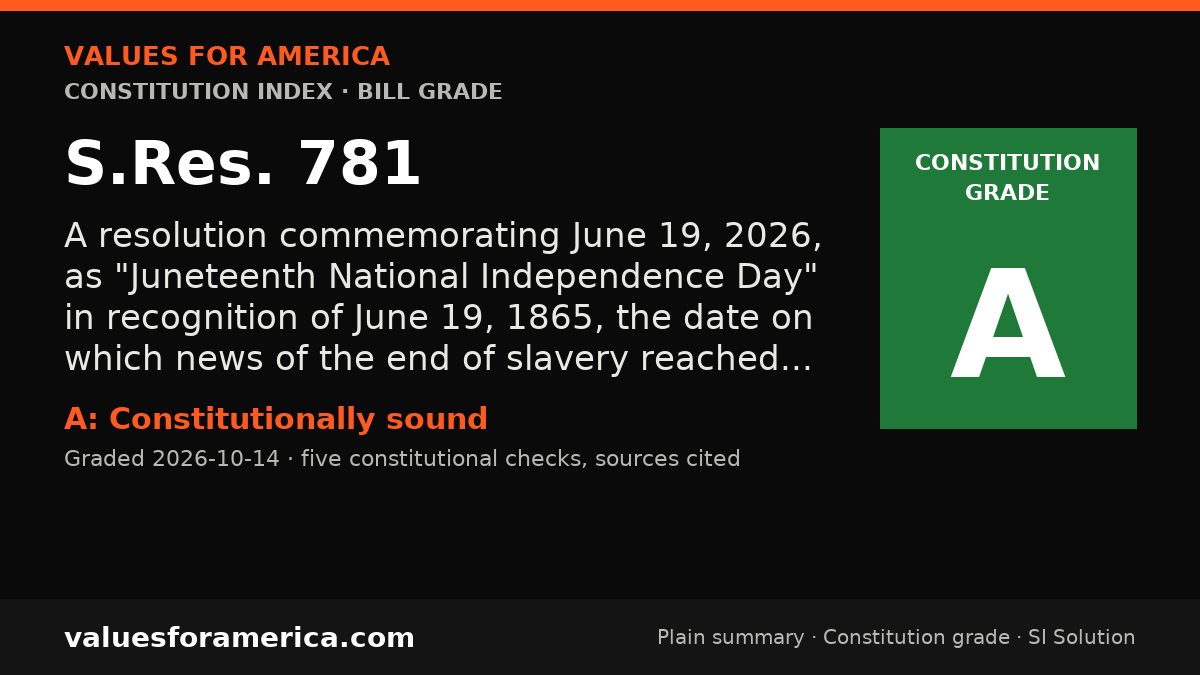
A resolution commemorating June 19, 2026, as "Juneteenth National Independence Day" in recognition of June 19, 1865, the date on which news of the end of slavery reached the slaves in the Southwestern States.
Cosponsors: 22 (13 D, 7 R, 2 other) · per Congress.gov, 2026-10-14
Introduced: 2026-06-18
Latest action (2026-07-27): Resolution agreed to in Senate without amendment and with a preamble by Unanimous Consent. (consideration: CR S4286)
What S.Res. 781 does, in plain terms
This resolution commemorates June 19, 2026, as Juneteenth National Independence Day to recognize and observe the end of slavery in the United States.
Official summary by the Congressional Research Service, via Congress.gov.
Constitution Index
“VFA Constitution grade”
Constitutionally sound
Graded 2026-10-14
SI-generated grade · five published checks · not individually reviewed by a person · methodology
This resolution is purely ceremonial and symbolic. It does not grant new powers, restrict rights, or take any property. It is a simple expression of congressional sentiment, fully within the legislative branch's authority to issue resolutions. No constitutional provision is violated.
-
✓ Passes · Enumerated powers
The resolution is a simple legislative expression, not a law with binding effect. The Constitution grants Congress the power to legislate on enumerated subjects (Article I, Section 8), and while a ceremonial resolution does not rely on a specific enumerated power, it is a customary exercise of legislative speech and internal procedure. It does not exceed any enumerated power because it imposes no … -
✓ Passes · Bill of Rights
The resolution does not infringe upon any right protected by the Bill of Rights. It does not restrict speech, religion, assembly, press, petition, arms, quartering, search and seizure, self-incrimination, due process, takings, trial rights, or cruel and unusual punishment. It is purely expressive and honors a historical event. -
✓ Passes · Individual sovereignty
The resolution does not restrict any individual's person, property, speech, labor, or belief. It imposes no mandates or prohibitions. It merely commemorates a date, which does not burden individual sovereignty in any way. -
✓ Passes · Decentralization
The resolution is a symbolic act by the Senate. It does not consolidate decision-making authority; it does not preempt state or local action. It is a non-binding expression that leaves all governance functions at their existing levels. It passes all four questions: individuals, local communities, and states are unaffected, and no decision-making is consolidated upward. -
✓ Passes · Due process and takings
The resolution does not affect any person's life, liberty, or property. It does not deprive anyone of due process or take property without just compensation. It is purely ceremonial and has no legal effect.
Sources: Congress.gov: SRES 781 summary
Report an error in this grade
What should pass
“VFA SI Solution”
Archived SI output (machine-generated) · No editorial review recorded
This historical draft has no editorial review time on record. Check its claims against the original bill and current law.
Juneteenth National Commemoration Act of 2026
Generated by VFA SI Solutions
Formally recognize June 19, 2026, as a national day of commemoration for the end of slavery in the United States, honoring the historical significance of Juneteenth.
Bipartisan rationale: Democratic priorities honored: Recognizing the historical significance of Juneteenth and the end of slavery, promoting racial justice and education, and honoring African American heritage. Republican priorities honored: Avoiding new federal mandates or spending, respecting state and local autonomy in commemorations, and using a non-binding resolution rather than creating a new federal holiday.
Report an error in this Solution
Citizen Consensus
“Do you support this VFA SI Solution?”
One vote per verified account; you can change it any time. Only verified accounts count, results publish once 30 verified people have voted, and state and district results count only people who attested a home ZIP code. How this works.
Email verification is not switched on yet, so no vote counts toward results yet. Votes cast now are saved and count once the voter verifies their email address.
Sign in or create a free account to vote.
Add a short reason (optional)
/280 · no links or contact details · reasons are reviewed before anyone sees them, and many never are shown.
Your vote is saved but held out of published results by an automated integrity check (for example, several accounts voting from one browser).
Your vote is saved. It will count once you verify your email address. Verify on your account page.
Your vote counts nationally. Add your home ZIP code to count in your state and district too.
Your vote counts nationally and in .
Reason saved privately; it is shown only if it passes review.
Verified participants nationwide · n =
Self-selected participants, not a random sample; ± is the 95% sampling margin.
Not enough verified votes yet. Results publish at verified votes.
A sudden surge of votes on this item was flagged and is under review; votes from new accounts in that surge are held out until it is resolved.
Related on VFA

For journalists and bloggers
“Embed this grade”
Free to use with the link back. The badge and card update when the grade changes. Embed terms →
