S.Res. 526 explained · 119th Congress · Agreed to in the Senate
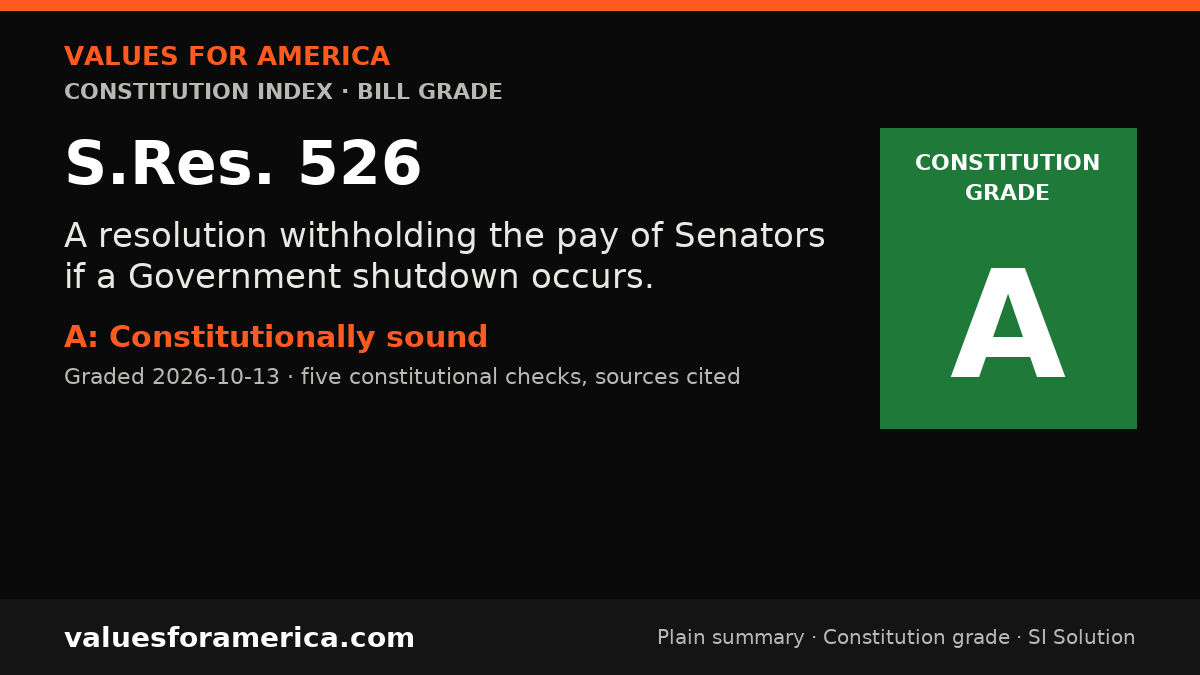
A resolution withholding the pay of Senators if a Government shutdown occurs.
Cosponsors: 4 (0 D, 4 R) · per Congress.gov, 2026-10-08
Introduced: 2025-12-03
Latest action (2026-05-14): Resolution agreed to in Senate without amendment by Voice Vote. (consideration: CR S2295)
What S.Res. 526 does, in plain terms
This resolution withholds compensation from Senators during any federal government shutdown (i.e., lapse in appropriations for one or more federal agencies or departments). Senators are to be paid as soon as practicable after the date on which the government shutdown ends. The restriction applies beginning on the day after the regularly scheduled general election for federal office held in November 2026. (As background, the U.S. Constitution provides that legislation varying the level of compensation paid to members of Congress may not take effect until an intervening election has occurred.)
Official summary by the Congressional Research Service, via Congress.gov.
Constitution Index
“VFA Constitution grade”
Constitutionally sound
Graded 2026-10-13
SI-generated grade · five published checks · not individually reviewed by a person · methodology
The resolution is a valid exercise of Congress's constitutional authority to set the compensation of its own members, and it explicitly respects the Twenty-Seventh Amendment's requirement that compensation changes take effect only after an intervening election. It does not infringe any constitutional right, does not take property without due process, and does not consolidate power upward—it actually withholds pay from federal legislators during a shutdown, which is a modest, self-imposed restriction that aligns with constitutional principles of accountability and separation of powers.
-
✓ Passes · Enumerated powers
Article I, Section 6, Clause 1 of the U.S. Constitution expressly authorizes Congress to determine the compensation of its members. The resolution is a direct exercise of that enumerated power. It does not regulate any external activity or exceed the scope of Congress's authority over its own internal operations. -
✓ Passes · Bill of Rights
The resolution does not implicate any provision of the Bill of Rights. It does not restrict speech, religion, assembly, press, petition, arms, quartering, search and seizure, self-incrimination, due process, trial rights, jury rights, cruel and unusual punishment, unenumerated rights, or reserved powers. It merely conditions the receipt of salary on the absence of a government shutdown, which is a… -
✓ Passes · Individual sovereignty
The resolution does not restrict any individual's person, property, speech, labor, or belief. It applies only to Senators, who are public officials voluntarily serving in office. The restriction is a condition of their public employment, not a general restriction on individual liberty. The government has a compelling interest in ensuring that its own officials are accountable for the continuity of… -
✓ Passes · Decentralization
The resolution does not consolidate decision-making at a higher level of government. It is a self-imposed rule by the Senate regarding its own members' pay. It does not involve individual, local, or state action because it concerns the internal operations of the federal legislature. The four-question test is not applicable in a way that would suggest a violation; the action is at the federal level… -
✓ Passes · Due process and takings
The resolution does not take property without just compensation. Senators' pay is not a vested property right; it is a salary subject to the conditions set by Congress under Article I, Section 6. The resolution provides clear notice and a clear rule: pay is withheld during a shutdown and restored afterward. There is no arbitrary or capricious action, and the Twenty-Seventh Amendment's requirement …
Sources: Congress.gov: SRES 526 summary
Report an error in this grade
What should pass
“VFA SI Solution”
No solution yet
A sourced SI draft appears here once it passes automated checks (Constitution citation, source verification, independent SI critic). How publication works.
Related on VFA

For journalists and bloggers
“Embed this grade”
Free to use with the link back. The badge and card update when the grade changes. Embed terms →
