S.J.Res. 89 explained · 119th Congress · Pending in Congress
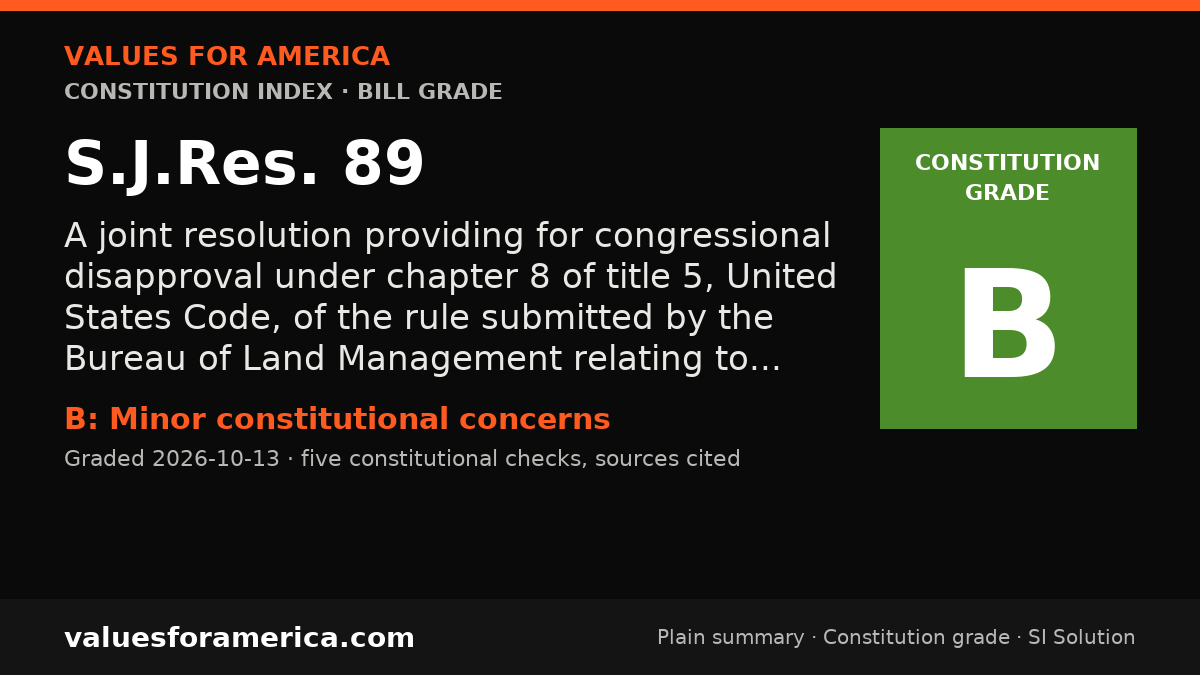
A joint resolution providing for congressional disapproval under chapter 8 of title 5, United States Code, of the rule submitted by the Bureau of Land Management relating to "Buffalo Field Office Record of Decision and Approved Resource Management Plan Amendment".
Cosponsors: 1 (0 D, 1 R) · per Congress.gov, 2026-10-10
Introduced: 2025-10-08
Latest action (2025-11-20): Indefinitely postponed by Senate by Unanimous Consent. (consideration: CR S8395)
What S.J.Res. 89 does, in plain terms
This joint resolution nullifies the rule submitted by the Bureau of Land Management (BLM) on November 20, 2024, which amended the 2015 resource management plan (RMP) for the Buffalo Field Office in Wyoming to make no federal coal available for future leasing. Thus, the joint resolution requires the BLM to follow the 2015 RMP as it was before it was amended in 2024 and make coal available for leasing. By way of background, the BLM developed the amendment to the plan in response to Western Organization of Resource Councils v. Bureau of Land Management. In that case, the court held that the BLM must evaluate the climate impacts of federal coal leasing in the Buffalo Field Office and include alternatives to limit or stop coal leasing in the evaluation in order to comply with the National Environmental Policy Act. After conducting the evaluation, the BLM amended the RMP and made BLM-managed coal resources in the Buffalo Field Office planning area unavailable for future leasing.
Official summary by the Congressional Research Service, via Congress.gov.
Constitution Index
“VFA Constitution grade”
Minor constitutional concerns
Graded 2026-10-13
SI-generated grade · five published checks · not individually reviewed by a person · methodology
The joint resolution is a valid exercise of Congress's legislative power to disapprove an agency rule under the Congressional Review Act. It does not infringe on individual rights, and it does not raise due process or takings concerns. However, it centralizes decision-making at the federal level regarding public lands, which are constitutionally subject to federal control under the Property Clause, but the resolution itself does not alter the constitutional allocation of power. The grade reflects a minor tension with decentralization principles, as the resolution maintains federal control over land use decisions that could arguably be handled at the state or local level.
-
✓ Passes · Enumerated powers
Congress has the enumerated power to make all needful rules and regulations respecting the territory or other property belonging to the United States under Article IV, Section 3, Clause 2. The joint resolution disapproves a rule regarding federal coal leasing on public lands, which is squarely within this authority. Additionally, the Congressional Review Act (5 U.S.C. §§ 801-808) provides a statut… -
✓ Passes · Bill of Rights
The resolution does not implicate any of the first ten amendments. It does not restrict speech, religion, assembly, press, petition, arms, quartering, search and seizure, self-incrimination, due process, takings, trial rights, or cruel and unusual punishment. It is a purely administrative action regarding federal land management. -
✓ Passes · Individual sovereignty
The resolution does not restrict individual liberty or property rights. It concerns the availability of federal coal for leasing, which is a government-owned resource. Individuals and corporations may lease federal coal, but the resolution does not impose new restrictions on their freedom; it simply reverses a prior administrative decision to make coal unavailable. There is no compelling constitut… -
✗ Concern · Decentralization
The resolution fails the decentralization test because it consolidates decision-making at the federal level. While the federal government has constitutional authority over federal lands, the decision to make coal available for leasing could arguably be made at the state or local level, as Wyoming has significant interest in its natural resources. However, the resolution does not directly violate t… -
✓ Passes · Due process and takings
The resolution does not bypass due process or take property without just compensation. It is a legislative action that disapproves an agency rule, which is a standard procedure under the Congressional Review Act. No individual's property is being taken; the resolution merely affects the availability of federal coal for future leasing, which is not a vested property right. There is no deprivation o…
Sources: Congress.gov: SJRES 89 summary
Report an error in this grade
What should pass
“VFA SI Solution”
No solution yet
A sourced SI draft appears here once it passes automated checks (Constitution citation, source verification, independent SI critic). How publication works.
Related on VFA

For journalists and bloggers
“Embed this grade”
Free to use with the link back. The badge and card update when the grade changes. Embed terms →
