S.J.Res. 88 explained · 119th Congress · Pending in Congress
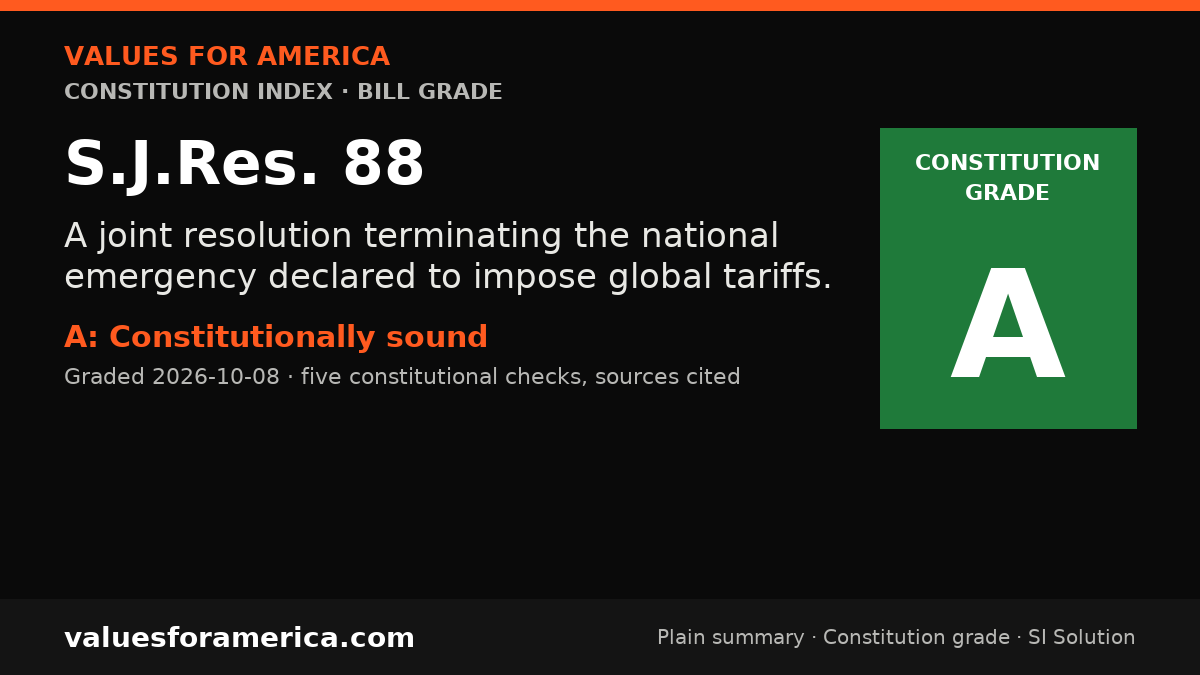
A joint resolution terminating the national emergency declared to impose global tariffs.
Cosponsors: 6 (5 D, 1 R) · per Congress.gov, 2026-10-10
Introduced: 2025-10-07
Latest action (2025-10-31): Held at the desk.
What S.J.Res. 88 does, in plain terms
This joint resolution terminates the national emergency declared by President Donald J. Trump on April 2, 2025, which imposed a 10% tariff on most imports to the United States and additional duties on specified trading partners.
Official summary by the Congressional Research Service, via Congress.gov.
Constitution Index
“VFA Constitution grade”
Constitutionally sound
Graded 2026-10-08
SI-generated grade · five published checks · not individually reviewed by a person · methodology
SJRES 88 is constitutional. It restores Congress as tariff-maker under Article I, Section 8, Clauses 1 and 3, ends emergency executive duties, and expands individual economic liberty with no rights infringement or due-process loss.
-
✓ Passes · Enumerated powers
Congress holds explicit tariff and commerce authority under Article I, Section 8, Clause 1 to lay duties, and Clause 3 to regulate commerce with foreign nations. A joint resolution ending an executive-declared emergency and restoring congressional control over duties is within that grant and corrects executive exercise of legislative power under Article I, Section 1. -
✓ Passes · Bill of Rights
Terminating emergency tariffs removes a federal burden on speech-adjacent commercial activity and private transactions rather than infringing the first ten amendments. No provision authorizes search, seizure, compelled testimony, or punishment without trial. Under the First Amendment and the Tenth Amendment reservation of unlisted powers, ending the emergency expands rather than restricts liberty. -
✓ Passes · Individual sovereignty
The measure reduces government restriction on what persons may buy, sell, import, and use in their labor and property. Emergency-based 10% global tariffs raised costs and limited voluntary exchange without compelling constitutional justification. Termination returns the burden to the government to justify any future duty, consistent with individual sovereignty. -
✓ Passes · Decentralization
Foreign commerce and uniform tariff policy cannot be handled by individuals, counties, or single states without fragmenting national trade policy. The action de-consolidates power: it ends unilateral executive emergency rule and restores Congress as the minimum necessary national decision-maker under the Tenth Amendment. Therefore upward consolidation is false. -
✓ Passes · Due process and takings
The resolution bypasses no hearing and takes no property. It ends an emergency tariff regime that functioned as a broad exaction on importers and consumers without individualized notice or hearing under the Fifth Amendment Due Process Clause. Restoring normal legislative tariff-setting improves procedural regularity and avoids a Takings Clause concern.
Sources: Congress.gov: SJRES 88 summary
Report an error in this grade
What should pass
“VFA SI Solution”
No solution yet
A sourced SI draft appears here once it passes automated checks (Constitution citation, source verification, independent SI critic). How publication works.
Related on VFA

For journalists and bloggers
“Embed this grade”
Free to use with the link back. The badge and card update when the grade changes. Embed terms →
