S.J.Res. 82 explained · 119th Congress · Pending in Congress
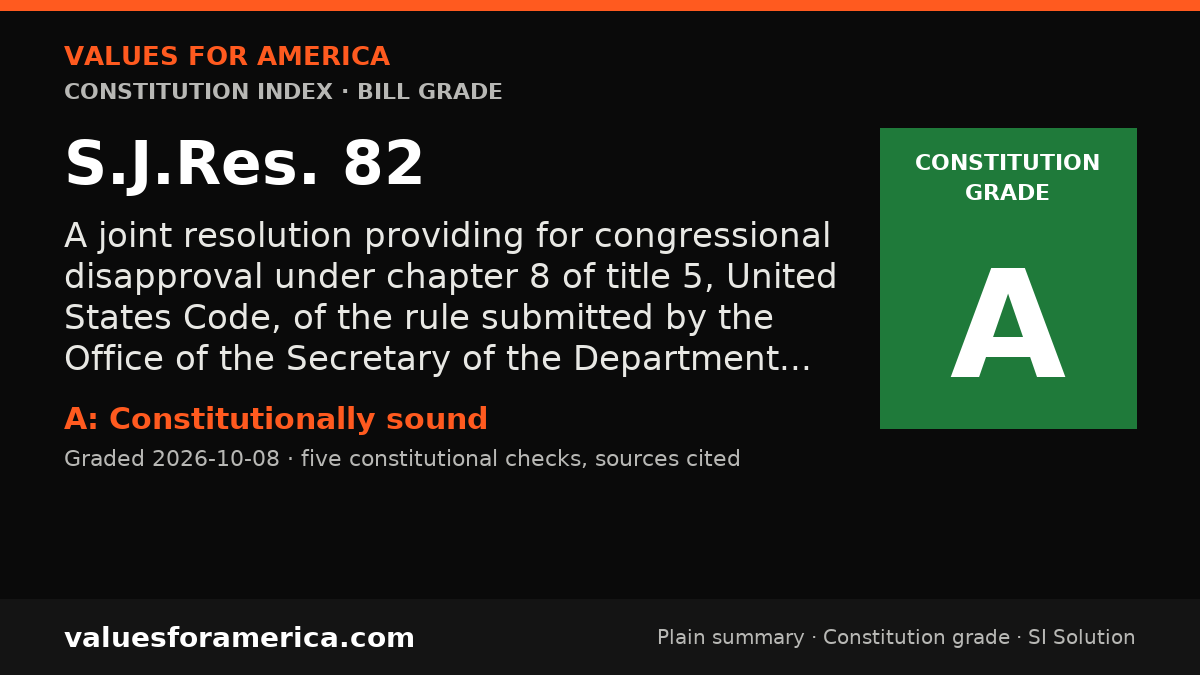
A joint resolution providing for congressional disapproval under chapter 8 of title 5, United States Code, of the rule submitted by the Office of the Secretary of the Department of Health and Human Services relating to "Policy on Adhering to the Text of the Administrative Procedure Act".
Cosponsors: 37 (37 D, 0 R) · per Congress.gov, 2026-10-09
Introduced: 2025-09-18
Latest action (2025-12-18): Failed of passage in Senate by Yea-Nay Vote. 50 - 50. Record Vote Number: 654.
What S.J.Res. 82 does, in plain terms
The Congressional Research Service has not published a summary of S.J.Res. 82 yet. Its official title: “A joint resolution providing for congressional disapproval under chapter 8 of title 5, United States Code, of the rule submitted by the Office of the Secretary of the Department of Health and Human Services relating to "Policy on Adhering to the Text of the Administrative Procedure Act".”.
Constitution Index
“VFA Constitution grade”
Constitutionally sound
Graded 2026-10-08
SI-generated grade · five published checks · not individually reviewed by a person · methodology
S.J.Res.82 is a constitutional exercise of congressional oversight: it uses the lawful Congressional Review Act process to disapprove an HHS policy, infringes no rights, restricts no individual, consolidates no power, and denies no due process.
-
✓ Passes · Enumerated powers
Congress has explicit authority to legislate and to check executive rulemaking. Article I, Section 1 vests legislative power in Congress, and Article I, Section 8, Clause 18 (Necessary and Proper Clause) supports the Congressional Review Act framework at 5 U.S.C. chapter 8. A joint resolution disapproving an HHS rule and providing it shall have no force or effect is a direct exercise of that legis… -
✓ Passes · Bill of Rights
S.J.Res.82 imposes no restriction on speech, religion, press, assembly, arms, searches, trial rights, or other Bill of Rights guarantees. It is a one-sentence congressional disapproval under the Congressional Review Act. It does not criminalize conduct, authorize surveillance, or delegate enforcement against individuals. No First through Tenth Amendment infringement. First Amendment and Fourth Ame… -
✓ Passes · Individual sovereignty
The resolution restricts no person in use of their person, property, speech, labor, or belief. It directs no mandate, prohibition, tax, or condition on private conduct. It operates only on the legal status of an executive-branch policy statement. The government bears no additional justification burden because no individual liberty is curtailed. -
✓ Passes · Decentralization
Oversight of a federal agency rule is an inherently federal function under Article I, Section 1 and Article I, Section 8, Clause 18. (1) Individuals and families cannot nullify a federal HHS policy statement. (2) Local communities and counties have no authority over federal rulemaking procedure. (3) States have no authority to disapprove a federal rule under 5 U.S.C. chapter 8. (4) The resolution … -
✓ Passes · Due process and takings
The resolution bypasses no notice, hearing, or presumption of innocence and takes no property under the Fifth Amendment Due Process and Takings Clauses. It creates no penalty or seizure. If anything, disapproving a Policy on Adhering to the Text of the Administrative Procedure Act relates to preserving Administrative Procedure Act notice-and-comment safeguards, which support procedural due process…
Sources: Official text: SJRES 82 (Placed on Calendar Senate)
Report an error in this grade
What should pass
“VFA SI Solution”
No solution yet
A sourced SI draft appears here once it passes automated checks (Constitution citation, source verification, independent SI critic). How publication works.
Related on VFA

For journalists and bloggers
“Embed this grade”
Free to use with the link back. The badge and card update when the grade changes. Embed terms →
