S.J.Res. 81 explained · 119th Congress · Pending in Congress
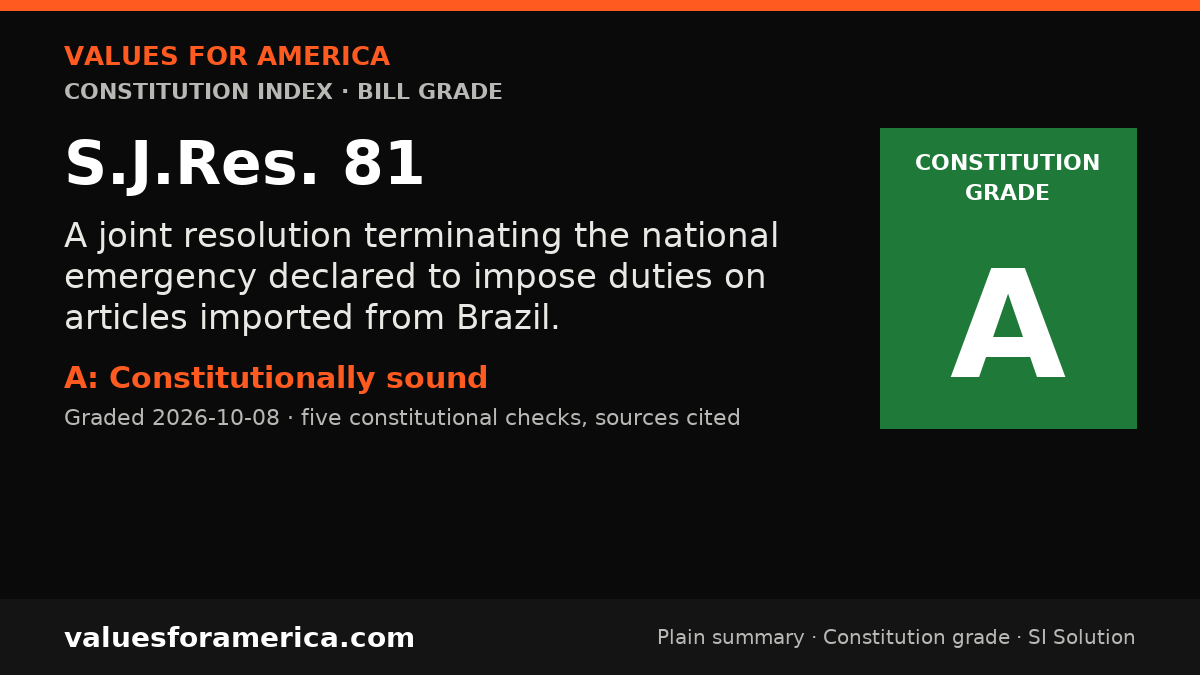
A joint resolution terminating the national emergency declared to impose duties on articles imported from Brazil.
Cosponsors: 10 (7 D, 1 R, 2 other) · per Congress.gov, 2026-10-10
Introduced: 2025-09-18
Latest action (2025-10-31): Held at the desk.
What S.J.Res. 81 does, in plain terms
This joint resolution terminates the national emergency that was declared by President Donald J. Trump in an executive order on July 30, 2025, that also imposed an additional 40% tariff on certain imports from Brazil based on the emergency declaration. (The executive order exempted certain products, such as civil aircraft and parts, wood pulp, precious metals, energy and energy products, and fertilizers, from this additional tariff.)
Official summary by the Congressional Research Service, via Congress.gov.
Constitution Index
“VFA Constitution grade”
Constitutionally sound
Graded 2026-10-08
SI-generated grade · five published checks · not individually reviewed by a person · methodology
SJRES 81 is constitutional. It uses explicit Article I foreign-commerce and duties powers to end an emergency-based 40% Brazil tariff, infringes no Bill of Rights protection, expands individual economic liberty, keeps foreign trade at the proper federal level while reducing emergency executive concentration, and creates no due process or takings issue.
-
✓ Passes · Enumerated powers
Congress has explicit authority over foreign commerce and duties under Article I, Section 8, Clauses 1 and 3, including power to lay and collect imposts and to regulate commerce with foreign nations. Terminating a declared national emergency and the duties imposed under it is a direct exercise of that legislative authority and of congressional control over delegated emergency powers. -
✓ Passes · Bill of Rights
Terminates a 40% additional tariff and emergency regime rather than imposing a new restriction. No speech, religion, press, arms, search, trial, or other First through Eighth Amendment right is infringed. If anything, removal of import duties reduces government burden on purchasing, selling, and contracting liberty protected under the First, Fifth, and Ninth Amendments. -
✓ Passes · Individual sovereignty
Imposes no new restraint on person, property, speech, labor, or belief. It removes a 40% surcharge on certain Brazil-origin goods, expanding individual freedom to buy, sell, import, and contract. The government needs no additional justification because liberty is expanded, not restricted. -
✓ Passes · Decentralization
Foreign commerce and import duties cannot be handled by individuals, counties, or single states without fragmentation and retaliation. Article I, Section 10 limits state power over imposts and foreign compacts. Federal handling is the minimum necessary level, and this resolution moves power downward from emergency executive control back to normal congressional control, so it does not consolidate u… -
✓ Passes · Due process and takings
Creates no criminal liability, no seizure, no forfeiture, and no physical or regulatory taking under the Fifth Amendment. It restores normal notice-and-process customs administration and ends emergency-based duties, reducing rather than creating procedural or substantive due process risk.
Sources: Congress.gov: SJRES 81 summary
Report an error in this grade
What should pass
“VFA SI Solution”
No solution yet
A sourced SI draft appears here once it passes automated checks (Constitution citation, source verification, independent SI critic). How publication works.
Related on VFA

For journalists and bloggers
“Embed this grade”
Free to use with the link back. The badge and card update when the grade changes. Embed terms →
