S.J.Res. 77 explained · 119th Congress · Pending in Congress
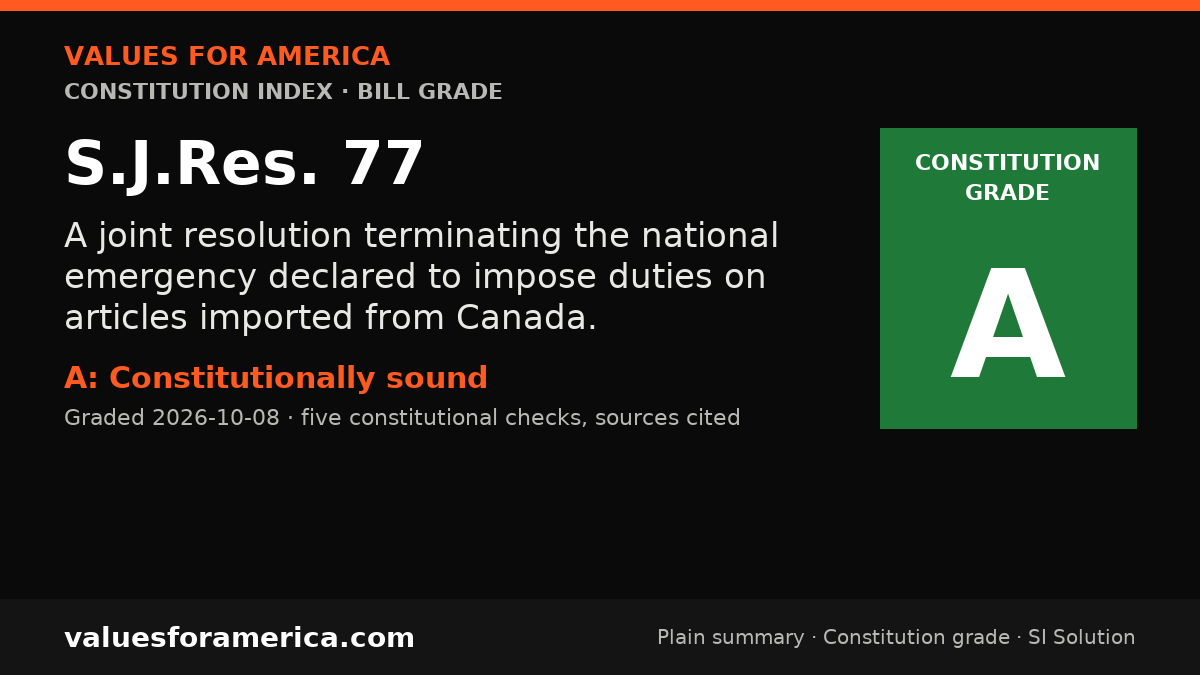
A joint resolution terminating the national emergency declared to impose duties on articles imported from Canada.
Cosponsors: 16 (11 D, 3 R, 2 other) · per Congress.gov, 2026-10-10
Introduced: 2025-09-16
Latest action (2025-10-31): Held at the desk.
What S.J.Res. 77 does, in plain terms
This joint resolution terminates the national emergency declared by President Donald J. Trump on February 1, 2025, which imposed an additional 25% tariff on most imports from Canada (except for Canadian energy or energy resources, which have an additional 10% tariff).
Official summary by the Congressional Research Service, via Congress.gov.
Constitution Index
“VFA Constitution grade”
Constitutionally sound
Graded 2026-10-08
SI-generated grade · five published checks · not individually reviewed by a person · methodology
SJRES 77 is constitutional. Congress uses its Article I foreign-commerce and duties powers to end an executive emergency tariff on Canada, removing a burden on peaceful exchange, restoring legislative process, and pushing power away from unilateral executive control. No rights infringement or overreach.
-
✓ Passes · Enumerated powers
Congress holds explicit authority over foreign commerce under Article I, Section 8, Clause 3, and over duties under Article I, Section 8, Clause 1. Terminating a declared national emergency is also authorized by statute under the National Emergencies Act and reflects Congress exercising its Article I, Section 1 legislative power to check executive action. The joint resolution stays within enumerat… -
✓ Passes · Bill of Rights
Terminates rather than imposes a burden; infringes no right under Amendments 1-10. To the contrary it removes a government-imposed restraint on peaceful exchange and on the First Amendment right to petition regarding trade policy. No speech, arms, search, trial, or other Bill of Rights interest is restricted. Cites First Amendment and Tenth Amendment. -
✓ Passes · Individual sovereignty
Expands rather than restricts sovereignty over person, property, labor, and exchange by removing a 25 percent surcharge (10 percent on energy) on Canadian goods. American buyers, sellers, and workers regain freedom to contract across the border without the emergency penalty. Government bears the burden to justify trade restraints; no compelling constitutional justification for the emergency surcha… -
✓ Passes · Decentralization
Foreign commerce with Canada cannot be handled by an individual, county, or single state without fragmentation and retaliation; the minimum necessary level is the federal government under Article I, Section 8, Clause 3. This measure does not consolidate upward -- it de-consolidates by ending a unilateral executive emergency regime and restoring congressional control under Article I, Section 1 and … -
✓ Passes · Due process and takings
Imposes no penalty, seizure, or taking and creates no ex parte adjudication. It restores procedural regularity by requiring that duties be imposed through Article I legislative process with notice, deliberation, and vote, rather than by open-ended emergency declaration. No Fifth Amendment procedural due process, substantive due process, or Takings Clause violation. Cites Fifth Amendment Due Proces…
Sources: Congress.gov: SJRES 77 summary
Report an error in this grade
What should pass
“VFA SI Solution”
No solution yet
A sourced SI draft appears here once it passes automated checks (Constitution citation, source verification, independent SI critic). How publication works.
Related on VFA

For journalists and bloggers
“Embed this grade”
Free to use with the link back. The badge and card update when the grade changes. Embed terms →
