S.J.Res. 55 explained · 119th Congress · Pending in Congress
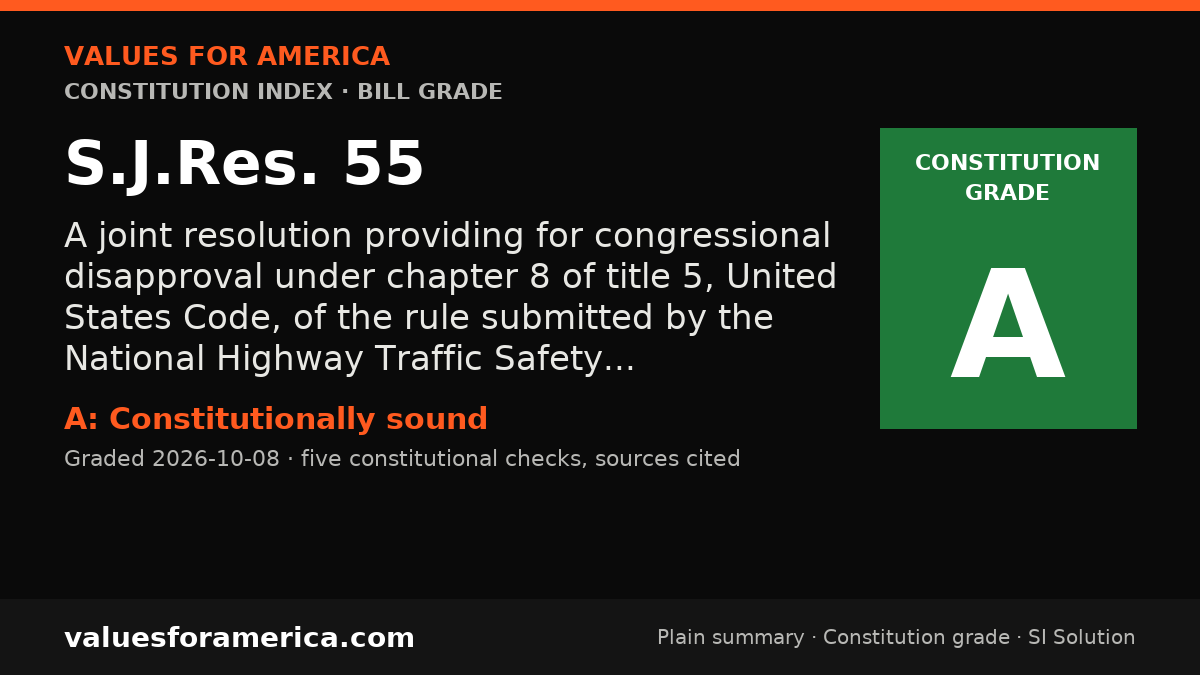
A joint resolution providing for congressional disapproval under chapter 8 of title 5, United States Code, of the rule submitted by the National Highway Traffic Safety Administration relating to "Federal Motor Vehicle Safety Standards; Fuel System Integrity of Hydrogen Vehicles; Compressed Hydrogen Storage System Integrity; Incorporation by Reference".
Cosponsors: none · per Congress.gov, 2026-10-11
Introduced: 2025-05-19
Latest action (2025-05-26): Held at the desk.
What S.J.Res. 55 does, in plain terms
This joint resolution nullifies the final rule issued by the National Highway Traffic Safety Administration titled Federal Motor Vehicle Safety Standards; Fuel System Integrity of Hydrogen Vehicles; Compressed Hydrogen Storage System Integrity; Incorporation by Reference and published on January 17, 2025. This final rule establishes two new Federal Motor Vehicle Safety Standards (FMVSS) specifying performance requirements for all motor vehicles that use hydrogen as a fuel source. FMVSS No. 307 sets requirements for the fuel system in hydrogen vehicles during normal vehicle operations and after crashes, as well as performance requirements for the hydrogen fuel system. FMVSS No. 308 regulates the compressed hydrogen storage system (CHSS) and includes performance requirements intended to ensure the CHSS is unlikely to leak or burst during use. It also specifies performance requirements for different CHSS closure devices (i.e., the check valves, shut-off valves, and thermally activated pressure relief devices that control the flow of hydrogen into or out of a CHSS). The final rule is based on Global Technical Regulation (GTR) No. 13, Hydrogen and Fuel Cell Vehicles. As background, the United States is a contracting party to a 1998 agreement that is administered by the UN Economic Commission for Europe's World Forum for the Harmonization of Vehicle Regulations and concerns the establishment of GTRs.
Official summary by the Congressional Research Service, via Congress.gov.
Constitution Index
“VFA Constitution grade”
Constitutionally sound
Graded 2026-10-08
SI-generated grade · five published checks · not individually reviewed by a person · methodology
SJRES 55 is a constitutional exercise of congressional legislative power that repeals a federal agency safety mandate for hydrogen vehicles. It violates no rights, takes no property, affords full legislative process, and decentralizes decision-making away from federal agency and foreign-harmonized standard-setting toward states and markets.
-
✓ Passes · Enumerated powers
Congress acts within explicit constitutional authority. Article I, Section 1 vests legislative power in Congress and Article I, Section 7 prescribes bicameralism and presentment, which a joint resolution of disapproval under 5 U.S.C. chapter 8 follows. Nullifying an executive-branch safety rule is a proper exercise of that legislative and oversight power, unlike the underlying agency claim to broa… -
✓ Passes · Bill of Rights
The resolution restricts no speech, religion, press, arms, search, trial or other protected right. No First Amendment, Second Amendment, or Fourth Amendment interest is infringed. It removes a federal performance mandate on vehicle design rather than imposing one, so no provision of the Bill of Rights is triggered. -
✓ Passes · Individual sovereignty
The resolution expands rather than restricts individual sovereignty. It lifts a federal design mandate affecting what manufacturers may build and what persons may buy, own, and use as personal property, protected under the Ninth Amendment and Tenth Amendment. The government bears the burden to justify restrictions on person, property, and labor, and here Congress removes the restriction instead of… -
✓ Passes · Decentralization
This resolution moves power downward, not upward. Individuals and counties cannot realistically set crash and compressed-storage test protocols for hydrogen fuel systems sold in interstate commerce, and states can regulate vehicle use, tort liability, and road safety under their police powers reserved by the Tenth Amendment. The action satisfies the Tenth Amendment because it withdraws a federal a… -
✓ Passes · Due process and takings
No person is deprived of life, liberty, or property under the Fifth Amendment Due Process Clause, and no property is taken for public use under the Fifth Amendment Takings Clause. The resolution imposes no penalty, seizure, or compliance cost; it cancels a future regulatory obligation through public bicameral action with presentment under Article I, Section 7, preserving fair notice.
Sources: Congress.gov: SJRES 55 summary
Report an error in this grade
What should pass
“VFA SI Solution”
No solution yet
A sourced SI draft appears here once it passes automated checks (Constitution citation, source verification, independent SI critic). How publication works.
Related on VFA

For journalists and bloggers
“Embed this grade”
Free to use with the link back. The badge and card update when the grade changes. Embed terms →
