S.J.Res. 47 explained · 119th Congress · Pending in Congress
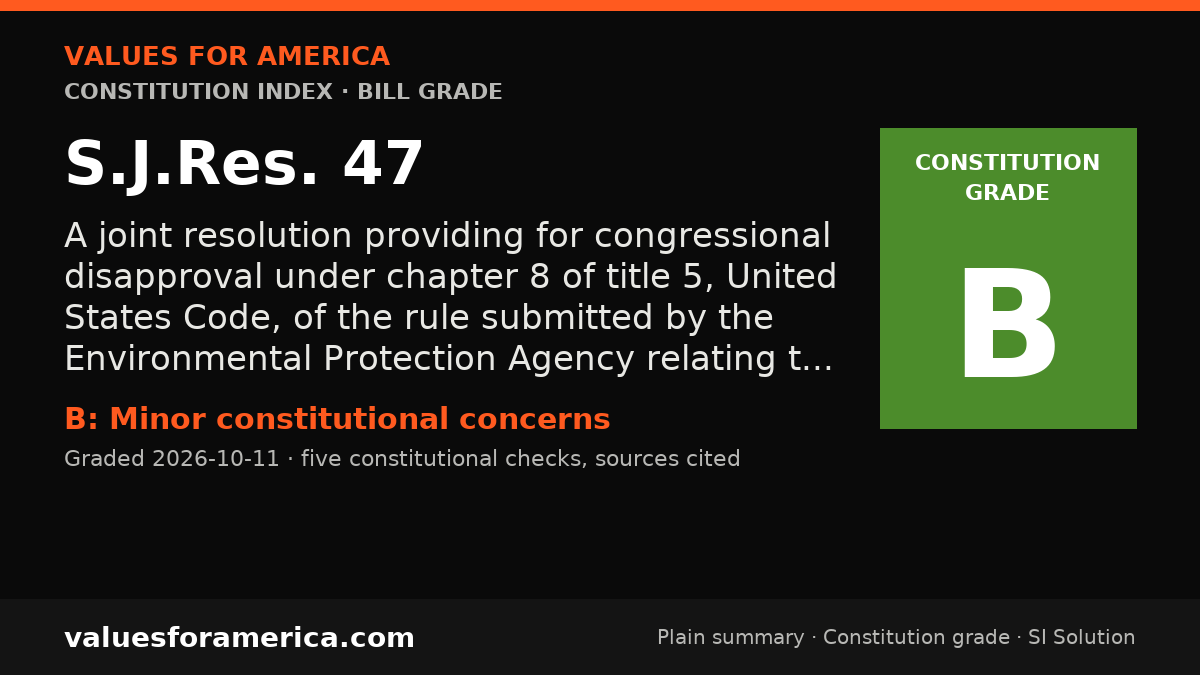
A joint resolution providing for congressional disapproval under chapter 8 of title 5, United States Code, of the rule submitted by the Environmental Protection Agency relating to "California State Motor Vehicle and Engine and Nonroad Engine Pollution Control Standards; The 'Omnibus' Low NOx Regulation; Waiver of Preemption; Notice of Decision".
Cosponsors: 13 (0 D, 13 R) · per Congress.gov, 2026-10-11
Introduced: 2025-04-04
Latest action (2025-04-04): Read twice and referred to the Committee on Environment and Public Works.
What S.J.Res. 47 does, in plain terms
This joint resolution nullifies the Environmental Protection Agency notice titled California State Motor Vehicle and Engine and Nonroad Engine Pollution Control Standards; The ‘Omnibus’ Low NOX Regulation; Waiver of Preemption; Notice of Decision (90 Fed. Reg. 643) and published on January 6, 2025. Among other elements, the notice grants the California Air Resources Board request for a waiver for its Heavy-Duty Vehicle and Engine Omnibus Low NOX regulations. (Under the Clean Air Act, California may seek waivers of the preemption prohibiting states from enacting certain emission standards.)
Official summary by the Congressional Research Service, via Congress.gov.
Constitution Index
“VFA Constitution grade”
Minor constitutional concerns
Graded 2026-10-11
SI-generated grade · five published checks · not individually reviewed by a person · methodology
The joint resolution is a constitutionally sound exercise of Congress's legislative oversight authority under the Congressional Review Act, which is rooted in Article I, Section 7 and the Necessary and Proper Clause. It does not infringe on individual rights, and it actually promotes decentralization by allowing states to set their own standards while preserving federal oversight. The only minor concern is the potential for Congress to override state environmental policy, but this is within its enumerated powers and does not rise to a significant constitutional issue.
-
✓ Passes · Enumerated powers
Congress has the enumerated power to legislate on interstate commerce (Article I, Section 8, Clause 3) and to make all laws necessary and proper for executing its powers (Article I, Section 8, Clause 18). The Clean Air Act, under which the EPA waiver was granted, is a valid exercise of the commerce power. The Congressional Review Act, which authorizes this joint resolution, is a procedural mechani… -
✓ Passes · Bill of Rights
The resolution does not implicate any of the first ten amendments. It does not restrict speech, religion, assembly, press, petition, arms, quartering, search and seizure, self-incrimination, due process, takings, fair trial, jury, cruel and unusual punishment, or unenumerated rights. It is a purely legislative action regarding administrative rulemaking. -
✓ Passes · Individual sovereignty
The resolution does not restrict individual liberty. It nullifies an EPA waiver that would have allowed California to enforce stricter emission standards. While this may affect the regulatory environment, it does not directly restrict what individuals can do with their person, property, speech, labor, or belief. The burden of justification for any indirect effect is met by Congress's broad authori… -
✓ Passes · Decentralization
The resolution does not consolidate decision-making at a higher level of government. On the contrary, it removes a federal waiver that would have allowed California to set its own standards, thereby reducing federal involvement in state environmental policy. This aligns with the principle of decentralization, as it allows states to make their own choices without federal preemption. The four-questi… -
✓ Passes · Due process and takings
The resolution does not bypass due process or take property without just compensation. It is a legislative action that follows the procedures of the Congressional Review Act, which provides for congressional disapproval of agency rules. There is no deprivation of life, liberty, or property without due process, and no taking of private property for public use without just compensation.
Sources: Congress.gov: SJRES 47 summary
Report an error in this grade
What should pass
“VFA SI Solution”
No solution yet
A sourced SI draft appears here once it passes automated checks (Constitution citation, source verification, independent SI critic). How publication works.
Related on VFA

For journalists and bloggers
“Embed this grade”
Free to use with the link back. The badge and card update when the grade changes. Embed terms →
