S.J.Res. 31 explained · 119th Congress · Became law
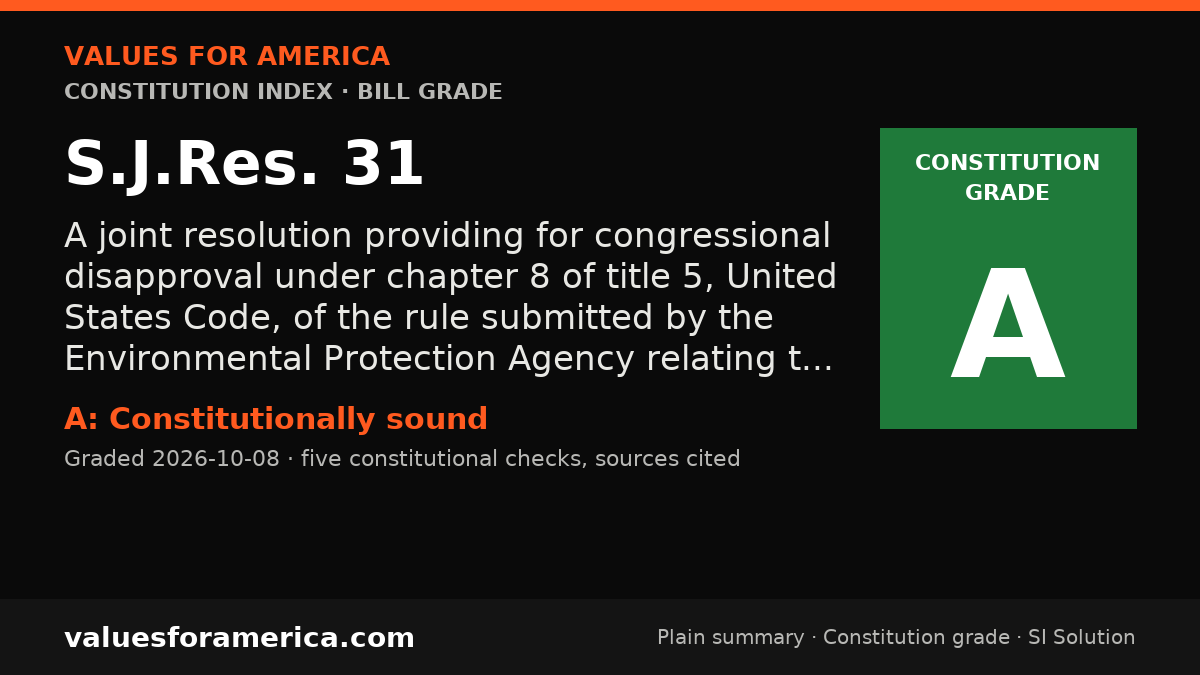
A joint resolution providing for congressional disapproval under chapter 8 of title 5, United States Code, of the rule submitted by the Environmental Protection Agency relating to "Review of Final Rule Reclassification of Major Sources as Area Sources Under Section 112 of the Clean Air Act".
Cosponsors: 5 (0 D, 5 R) · per Congress.gov, 2026-10-11
Introduced: 2025-03-06
Latest action (2025-06-20): Became Public Law No: 119-20.
What S.J.Res. 31 does, in plain terms
This joint resolution removes the requirements for sources of persistent and bioaccumulative hazardous air pollutants to comply with certain major source emissions standards when those sources reclassify as area sources (which have less stringent standards). Specifically, the joint resolution nullifies the Environmental Protection Agency rule titled Review of Final Rule Reclassification of Major Sources as Area Sources Under Section 112 of the Clean Air Act. The rule requires sources that seek to reclassify as area sources to implement certain control methods (e.g., continue to employ emission control methods required under the major sources requirements) to ensure they do not increase emissions beyond the major source requirements applicable at the time of reclassification.
Official summary by the Congressional Research Service, via Congress.gov.
Constitution Index
“VFA Constitution grade”
Constitutionally sound
Graded 2026-10-08
SI-generated grade · five published checks · not individually reviewed by a person · methodology
Constitutional oversight that stays inside enumerated commerce and oversight powers, infringes no rights, expands individual and state latitude, and uses lawful process. Grade A.
-
✓ Passes · Enumerated powers
Congress acts within explicit authority. Article I, Section 8, Clause 3 gives Congress power over interstate commerce, the established basis for Clean Air Act regulation of interstate emissions. Article I, Section 8, Clause 18 authorizes laws necessary and proper to oversee and limit executive implementation, exercised here through the Congressional Review Act in chapter 8 of title 5. Disapproving… -
✓ Passes · Bill of Rights
This resolution restricts government regulation rather than individual liberty. It does not limit speech, religion, press, assembly under the First Amendment, does not implicate the Second, Third, Fourth, Sixth, Seventh, or Eighth Amendments, and does not authorize searches, seizures, or compelled testimony under the Fourth and Fifth Amendments. By removing an added regulatory condition on reclass… -
✓ Passes · Individual sovereignty
The resolution lessens federal restraint on private persons, property use, and labor by nullifying a requirement to retain major-source controls after becoming an area source. It adds no new prohibition on speech, belief, work, or property. Any remaining area-source standards must still be justified by the government, but this measure itself expands rather than contracts individual sovereignty. -
✓ Passes · Decentralization
Emissions control involves interstate spillovers that individuals and single counties cannot fully handle, so some government role remains. However this measure moves power downward: it blocks a federal agency from locking sources into major-source controls after reclassification, preserving room for state implementation of Clean Air Act area-source standards under 42 U.S.C. cooperative federalism… -
✓ Passes · Due process and takings
No person is deprived of life, liberty, or property without process under the Fifth Amendment Due Process Clause, and no property is taken for public use under the Fifth Amendment Takings Clause. The resolution itself went through bicameralism and presentment under Article I, Section 7, with fair notice via chapter 8 of title 5 disapproval procedures. It reduces compliance burdens rather than impo…
Sources: Congress.gov: SJRES 31 summary
Report an error in this grade
What should pass
“VFA SI Solution”
No solution yet
A sourced SI draft appears here once it passes automated checks (Constitution citation, source verification, independent SI critic). How publication works.
Related on VFA

For journalists and bloggers
“Embed this grade”
Free to use with the link back. The badge and card update when the grade changes. Embed terms →
