S.J.Res. 29 explained · 119th Congress · Pending in Congress
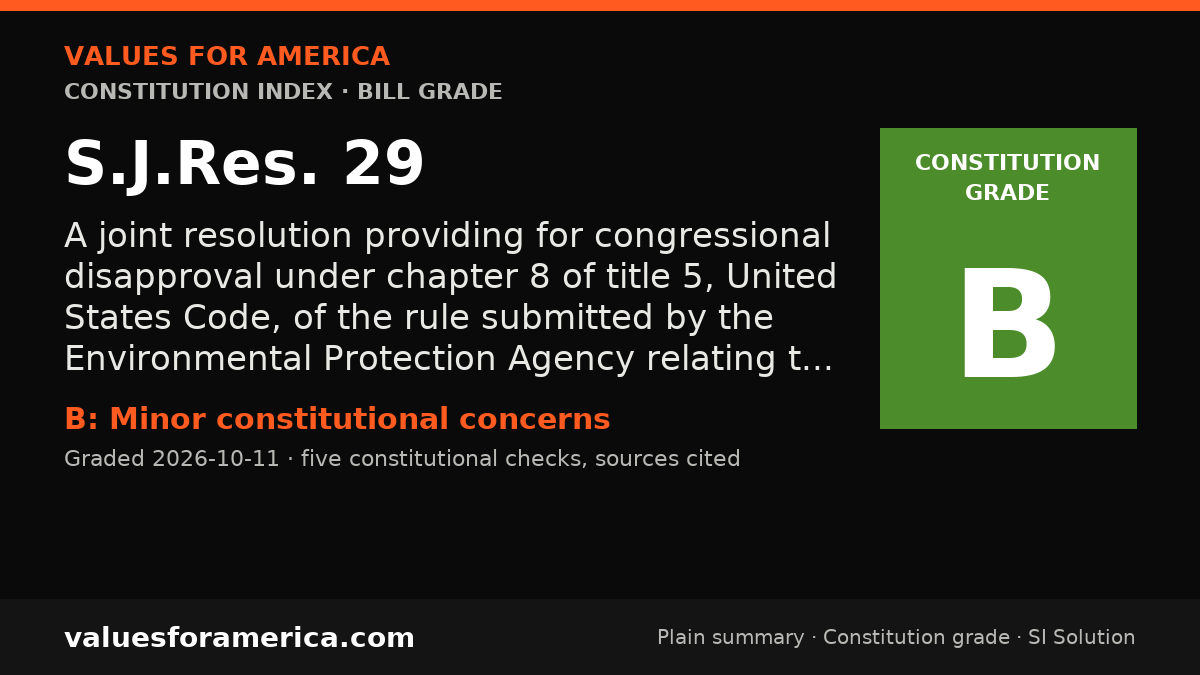
A joint resolution providing for congressional disapproval under chapter 8 of title 5, United States Code, of the rule submitted by the Environmental Protection Agency relating to "Air Plan Approval; Ohio; Withdrawal of Technical Amendment".
Cosponsors: 1 (0 D, 1 R) · per Congress.gov, 2026-10-12
Introduced: 2025-03-03
Latest action (2025-03-03): Read twice and referred to the Committee on Environment and Public Works.
What S.J.Res. 29 does, in plain terms
This joint resolution nullifies the Environmental Protection Agency (EPA) rule titled Air Plan Approval; Ohio; Withdrawal of Technical Amendment (90 Fed. Reg. 6811) and published on January 21, 2025. Among other elements, the rule reversed a final rule from November 2020 that removed the Air Nuisance Rule (ANR) from the Ohio State Implementation Plan (SIP). The EPA determined its original action to remove the ANR was in error, and this rule reinstates the ANR. (Under the Clean Air Act, states must submit SIPs to comply with the National Ambient Air Quality Standards. This ANR was included in Ohio’s SIP.)
Official summary by the Congressional Research Service, via Congress.gov.
Constitution Index
“VFA Constitution grade”
Minor constitutional concerns
Graded 2026-10-11
SI-generated grade · five published checks · not individually reviewed by a person · methodology
The joint resolution uses Congress's explicit authority under the Congressional Review Act to disapprove an agency rule, which is a legitimate exercise of legislative oversight. It does not infringe on individual rights, and it does not consolidate power at the federal level beyond what is necessary for Congress to exercise its enumerated powers. The only minor concern is that the resolution reinstates a state-level rule, which could be seen as a federal action affecting state policy, but it ultimately respects state sovereignty by allowing Ohio's SIP to include the Air Nuisance Rule as originally intended.
-
✓ Passes · Enumerated powers
Congress has the authority to pass joint resolutions disapproving agency rules under the Congressional Review Act (5 U.S.C. §§ 801-808), which is an exercise of its legislative powers under Article I, Section 1 and the Necessary and Proper Clause (Article I, Section 8, Clause 18). The resolution is a direct exercise of Congress's oversight over the executive branch and its rulemaking, which is wit… -
✓ Passes · Bill of Rights
The resolution does not implicate any of the first ten amendments. It does not restrict speech, religion, assembly, press, petition, arms, quartering, search and seizure, self-incrimination, due process, takings, trial rights, or cruel and unusual punishment. It is a procedural action regarding an EPA rule and does not affect individual rights. -
✓ Passes · Individual sovereignty
The resolution does not restrict individual liberty or property rights. It merely nullifies an EPA rule that reinstated a state implementation plan provision. Individuals are not directly affected in their person, property, speech, labor, or belief. The action is a government-to-government matter between Congress and the EPA, with no direct impact on individual sovereignty. -
✓ Passes · Decentralization
The resolution does not consolidate decision-making at a higher level of government than necessary. It is a congressional action to disapprove a federal agency rule, which is a proper exercise of federal legislative oversight. The rule in question was about Ohio's state implementation plan, and the resolution effectively allows Ohio's original state decision to stand. This does not centralize powe… -
✓ Passes · Due process and takings
The resolution does not bypass due process or take property without just compensation. It is a legislative action that follows the procedures of the Congressional Review Act, providing notice and an opportunity for debate. It does not affect any individual's property rights or deprive anyone of life, liberty, or property without due process.
Sources: Congress.gov: SJRES 29 summary
Report an error in this grade
What should pass
“VFA SI Solution”
No solution yet
A sourced SI draft appears here once it passes automated checks (Constitution citation, source verification, independent SI critic). How publication works.
Related on VFA

For journalists and bloggers
“Embed this grade”
Free to use with the link back. The badge and card update when the grade changes. Embed terms →
