S.J.Res. 198 explained · 119th Congress · Pending in Congress
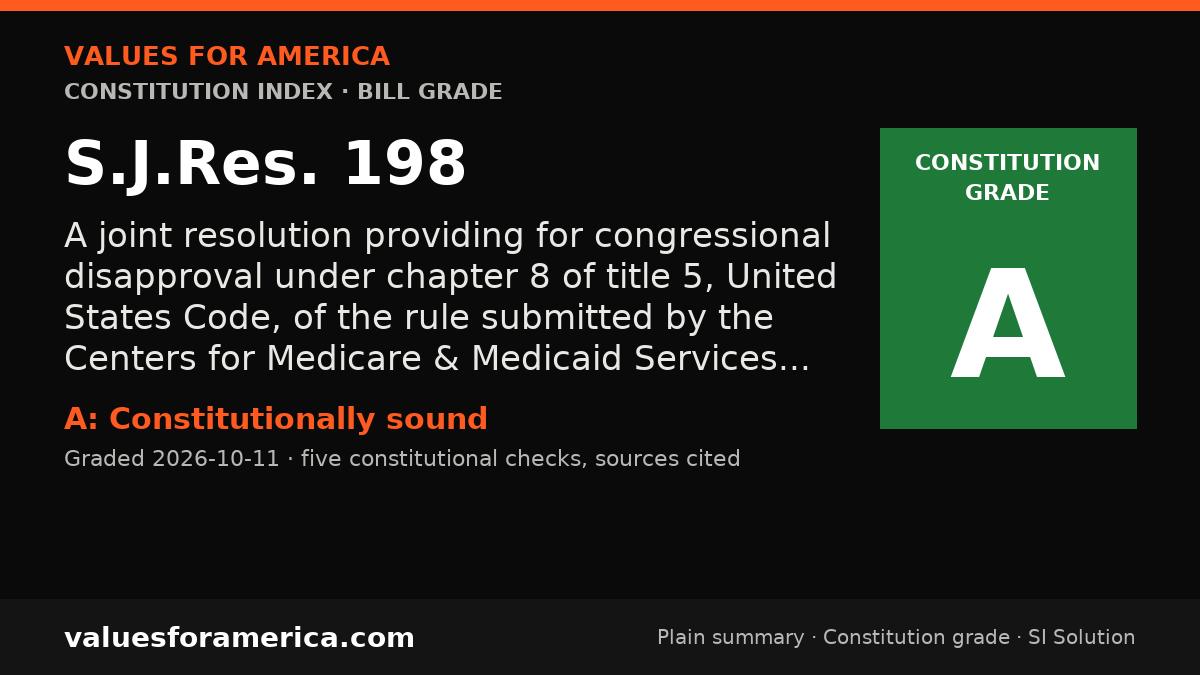
A joint resolution providing for congressional disapproval under chapter 8 of title 5, United States Code, of the rule submitted by the Centers for Medicare & Medicaid Services of the Department of Health and Human Services relating to "Medicare Program; Implementation of Prior Authorization for Select Services for the Wasteful and Inappropriate Services Reduction (WISeR) Model".
Cosponsors: 21 (20 D, 0 R, 1 other) · per Congress.gov, 2026-10-08
Introduced: 2026-06-24
Latest action (2026-07-16): Motion to proceed to consideration of measure rejected in Senate by Yea-Nay Vote. 46 - 50. Record Vote Number: 199.
What S.J.Res. 198 does, in plain terms
This joint resolution prohibits the Centers for Medicare & Medicaid Services (CMS) from testing a new Medicare payment model in certain states that involves a prior authorization process and the use of enhanced technology by third-party contractors to determine whether certain claims should be paid. Specifically, the joint resolution nullifies a notice issued by the CMS on July 1, 2025, titled Medicare Program; Implementation of Prior Authorization for Select Services for the Wasteful and Inappropriate Services Reduction (WISeR) Model. (On May 12, 2026, the Government Accountability Office issued a letter of opinion stating that this notice constituted an agency rule and is therefore subject to the Congressional Review Act.) The CMS selected six states to participate in this model over a six-year period: New Jersey, Ohio, Oklahoma, Texas, Arizona, and Washington. Under the model, contracted companies must process prior authorization requests (i.e., requests for coverage determinations before a service is furnished) for certain services using enhanced technology (e.g., artificial intelligence). Contracted companies are paid based on the share of resulting savings. The CMS aims to test the model's ability to produce accurate results while streamlining the prior authorization process for Medicare claims. The model is based in part on similar processes used for Medicare Advantage claims. CMS began implementing the model on January 1, 2026. This joint resolution prohibits the CMS from continuing to do so.
Official summary by the Congressional Research Service, via Congress.gov.
Constitution Index
“VFA Constitution grade”
Constitutionally sound
Graded 2026-10-11
SI-generated grade · five published checks · not individually reviewed by a person · methodology
This joint resolution is a proper exercise of Congress's legislative power to disapprove an agency rule under the Congressional Review Act. It does not infringe on any constitutional right, does not improperly centralize power, and does not violate due process or takings protections. The resolution simply halts a Medicare demonstration project, which is within Congress's enumerated power over spending and federal programs.
-
✓ Passes · Enumerated powers
Congress has the enumerated power to regulate interstate commerce and to provide for the general welfare, which includes the authority to establish and modify Medicare programs. Article I, Section 8, Clause 1 grants Congress the power to 'provide for the common Defence and general Welfare of the United States,' and the Necessary and Proper Clause (Article I, Section 8, Clause 18) allows Congress t… -
✓ Passes · Bill of Rights
The resolution does not implicate any of the first ten amendments. It does not restrict speech, religion, assembly, press, petition, arms, quartering, search and seizure, self-incrimination, due process, takings, fair trial, jury trial, cruel and unusual punishment, or unenumerated rights. It merely prevents a federal agency from implementing a specific payment model. -
✓ Passes · Individual sovereignty
The resolution does not restrict individual liberty. It actually prevents a federal program from imposing prior authorization requirements on Medicare beneficiaries and providers. By nullifying the rule, the resolution preserves the status quo, which is less restrictive than the proposed model. The burden of justification for any restriction is on the government, and here the government is not imp… -
✓ Passes · Decentralization
This resolution does not consolidate power upward; it prevents the federal government from implementing a centralized prior authorization model. The questions are answered as follows: (1) Individuals and families could not handle Medicare payment policy on their own, so federal involvement is necessary. (2) Local communities could not handle Medicare payment policy, so state or federal involvement… -
✓ Passes · Due process and takings
The resolution does not deprive any person of life, liberty, or property without due process of law. It does not take private property for public use without just compensation. It simply disapproves an agency rule, which is a legislative act that does not target specific individuals or property. The Congressional Review Act provides a structured process for such disapproval, ensuring procedural re…
Sources: Congress.gov: SJRES 198 summary
Report an error in this grade
What should pass
“VFA SI Solution”
No solution yet
A sourced SI draft appears here once it passes automated checks (Constitution citation, source verification, independent SI critic). How publication works.
Related on VFA

For journalists and bloggers
“Embed this grade”
Free to use with the link back. The badge and card update when the grade changes. Embed terms →
