S.J.Res. 124 explained · 119th Congress · Pending in Congress
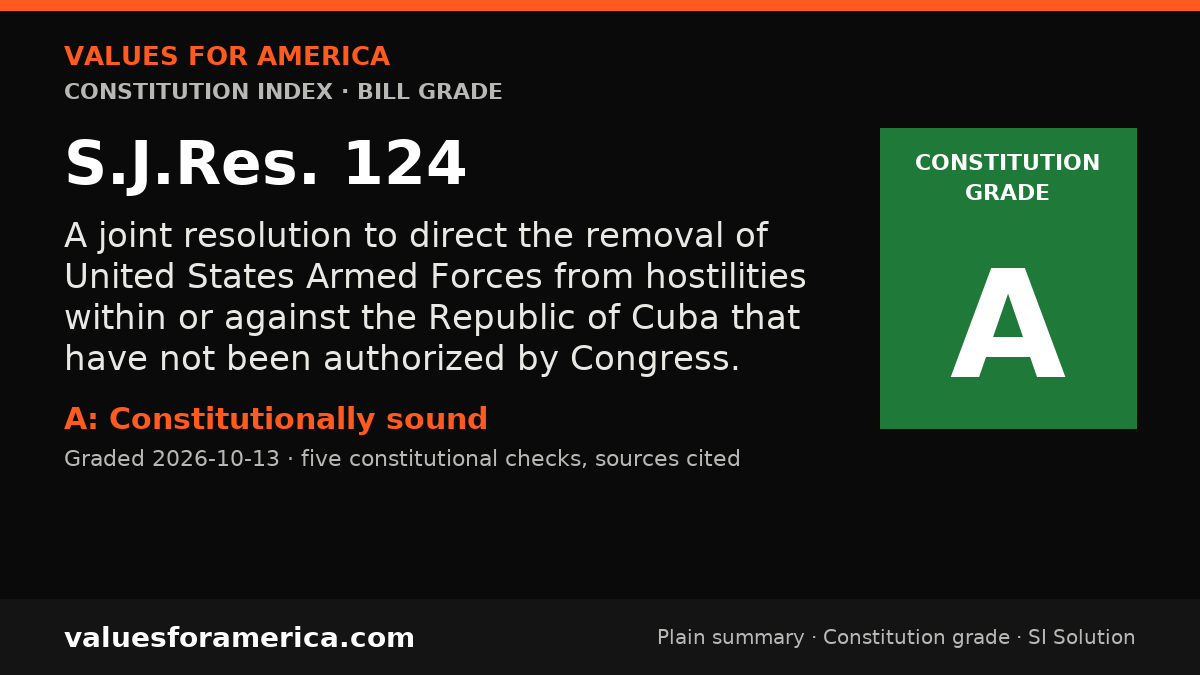
A joint resolution to direct the removal of United States Armed Forces from hostilities within or against the Republic of Cuba that have not been authorized by Congress.
Cosponsors: 13 (12 D, 0 R, 1 other) · per Congress.gov, 2026-10-08
Introduced: 2026-03-12
Latest action (2026-04-28): The motion to discharge fell when the point of order was well taken.
What S.J.Res. 124 does, in plain terms
This joint resolution directs the President to remove U.S. Armed Forces from hostilities within or against Cuba unless a declaration of war or authorization to use military force for such purpose has been enacted. The resolution specifies that it shall not be construed to prevent the United States from defending itself from an armed attack, the threat of an imminent armed attack, or the lawful execution of counternarcotics operations.
Official summary by the Congressional Research Service, via Congress.gov.
Constitution Index
“VFA Constitution grade”
Constitutionally sound
Graded 2026-10-13
SI-generated grade · five published checks · not individually reviewed by a person · methodology
This joint resolution is fully constitutional. It reinforces the separation of war powers by requiring congressional authorization for military hostilities against Cuba, consistent with Article I, Section 8, Clause 11. It does not infringe on any constitutional rights, respects individual sovereignty, and appropriately maintains the federal structure by not consolidating power upward. The resolution also preserves the President's inherent authority to defend the nation from attack, which is consistent with Article II, Section 2, Clause 1.
-
✓ Passes · Enumerated powers
The resolution is a proper exercise of Congress's enumerated power to declare war and to make rules for the regulation of the armed forces under Article I, Section 8, Clauses 11-14. It directs the President to remove forces from unauthorized hostilities, which is within Congress's constitutional authority over the military. The resolution does not expand federal power; it merely enforces the exist… -
✓ Passes · Bill of Rights
The resolution does not implicate any of the first ten amendments. It does not restrict speech, religion, assembly, press, petition, arms, quartering, search and seizure, self-incrimination, due process, takings, trial rights, or cruel and unusual punishment. It is a procedural measure regarding military deployment, not a restriction on individual liberties. -
✓ Passes · Individual sovereignty
The resolution does not restrict the actions of individuals. It concerns the deployment of U.S. Armed Forces, which is a governmental action. It does not limit personal freedom, property, speech, labor, or belief. The burden of justification for any restriction is not triggered because no individual restriction is imposed. -
✓ Passes · Decentralization
This resolution does not consolidate decision-making at a higher level of government; it reinforces the constitutional separation of powers at the federal level. The questions are not directly applicable to a military action, but the resolution does not shift power upward—it maintains the existing constitutional balance. It does not violate the Tenth Amendment because it concerns a federal power e… -
✓ Passes · Due process and takings
The resolution does not bypass due process or take property. It is a legislative directive to the President, not an adjudicative action. It does not deprive any person of life, liberty, or property without due process of law, nor does it implicate the Takings Clause of the Fifth Amendment.
Sources: Congress.gov: SJRES 124 summary
Report an error in this grade
What should pass
“VFA SI Solution”
No solution yet
A sourced SI draft appears here once it passes automated checks (Constitution citation, source verification, independent SI critic). How publication works.
Related on VFA

For journalists and bloggers
“Embed this grade”
Free to use with the link back. The badge and card update when the grade changes. Embed terms →
