S.J.Res. 123 explained · 119th Congress · Pending in Congress
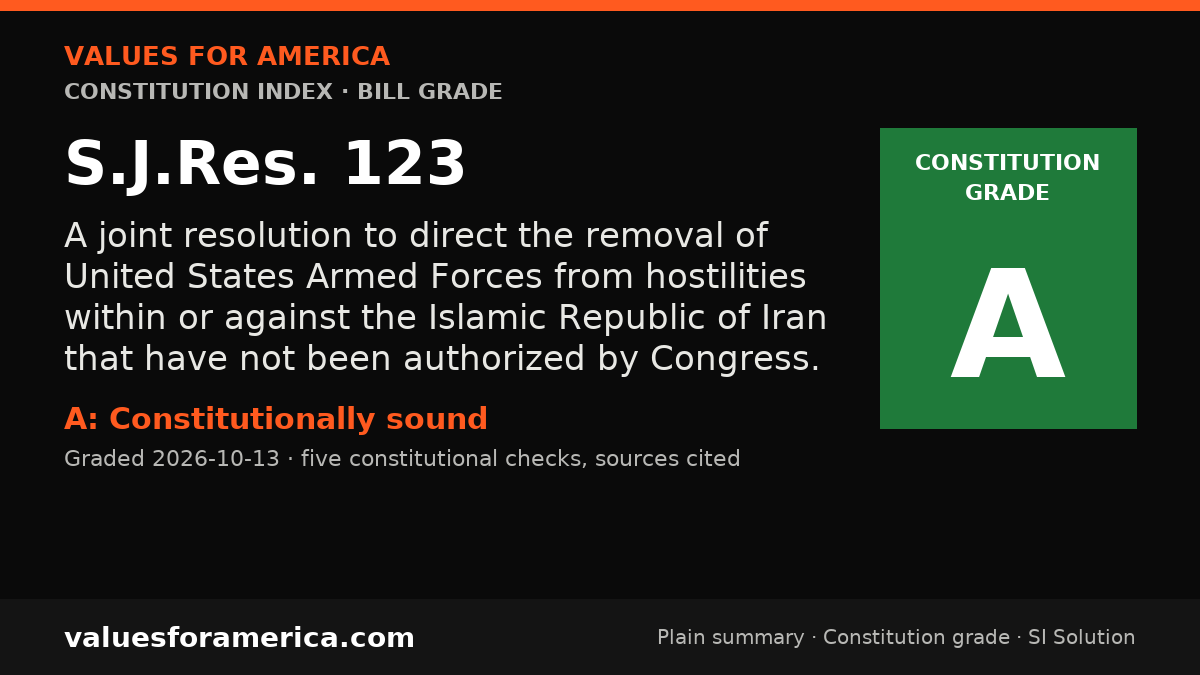
A joint resolution to direct the removal of United States Armed Forces from hostilities within or against the Islamic Republic of Iran that have not been authorized by Congress.
Cosponsors: 6 (6 D, 0 R) · per Congress.gov, 2026-10-09
Introduced: 2026-03-10
Latest action (2026-04-15): Motion to discharge Senate Committee on Foreign Relations rejected by Yea-Nay Vote. 47 - 52. Record Vote Number: 79.
What S.J.Res. 123 does, in plain terms
This joint resolution directs the President to remove U.S. Armed Forces from hostilities within or against Iran unless a declaration of war or authorization to use military force for such purpose has been enacted. The resolution specifies that it shall not be construed to prevent the United States from defending against an attack on the United States or its personnel or facilities in other nations.
Official summary by the Congressional Research Service, via Congress.gov.
Constitution Index
“VFA Constitution grade”
Constitutionally sound
Graded 2026-10-13
SI-generated grade · five published checks · not individually reviewed by a person · methodology
This joint resolution is fully constitutional. It reinforces Congress's exclusive power to declare war under Article I, Section 8, Clause 11, and does not infringe any rights or liberties. It properly restrains executive war-making that lacks congressional authorization, while preserving the President's inherent authority to repel sudden attacks.
-
✓ Passes · Enumerated powers
Congress has explicit constitutional authority under Article I, Section 8, Clause 11 to declare war and to define the limits of military hostilities. This resolution exercises that power by requiring congressional authorization for ongoing or new hostilities against Iran. It does not exceed any enumerated power; rather, it reasserts a core legislative function. -
✓ Passes · Bill of Rights
The resolution does not regulate speech, religion, assembly, press, petition, arms, quartering, search and seizure, self-incrimination, due process, takings, trial rights, or cruel punishment. It addresses only the deployment of armed forces abroad, which does not implicate any provision of the Bill of Rights. -
✓ Passes · Individual sovereignty
The resolution imposes no restriction on individual person, property, speech, labor, or belief. It directs the President to remove troops from hostilities, which is a structural check on executive power, not a limitation on individual freedom. No compelling governmental justification is needed because no individual right is burdened. -
✓ Passes · Decentralization
The resolution passes all four questions: (1) Individuals and families cannot handle international military hostilities; (2) local communities cannot handle them; (3) states cannot handle them; (4) the resolution does not consolidate decision-making upward—it actually returns war-making authority to Congress, the most representative branch, rather than leaving it with the President alone. This is … -
✓ Passes · Due process and takings
The resolution does not deprive any person of life, liberty, or property without due process, nor does it take private property for public use. It addresses the conduct of foreign military operations, which does not trigger Fifth Amendment procedural or substantive due process protections for individuals. No takings issue arises.
Sources: Congress.gov: SJRES 123 summary
Report an error in this grade
What should pass
“VFA SI Solution”
No solution yet
A sourced SI draft appears here once it passes automated checks (Constitution citation, source verification, independent SI critic). How publication works.
Related on VFA

For journalists and bloggers
“Embed this grade”
Free to use with the link back. The badge and card update when the grade changes. Embed terms →
