S.J.Res. 10 explained · 119th Congress · Pending in Congress
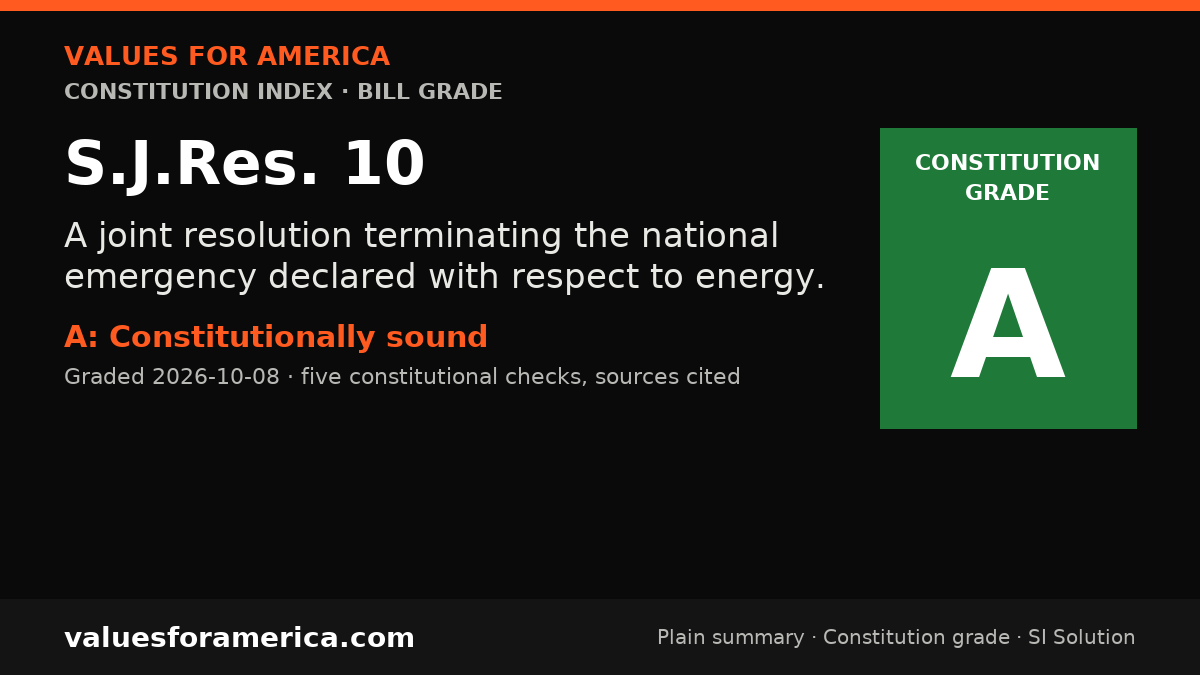
A joint resolution terminating the national emergency declared with respect to energy.
Cosponsors: 11 (10 D, 0 R, 1 other) · per Congress.gov, 2026-10-12
Introduced: 2025-02-03
Latest action (2025-02-26): Failed of passage in Senate by Yea-Nay Vote. 47 - 52. Record Vote Number: 95. (consideration: CR S1364, S1367-1390)
What S.J.Res. 10 does, in plain terms
This joint resolution terminates the national emergency relating to energy declared by the President on January 20, 2025, in Executive Order 14156. The executive order states that the supply of and infrastructure for energy in the United States is insufficient to meet the country's needs. It defines energy as crude oil, natural gas, lease condensates, natural gas liquids, refined petroleum products, uranium, coal, biofuels, geothermal heat, the kinetic movement of flowing water, and critical minerals. The executive order directs the heads of executive departments and agencies to use available emergency and other authorities to take certain actions to address this topic, including approving development of domestic energy resources, expediting the completion of authorized energy infrastructure (particularly in the Northeast, West Coast, and Alaska), and pursuing the use of emergency permitting provisions under certain environmental regulations. The executive order also directs the Department of Defense to conduct an assessment of its ability to acquire and transport energy resources (particularly in the Northeast and West Coast), and invokes emergency military construction authority to address any vulnerabilities identified in the assessment.
Official summary by the Congressional Research Service, via Congress.gov.
Constitution Index
“VFA Constitution grade”
Constitutionally sound
Graded 2026-10-08
SI-generated grade · five published checks · not individually reviewed by a person · methodology
SJRES 10 is constitutional. It uses lawful congressional authority to end an energy emergency, reducing federal overreach, restoring Bill of Rights safeguards, protecting individual sovereignty, decentralizing decisions toward states, and preserving due process and just compensation. SI analysis finds no rights infringement or power overstep.
-
✓ Passes · Enumerated powers
Congress has explicit authority to terminate a declared national emergency under Article I, Section 8, Clause 18 for carrying into execution federal powers, combined with Article I, Section 1 vesting of legislative power and the National Emergencies Act framework. This action does not assert a new substantive federal power; it withdraws extraordinary executive power and restores enumerated limits … -
✓ Passes · Bill of Rights
Termination removes emergency authorities that risked First Amendment petition/association burdens via expedited permitting, Fourth Amendment searches incident to infrastructure expansion, and Fifth Amendment takings pressure. No provision of SJRES 10 restricts speech, religion, press, arms, searches, trial rights, or other protections under Amendments 1-10. It restores normal statutory protection… -
✓ Passes · Individual sovereignty
SJRES 10 imposes no restriction on person, property, speech, labor, or belief. Under Ninth Amendment and Fifth Amendment liberty, the burden is on government to justify restrictions. Emergency directives to expedite development and invoke military construction could burden property and local use; termination reduces that burden and restores the presumption of liberty. -
✓ Passes · Decentralization
The resolution de-consolidates power. It ends federal emergency direction of energy development, expedited federal permitting overrides, and emergency military construction authority, returning decisions to normal state permitting and congressional authorization under Tenth Amendment. States can handle resource and land-use decisions without a federal emergency; while individuals and localities al… -
✓ Passes · Due process and takings
SJRES 10 improves due process and takings compliance under Fifth Amendment Due Process and Takings Clauses. Emergency permitting and emergency military construction authority increase risk of abbreviated notice/hearing and uncompensated physical or regulatory takings. Termination restores procedural due process with full notice, hearing, and judicial review, and requires any future takings to proc…
Sources: Congress.gov: SJRES 10 summary
Report an error in this grade
What should pass
“VFA SI Solution”
No solution yet
A sourced SI draft appears here once it passes automated checks (Constitution citation, source verification, independent SI critic). How publication works.
Related on VFA

For journalists and bloggers
“Embed this grade”
Free to use with the link back. The badge and card update when the grade changes. Embed terms →
