S.Con.Res. 40 explained · 119th Congress · Pending in Congress
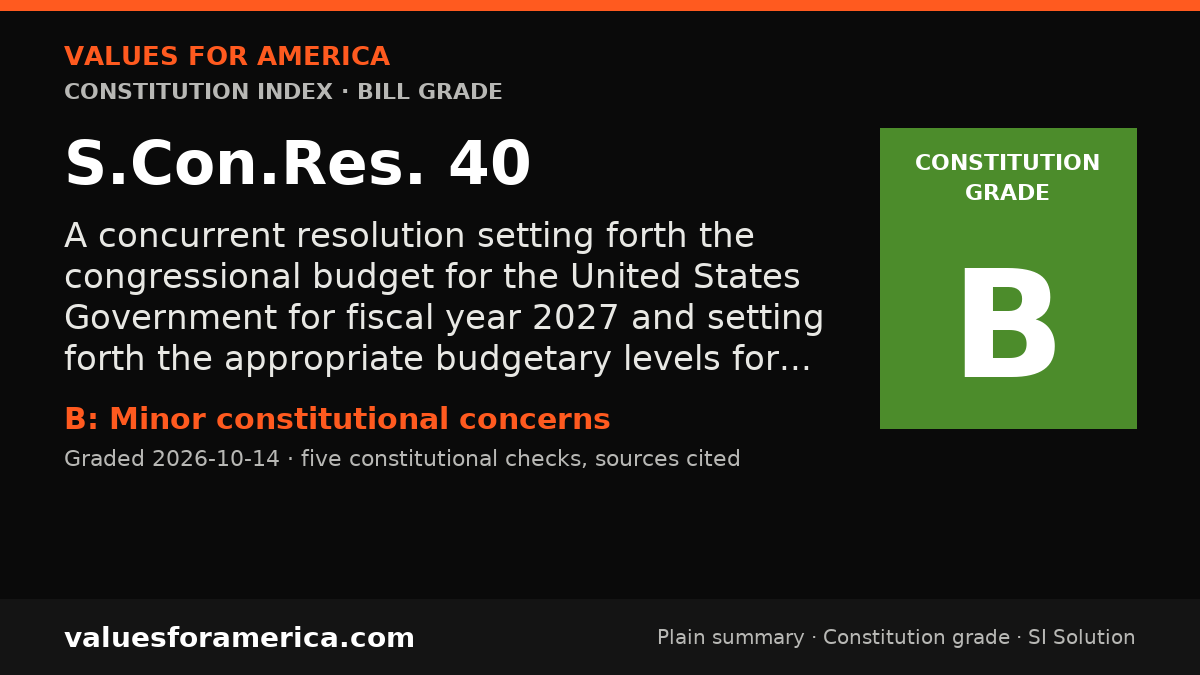
A concurrent resolution setting forth the congressional budget for the United States Government for fiscal year 2027 and setting forth the appropriate budgetary levels for fiscal years 2028 through 2036.
Cosponsors: none · per Congress.gov, 2026-10-14
Introduced: 2026-09-22
Latest action (2026-09-22): Placed on Senate Legislative Calendar under General Orders. Calendar No. 677.
What S.Con.Res. 40 does, in plain terms
This concurrent resolution establishes the congressional budget for the federal government for FY2027 and sets forth budgetary levels for FY2028-FY2036. The resolution recommends levels and amounts for FY2027-FY2036 for federal revenues, new budget authority, budget outlays, deficits, public debt, debt held by the public, and the major functional categories of spending. It also recommends levels and amounts for Social Security and U.S. Postal Service (USPS) discretionary administrative expenses for the purpose of budget enforcement in the Senate. Finally, the resolution sets forth budget enforcement procedures that address issues such as adjustments to committee allocations and other budgetary levels; the budgetary treatment of discretionary administrative expenses for the Social Security Administration and the USPS; emergency spending requirements in the House; and additional adjustments in the House for disaster relief, wildfire suppression, health care fraud and abuse control, continuing disability reviews and redeterminations, and reemployment services and eligibility assessments.
Official summary by the Congressional Research Service, via Congress.gov.
Constitution Index
“VFA Constitution grade”
Minor constitutional concerns
Graded 2026-10-14
SI-generated grade · five published checks · not individually reviewed by a person · methodology
This concurrent resolution establishes a congressional budget framework for FY2027-2036. It does not itself authorize any specific spending or revenue programs, but sets aggregate levels and enforcement procedures. The resolution is generally constitutional because Congress has clear enumerated power over the budget (Article I, Section 8, Clause 1; Article I, Section 9, Clause 7). However, the grade is B rather than A because the resolution's enforcement mechanisms and long-term projections could, depending on implementation, create minor tensions with decentralization principles and individual sovereignty if they lead to federal overreach into state or personal affairs. No direct rights infringements are present in the text itself.
-
✓ Passes · Enumerated powers
Article I, Section 8, Clause 1 grants Congress the power to lay and collect taxes, duties, imposts, and excises, to pay the debts and provide for the common defense and general welfare. Article I, Section 9, Clause 7 requires that no money be drawn from the Treasury but in consequence of appropriations made by law. This concurrent resolution is a budget framework that sets recommended levels for r… -
✓ Passes · Bill of Rights
The resolution does not restrict speech, religion, assembly, press, petition, arms, quartering, search and seizure, self-incrimination, due process, takings, fair trial, jury, cruel and unusual punishment, or any other right protected by the first ten amendments. It is a fiscal framework document with no provisions that directly infringe upon any enumerated right. The enforcement procedures (e.g.,… -
✓ Passes · Individual sovereignty
The resolution does not restrict what individuals may do with their person, property, speech, labor, or belief. It sets aggregate budget levels and enforcement procedures for Congress's internal budgeting process. While future implementing legislation could impose restrictions on individuals, this resolution itself imposes no direct constraints on individual liberty. The burden on government to ju… -
✗ Concern · Decentralization
The resolution fails the decentralization test because it consolidates decision-making at the federal level for broad categories of spending that could be handled by states or localities. Specifically, the resolution sets budget levels for major functional categories including areas traditionally under state and local control (e.g., education, transportation, health). While Congress has enumerated… -
✓ Passes · Due process and takings
The resolution does not bypass due process, presume guilt, or take property without just compensation. It is a legislative budget framework that sets aggregate levels and internal enforcement procedures. No individual is deprived of life, liberty, or property by this resolution. The Fifth Amendment's Due Process Clause and Takings Clause are not implicated because the resolution does not authorize…
Sources: Congress.gov: SCONRES 40 summary
Report an error in this grade
What should pass
“VFA SI Solution”
No solution yet
A sourced SI draft appears here once it passes automated checks (Constitution citation, source verification, independent SI critic). How publication works.
Related on VFA

For journalists and bloggers
“Embed this grade”
Free to use with the link back. The badge and card update when the grade changes. Embed terms →
